THE CLASSIC COLLECTION✦An outlaw’s diary: the CommuneCLASSIC FREE BOOKS
An outlaw’s diary: the Commune
Cécile Tormay
THE CLASSIC COLLECTION · 1885
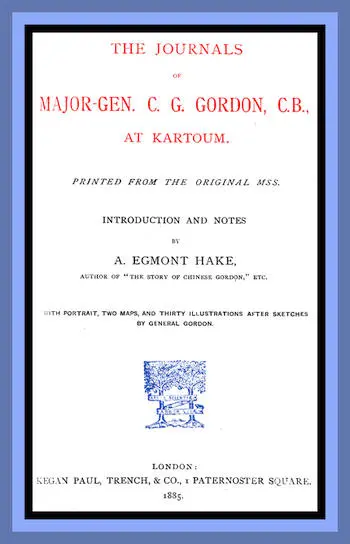
"The Journals of Major-Gen. C. G. Gordon, C.B., at Kartoum" by Charles George Gordon is a historical account written in the late 19th century. This work details the journals of General Gordon during his time in Kartoum, shedding light on the challenging conditions in Sudan and his efforts to navigate the complex political and military landscape of the region. At the start of the book, the author presents Gordon's initial observations and experiences following his appointment as Governor-General of the Sudan. The opening chapters describe his reflections on the dire circumstances faced by the local population, the oppressive regime in place, and his commitment to assisting the Soudanese people while opposing the slave trade. Gordon expresses a blend of hope and concern as he documents the precarious situation around Kartoum, emphasizing both his sense of duty and the moral complexities of his mission amidst rising tensions and rebellion from groups like the Mahdi. The tone suggests a deep introspection as he grapples with the responsibilities thrust upon him and the challenges of implementing meaningful reform.
Introduction adapted from the source catalogue; source summaries may be automatically generated.
Free to read · English · 174,578 words · No account needed
MAKE TIME FOR A GOOD BOOK
On by default. Untick to stop anonymous reading totals. Each page counts after 10 seconds in view. How this works.
Anonymous counting is on unless you have switched it off.
It appears 93,000 okes + 166,000 okes = 259,000 okes of biscuit have been stolen in the last year, only found out now; however, we have now quarter of a million okes, which will see us only for a month or so. It appears that more than thirty of the principal merchants are engaged in the above robbery of biscuit. The process is not finished. One of the greatest problems will be what to do with those Shaggyeh, those Cairo Bashi Bazouks and fellaheen soldiers, whose courage is about equal,—perhaps the palm is due to the Shaggyeh. The twenty cows I mentioned as captured by the men of Omdurman Fort (making up forty-one captured cows, page 309) were driven in by five soldiers escaping from the Arabs and were not captured. They do not stick at a lie (and, in this, resemble some people in high places I know). 259,000 okes of biscuit was a good haul, nearly 2½ million pounds: worth £26,000 now, or £9000 in ordinary times.[223]
November 12.—Last night three slaves came into Omdurman. At 11 P.M. they reported Arabs meant to attack to-day at dawn. It was reported to me, but the telegraph clerk did not choose to tell me till 7 A.M. to-day. We had been called up at 5.30 A.M. by a violent fusillade at Omdurman. The Arabs came out in considerable force, and, as I had not been warned, the steamers had not steam up. From 5.30 A.M. to 8.30 Arabs came on and went back continually. All the cavalry were out; the expenditure of ammunition was immense. The Arabs had a gun or guns on the bank. Details further on, as the firing is still going on.
10.20 A.M.—For half-an-hour firing lulled, but then recommenced, and is still going on. The Ismailia was struck with a shell, but I hear is not seriously damaged. The Husseinyeh is aground (I feel much the want of my other steamers at Metemma). 11.15 A.M.—Firing has lulled; it was very heavy for the last three-quarters of an hour from Ismailia and Arabs; it is now desultory, and is dying away. Husseinyeh is still aground. The Ismailia is at anchor. What a six hours of anxiety for me, when I saw the shells strike the water near the steamers from the Arabs; imagine my feelings! We have £831 in specie and £42,800 in paper; and there is £14,600 in paper out in the town! I call this state of finance not bad, after more than eight months’ blockade. The troops are owed half a month’s pay, and even that can be scarcely called owed them, for I have given them stores, and beyond the regulations. Noon.—The firing has ceased, I am glad to say. I have lived years in these last hours! Had I lost the Ismailia, I should have lost the Husseinyeh (aground), and then Omdurman, and the North Fort! And then the Town! 1 P.M.—The Arabs are firing on the steamers with their two guns. The Husseinyeh, still aground; that is the reason of it. Firing, 1.30 P.M., now has ceased. The Ismailia, struck by three shells, had one man killed, fifteen wounded on board of her; she did really very well. I boxed the telegraph clerk’s ears for not giving me the telegram last night (after repeated orders that no consideration was to prevent his coming to me); and then, as my conscience pricked me, I gave him $5. He said he did not mind if I killed him—I was his father (a chocolate-coloured youth of twenty). I know all this is brutal—abrutissant, as Hansall calls it—but what is one to do? If you cut their pay, you hurt their families. I am an advocate for summary and quick punishment, which hurts only the defaulter. Had this clerk warned me, of course at daybreak, the steamers would have had their steam up, and been ready. We have a Krupp at Mogrim Fort. Ferratch Pasha reports he has dismounted one of the Arab guns. The Arabs had a show of four hundred horsemen, who kept far off. Telegraph was, and is, interrupted between this and the Omdurman Fort (whether by bullet or otherwise is not known as yet). Considering that the Arab mountain gun can (and has) made holes two feet square in the steamer, my anxiety is not to be wondered at. (I feel as if I had walked thirty miles.) We fired eighty-three rounds of Krupp at the Arabs from Mogrim, forty-three rockets. The Arabs fired three hundred and seventy rounds from their guns at the steamers. As for ammunition (Remington), we fired from our steamers, forts, &c., fifty thousand rounds; and I certainly think the Arabs fired as much, Omdurman certainly was “OVER-EAGER TO FIRE ON THE ENEMY”[224] in the early dawn, and consequently wasted ammunition. This ends the greatest battle (as yet) of our second blockade. Spies (of last night) say it was undertaken against the Mahdi’s wish, by his Khalifa or Vizier, who persuaded him to allow it. During all through, the Arabs of the South and East never moved a peg. Like the Chinese, one may calculate, they will never assist one another.
Your reading position is saved on this browser. Take it to another device with a library code. Reading pages adapt to text, rather than matching a printed edition.
BEHIND THE BOOK
This eBook is for the use of anyone anywhere in the United States and most other parts of the world at no cost and with almost no restrictions whatsoever. You may copy it, give it away or re-use it under the terms of the Project Gutenberg License included with this eBook or online at www.gutenberg.org. If you are not located in the United States, you will have to check the laws of the country where you are located before using this eBook. Read the source licence.
The original source file, including credits and licence, is retained by this library. Request an original-format copy at no charge. Please include the book title and Project Gutenberg identifier #49224.
KEEP YOUR CURIOSITY GOING
Cécile Tormay

Moritz Busch
John L. Ransom
Frances Wright
Cécile Tormay

Mabel Potter Daggett