THE CLASSIC COLLECTION✦An outlaw’s diary: the CommuneCLASSIC FREE BOOKS
An outlaw’s diary: the Commune
Cécile Tormay
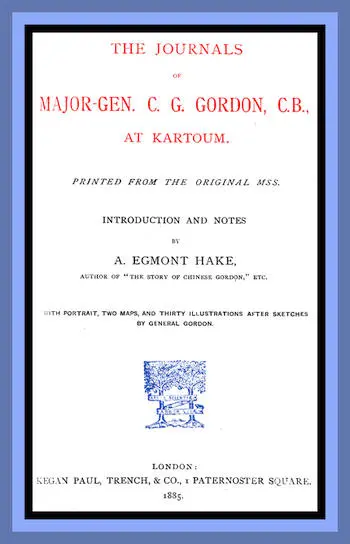
THE CLASSIC COLLECTION · 1885
"The Journals of Major-Gen. C. G. Gordon, C.B., at Kartoum" by Charles George Gordon is a historical account written in the late 19th century. This work details the journals of General Gordon during his time in Kartoum, shedding light on the challenging conditions in Sudan and his efforts to navigate the complex political and military landscape of the region. At the start of the book, the author presents Gordon's initial observations and experiences following his appointment as Governor-General of the Sudan. The opening chapters describe his reflections on the dire circumstances faced by the local population, the oppressive regime in place, and his commitment to assisting the Soudanese people while opposing the slave trade. Gordon expresses a blend of hope and concern as he documents the precarious situation around Kartoum, emphasizing both his sense of duty and the moral complexities of his mission amidst rising tensions and rebellion from groups like the Mahdi. The tone suggests a deep introspection as he grapples with the responsibilities thrust upon him and the challenges of implementing meaningful reform.
Introduction adapted from the source catalogue; source summaries may be automatically generated.
Free to read · English · 174,578 words · No account needed
MAKE TIME FOR A GOOD BOOK
On by default. Untick to stop anonymous reading totals. Each page counts after 10 seconds in view. How this works.
Anonymous counting is on unless you have switched it off.
October 29.—To-day, year 1301 A.H., is said to be about the date of Hicks’s disaster; it was on the 1st, 2nd, 3rd November, but with the Arabs it was the 12th, 13th, 14th Moharrem. The news was known in Cairo three weeks after the event occurred; since that date up to this date nine people have come up as reinforcements—myself, Stewart, Herbin, Hussein, Tongi, Ruckdi, and three servants, and not one penny of money.[172] Of those who came up, two, Stewart and Herbin, have gone down: Hussein is dead, so six of the reinforcements alone remain, while we must have sent down over 1500 and 700 soldiers, total 2200, including the two Pashas, Ibrahim Hardar, and Hussein Cheri, Coetlogon, &c. The regulars, who were in arrears of pay for three months when I came, are now only owed half a month, while the Bashi-Bazouks are owed only a quarter month, and we have some £500 in the treasury. It is quite a miracle. We have lost two battles, suffering severe losses in those actions of men and arms, and may have said to have scrambled through, for I cannot say we can lay claim to any great success during the whole time. Things apparently went against us when we thought we were getting the best of it.
I believe we have more ammunition, Remington (though we have fired three million rounds at the Arabs), and more soldiers now, than when I came up. We have every reason to thank God for His protection. We had many untoward and unexpected misfortunes; the death of Berzati Bey[173] at Gitana; the almost unprofitable first trip of steamers to Sennaar, and their useless delay; our defeat (after El foun victory), by which we lost the active part of our troops, and our fighting Pasha, Mahomet Ali; the surrender of Saleh Pasha and 1500 men, with the capture of the Mahomet Ali steamer; the fall of Berber, with two steamers lost. It is really very wonderful that, with such few successes and so many heavy disasters, we should be in the position we are now. Of the reinforcement, Stewart and Tongi got wounded. We have lost three steamers, two at Berber and one at the Blue Nile, and we have built another, the Husseinyeh, and hope to have another finished in a fortnight, which makes our loss only one. The defeat near El foun brought about the arrival here of the Mahdi, which might have been very serious, but his arrival has been apparently rendered innocuous. We have £40,000 in Treasury IN PAPER, and £500. When I came up, there was £5000 in Treasury. We have £15,000 out in the town in paper money. When I came, we had two Pashas, Ibrahim Hardar, Hussein Cheri; we have now two, Ferratch and Nutzer Pasha. Two women, wives of the men who escaped yesterday (with another very small brown baby), came into Omdurman to-day. They say the Arabs are very angry about the desertions; also a boy came in. It would seem, looking over the past months, that, if taken in detail, events have been very much against us; while, if taken generally, we have been most successful. I always had an idea we would not be allowed any success which we could impute to ourselves; that events would be so ruled that we should just scramble through and have nothing to boast of. Mahomet Ali Pasha’s defeat was owing to his and his men and the people of Khartoum’s desire to loot Sheikh el Obeyed (the man, not the city). It was against my grain, for I wanted to capture Berber, which was the proper military operation to undertake; it was only because they were so anxious, and represented the affair as so easy, that I consented to it. Perhaps, if we had taken Berber, Her Majesty’s Government would have said that no expedition was necessary for the relief of the garrisons; but it would not have been correct to reason thus, for, though Berber might have been taken, we could not have garrisoned it; and it would have been a barren victory, and not have done much towards the solution of the Soudan problem or withdrawal of the garrisons, while it might, on the other hand, have stopped the expedition for their relief.
Your reading position is saved on this browser. Take it to another device with a library code. Reading pages adapt to text, rather than matching a printed edition.
BEHIND THE BOOK
This eBook is for the use of anyone anywhere in the United States and most other parts of the world at no cost and with almost no restrictions whatsoever. You may copy it, give it away or re-use it under the terms of the Project Gutenberg License included with this eBook or online at www.gutenberg.org. If you are not located in the United States, you will have to check the laws of the country where you are located before using this eBook. Read the source licence.
The original source file, including credits and licence, is retained by this library. Request an original-format copy at no charge. Please include the book title and Project Gutenberg identifier #49224.
KEEP YOUR CURIOSITY GOING
Cécile Tormay

Moritz Busch
John L. Ransom
Frances Wright
Cécile Tormay

Mabel Potter Daggett