THE CLASSIC COLLECTION✦An outlaw’s diary: the CommuneCLASSIC FREE BOOKS
An outlaw’s diary: the Commune
Cécile Tormay
THE CLASSIC COLLECTION · 1885
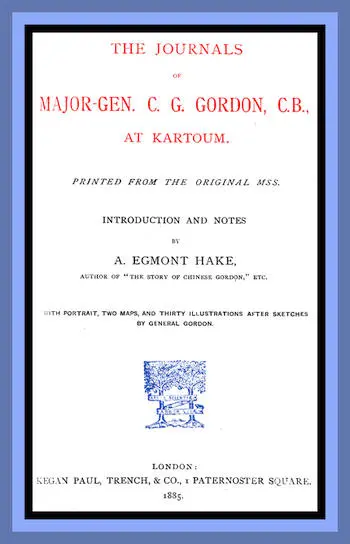
"The Journals of Major-Gen. C. G. Gordon, C.B., at Kartoum" by Charles George Gordon is a historical account written in the late 19th century. This work details the journals of General Gordon during his time in Kartoum, shedding light on the challenging conditions in Sudan and his efforts to navigate the complex political and military landscape of the region. At the start of the book, the author presents Gordon's initial observations and experiences following his appointment as Governor-General of the Sudan. The opening chapters describe his reflections on the dire circumstances faced by the local population, the oppressive regime in place, and his commitment to assisting the Soudanese people while opposing the slave trade. Gordon expresses a blend of hope and concern as he documents the precarious situation around Kartoum, emphasizing both his sense of duty and the moral complexities of his mission amidst rising tensions and rebellion from groups like the Mahdi. The tone suggests a deep introspection as he grapples with the responsibilities thrust upon him and the challenges of implementing meaningful reform.
Introduction adapted from the source catalogue; source summaries may be automatically generated.
Free to read · English · 174,578 words · No account needed
MAKE TIME FOR A GOOD BOOK
On by default. Untick to stop anonymous reading totals. Each page counts after 10 seconds in view. How this works.
Anonymous counting is on unless you have switched it off.
The man who came in (Zubair’s old soldier) was one of Lupton’s men from the Bahr Gazelle; he left five months ago (Bahr Gazelle). He says Lupton is at Shaka, and is Sheikh Abdullah, so he has changed his religion.[156] I wonder what has become of the garrison of the Equator. Another man has come in.
All that bloodshed in fighting the slave dealers in the Bahr Gazelle has gone, apparently, for nothing![157] There are great doubts if the Mahdi is really near, no one appears to have seen him.
Since the escape of the lot yesterday, the Arabs have taken the rifles of the regulars from them: at the Mahdi’s camp, the Arabs have a ferry under our nose, across the White Nile; but I do not like to send up the steamers, for the captains are so heedless.
I calculated that the advance force of troops arrived at Wady Halfa on 22nd September,[158] that they took twenty days from there to Debbeh, so that on 12th October they were at Debbeh (Stewart (D.V.) arrived at Debbeh on 28th September), and I calculate they could not be at Metemma—Shendy—before 10th November, which will give them twenty-nine days for 150 miles, thence it is five days here for a steamer, so that 15th November ought to see them or their advance guard.
Extracts from Appendix R.
La Route de Souakim à Berber.
Avant que la bataille de Tamai eut été livrée et gagnée, le Général Herbert Stewart, sinon les généraux Graham et Buller, avaient étudié avec soin la question de savoir si les troupes, ou une partie des troupes, pouvaient marcher jusqu’à Berber pour aider Gordon à réprimer les partisans du Mahdi dans la région du Nil. Cette proposition semblait alors si convenable que l’état des troupes les mieux adaptées à une semblable expédition, les dispositions pour les approvisionnements, l’équipement, les chevaux disponibles, etc., avaient été l’objet de l’étude journalière des officiers. On se souviendra qu’après Tamai, la cavalerie se transporta aux puits d’Handouk, à huit milles de Souakim. On croyait généralement, alors, que cette marche en avant n’était que la première étape d’un mouvement sur Berber d’une force montée. Pour empêcher toute souffrance provenant d’une disette d’eau, l’effectif ne devait pas être de plus de 500 hommes de cavalerie; aucune infanterie ne devait faire partie de l’expédition. Il était en outre entendu, qu’en cas de nécessité, un semblable effectif pourrait suivre un jour ou deux après et trouverait également, dans les puits, de l’eau en abondance. Le fait est que les généraux Graham, Buller, Stewart, les colonels Clery, Taylor, et d’autres, semblaient ne pas mettre en doute, si l’ordre en était donné, qu’une succession de détachements, forts chacun de 500 hommes, pourrait être rapidement poussée sur Berber. Le bruit de ce qui se passait parvint rapidement aux oreilles de nos hommes qui étaient à la Zariba d’Handouk, et la plupart des troupiers manifestèrent un désir intense de prendre part à l’expédition. On savait que le Général Stewart avait soumis ses plans pour la marche en avant au Général Graham, et que ce dernier, ainsi que l’Amiral Hewett, les avait recommandés au gouvernement. Les jours se succédèrent, mais l’ordre du départ n’arrivait pas: quelque empressés de partir que fussent beaucoup d’hommes, si nous avions connu alors la position exacte de Gordon, on eût manifesté beaucoup plus d’anxiété pour l’ordre du départ. Lorsque cette question était discutée, question qui au moment occupait pleinement nos pensées, entre officiers supérieurs, ils exprimaient l’étonnement que l’ordre fut tant retardé, et que le Gouvernement hésitât davantage. On n’arrivait qu’à une seule conclusion, c’était que la position du Général Gordon était telle qu’il n’avait pas besoin d’aide de troupes britanniques venant de Souakim. Quoi qu’en ait pu penser, après réflexion, le Général Graham, de la possibilité d’envoyer une troupe de cavalerie forte de 500 hommes, en mars dernier, de Souakim à Berber, je suis certain que lui et la plupart des officiers sous ses ordres croyaient alors que c’était une chose sage et guerrière à entreprendre. Nous nous apercevons tous trop tard, que cette simple expédition eût sauvé Berber, Khartoum et Gordon au vrai cœur.
Your reading position is saved on this browser. Take it to another device with a library code. Reading pages adapt to text, rather than matching a printed edition.
BEHIND THE BOOK
This eBook is for the use of anyone anywhere in the United States and most other parts of the world at no cost and with almost no restrictions whatsoever. You may copy it, give it away or re-use it under the terms of the Project Gutenberg License included with this eBook or online at www.gutenberg.org. If you are not located in the United States, you will have to check the laws of the country where you are located before using this eBook. Read the source licence.
The original source file, including credits and licence, is retained by this library. Request an original-format copy at no charge. Please include the book title and Project Gutenberg identifier #49224.
KEEP YOUR CURIOSITY GOING
Cécile Tormay

Moritz Busch
John L. Ransom
Frances Wright
Cécile Tormay

Mabel Potter Daggett