THE CLASSIC COLLECTION✦An outlaw’s diary: the CommuneCLASSIC FREE BOOKS
An outlaw’s diary: the Commune
Cécile Tormay
THE CLASSIC COLLECTION · 1885
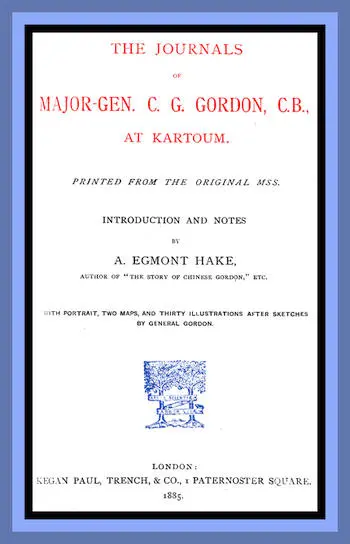
"The Journals of Major-Gen. C. G. Gordon, C.B., at Kartoum" by Charles George Gordon is a historical account written in the late 19th century. This work details the journals of General Gordon during his time in Kartoum, shedding light on the challenging conditions in Sudan and his efforts to navigate the complex political and military landscape of the region. At the start of the book, the author presents Gordon's initial observations and experiences following his appointment as Governor-General of the Sudan. The opening chapters describe his reflections on the dire circumstances faced by the local population, the oppressive regime in place, and his commitment to assisting the Soudanese people while opposing the slave trade. Gordon expresses a blend of hope and concern as he documents the precarious situation around Kartoum, emphasizing both his sense of duty and the moral complexities of his mission amidst rising tensions and rebellion from groups like the Mahdi. The tone suggests a deep introspection as he grapples with the responsibilities thrust upon him and the challenges of implementing meaningful reform.
Introduction adapted from the source catalogue; source summaries may be automatically generated.
Free to read · English · 174,578 words · No account needed
MAKE TIME FOR A GOOD BOOK
On by default. Untick to stop anonymous reading totals. Each page counts after 10 seconds in view. How this works.
Anonymous counting is on unless you have switched it off.
A sergeant escaped from the Arabs; he says the Arabs sent up about 200 black soldiers to Mesalamieh to get grain, and they escaped to Sennaar; that Waled a Goun meditates coming over, with two guns, to the old Dem, which was previously occupied by the son of Sheikh el Obeyed, on the north side, near Halfeyeh, which, if he does, will be a great bore for us. The Mahdi is at Jura Hadra; that a man had come from near Berber to say the expedition was advancing towards that place. One has heard so much of this sort of report that taken with the report of Waled a Goun coming to Halfeyeh, one is inclined to doubt it, for he would not be likely to do that if it was true about the expedition at Berber.
Sent out spy from Halfeyeh towards Shendy.
Whatever may happen, I hope it will be put to our credit that we gave you the Abbas steamer, and placed three steamers at your disposal at Metemma,—when, if we had them we might have cut the route between Jura on left bank of the Nile, and Fakir Ibraham on the right bank of the Nile,—besides using up 350 soldiers of our meagre garrison in the equipages of those steamers! Truly the indecision of our Government has been, from a military point of view, a very great bore, for we never could act as if independent; there was always the chance of their taking action, which hampered us.
Take the Tokar business: had Baker been supported by, say, 500 men, he would not have been defeated; yet, after he was defeated, you go and send a force to relieve the town. Had Baker been supported by these 500 men, he would, in all probability, have been victorious, and would have pushed on to Berber, and, once there, Berber would not have fallen. What was right to do in March, was right to do in February. We sent an expedition in March, so we ought to have sent it in February; and then, the worst of it was, that Baker, having been defeated, when you did send your expedition to Tokar, Baker’s force no longer existed, and his guns resist me at Berber. It is truly deplorable, the waste of men and money, on account of our indecision. Baker’s expedition ought never to have been pushed forward, unless by small stages, supported by forts. It had not more than fifteen or twenty miles to go, and that distance ought to be, so to say, sapped. Take your present expedition, I do not know (thanks to that Intelligence Department!) the details, but it seems to me that till 20th August, or thereabouts, we were supposed to be quietly disposed of, but about that date our resurrection occurred, and then, “Let us have an expedition at once, and send for Wolseley.” Had the men at Wady Halfa (Duncan) been told in March (when he came up to Assouan) to make étapes up to Dongola, they would have been all ready for the expedition now. Personally, I do not care, but I think what a perfect mess we would be in, in an European war. I am convinced Wood, the Sirdar, and many others, foresaw what was likely to happen, but they did not consider they were called upon to make a row about it. (Plutarch’s Lives are out of print in our generation; we do not like to be what club men call insubordinate, though, of all insubordinates, the club men are the worst.) What is the consequence? Why, an infinite expense and great difficulty. Mark the way the Mahdi treated Cuzzi: is it likely he did it for the love of Cuzzi? was it not because Cuzzi told him of Baring’s telegram, “that no troops will be sent to Berber”? Remember, though I put these queries, it is not I who put them: it is history. Why did Baker go to Suakin, and Wood, the Sirdar, stay at Cairo? One was chief of gendarmerie; the other was commander-in-chief. It was not a question of police, but of war. If it was right to let Sinkat perish, it was right to let Tokar; if it was right to relieve Tokar, it was right to see after Berber, and thence on to Kartoum, Sennaar, Kassala, Bahr Gazelle, and the Equator. At any rate, be consistent. No one can question the right of the Government to decide; but when they decide, let it be a decision. “WE WILL ABANDON ALTOGETHER, and not care what happens.” That is a decision one can understand, whether one approves or not. We are not the judges; but what we have done is such, that I declare I very much doubt what is really going to be the policy of our Government, even now that the expedition is at Dongola.
Your reading position is saved on this browser. Take it to another device with a library code. Reading pages adapt to text, rather than matching a printed edition.
BEHIND THE BOOK
This eBook is for the use of anyone anywhere in the United States and most other parts of the world at no cost and with almost no restrictions whatsoever. You may copy it, give it away or re-use it under the terms of the Project Gutenberg License included with this eBook or online at www.gutenberg.org. If you are not located in the United States, you will have to check the laws of the country where you are located before using this eBook. Read the source licence.
The original source file, including credits and licence, is retained by this library. Request an original-format copy at no charge. Please include the book title and Project Gutenberg identifier #49224.
KEEP YOUR CURIOSITY GOING
Cécile Tormay

Moritz Busch
John L. Ransom
Frances Wright
Cécile Tormay

Mabel Potter Daggett