THE CLASSIC COLLECTION✦An outlaw’s diary: the CommuneCLASSIC FREE BOOKS
An outlaw’s diary: the Commune
Cécile Tormay
THE CLASSIC COLLECTION · 1885
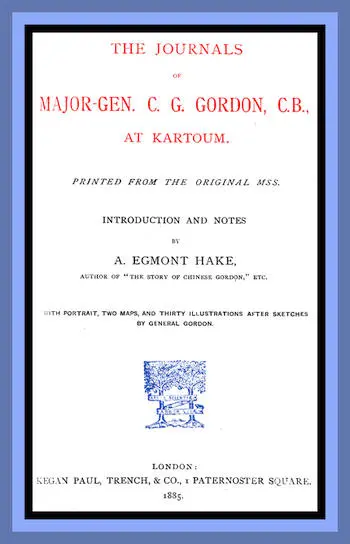
"The Journals of Major-Gen. C. G. Gordon, C.B., at Kartoum" by Charles George Gordon is a historical account written in the late 19th century. This work details the journals of General Gordon during his time in Kartoum, shedding light on the challenging conditions in Sudan and his efforts to navigate the complex political and military landscape of the region. At the start of the book, the author presents Gordon's initial observations and experiences following his appointment as Governor-General of the Sudan. The opening chapters describe his reflections on the dire circumstances faced by the local population, the oppressive regime in place, and his commitment to assisting the Soudanese people while opposing the slave trade. Gordon expresses a blend of hope and concern as he documents the precarious situation around Kartoum, emphasizing both his sense of duty and the moral complexities of his mission amidst rising tensions and rebellion from groups like the Mahdi. The tone suggests a deep introspection as he grapples with the responsibilities thrust upon him and the challenges of implementing meaningful reform.
Introduction adapted from the source catalogue; source summaries may be automatically generated.
Free to read · English · 174,578 words · No account needed
MAKE TIME FOR A GOOD BOOK
On by default. Untick to stop anonymous reading totals. Each page counts after 10 seconds in view. How this works.
Anonymous counting is on unless you have switched it off.
No one can judge the waste of money and expense of life in the present expedition—it is an utter waste of both—but it is simply due to the indecisions of our Government. Had they said from the first, “We do not care—we will do nothing for the garrisons of the Soudan, they may perish; had they not relieved Tokar; had they not telegraphed to me as to the force to relieve me (vide telegrams, 5th May, from Suakin; 29th April, from Massowah). Had they telegraphed (when Baring telegraphed to Cuzzi 29th March, which arrived here saying, ‘No British troops are coming to Berber, negotiations going on about opening road—Graham was about to attack Osman Digna’”), “SHIFT FOR YOURSELF”, why, nothing could have been said; but Her Majesty’s Government would not say they were going to abandon the garrisons, and therefore “shift for yourself”. It is that which has hampered us so much. On the one hand, if I bolted I deserted them (Her Majesty’s Government); on the other hand, by staying I have brought about this expedition. Baring gave me distinct orders not to go to the Equator without the permission of Her Majesty’s Government (vide telegrams with Stewart’s journal).[110] I do not question the policy of Her Majesty’s Government in not keeping the Soudan. It is a wretched country, and not worth keeping. I do not pretend even to judge the policy of letting the garrisons, &c., &c., perish; but I do say, I think that Her Majesty’s Government ought to have taken the bold step of speaking out and saying, “SHIFT FOR YOURSELF” in March, when I could have done so, and not now, when I am in honour bound to the people after six months’ bothering warfare. Not only did Baring not say, “Shift for yourself,” but he put a veto upon my going to the Equator—vide his telegrams in Stewart’s Journal. I say this because no one deplores more the waste of money and life in this expedition, and no one can realise its difficulties better than myself, but, owing to what has past, owing to indecision, we are in for it, and the only thing now to do is to see how to get out of it, with honour and the least expense possible—and I see no other way than by giving the country to the Turks. I am not raising difficulties, or being cantankerous; I wish most sincerely I was out of the place, where from February I have had no peace. The question is how to do so. I may be wrong, but I have a strong suspicion that much rejoicing (rejoicing perhaps a little for my personal, but a good deal for my official safety) would have taken place in official circles had I appeared in the Abbas with Stewart; but it was not even physically possible, and I should have been a disgraced man for ever had I been able to do so and had done it. Besides which, we were entirely in doubt as to the intentions of Her Majesty’s Government as to letting the garrisons slide or not. I might have been tried for deserting my post, and for letting the steamers and stores fall into the hands of the Mahdi, for that was certain within five days of my quitting the place. What I suspect or do not suspect, would not justify me in my action, and, as it turns out, my suspicions were wrong, for after Stewart left, I hear a British force is coming up—of course it is a query what is it coming up for? If for the garrisons, then I have done what the Government wants, for I have kept the city; if for me, then I have done wrong, for I should have come down at all costs; but in one case great inconvenience would have been given; while in the other it is only my life—and if it is for me the expedition comes, it would be better to tell me, “Shift for yourself; we do not mean to extricate the garrisons”—in which case perhaps we may find an issue—at any rate the people will know exactly the state of affairs, and our Government will not be exposed to an unnecessary expense and danger in sending troops up here for ME. I should consider Her Majesty’s Government were completely exonerated from all responsibility with respect to myself if they sent me that order, “Shift for yourself; we do not mean to extricate the garrisons,” I should make my arrangements, and (telling the people how I am situated, with no hope of relief for them), should make a bolt to the Equator in six weeks’ time. There would be no dishonour in that, for, as I had no relief coming, the only sequel of my staying with them would be to be a prisoner with them, and in fact my presence would only exasperate the Arabs instead of being of any good.
Your reading position is saved on this browser. Take it to another device with a library code. Reading pages adapt to text, rather than matching a printed edition.
BEHIND THE BOOK
This eBook is for the use of anyone anywhere in the United States and most other parts of the world at no cost and with almost no restrictions whatsoever. You may copy it, give it away or re-use it under the terms of the Project Gutenberg License included with this eBook or online at www.gutenberg.org. If you are not located in the United States, you will have to check the laws of the country where you are located before using this eBook. Read the source licence.
The original source file, including credits and licence, is retained by this library. Request an original-format copy at no charge. Please include the book title and Project Gutenberg identifier #49224.
KEEP YOUR CURIOSITY GOING
Cécile Tormay

Moritz Busch
John L. Ransom
Frances Wright
Cécile Tormay

Mabel Potter Daggett