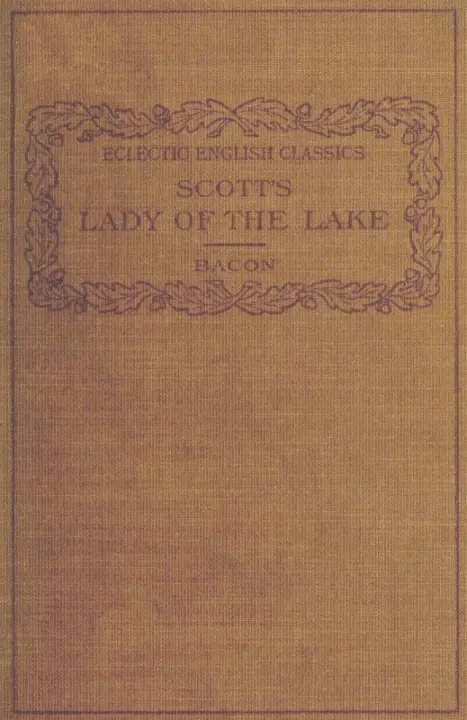
Scott’s Lady of the Lake
Walter Scott
THE CLASSIC COLLECTION · 1890
"The Journal of Sir Walter Scott" by Walter Scott is a diary kept between 1825 and 1832. It chronicles Scott's catastrophic financial collapse in 1826 and his heroic seven-year struggle to write his way out of debt totaling over £125,000. Through personal tragedies, declining health, and relentless work, Scott records his race against time with unflinching honesty. Critics have hailed it as one of the finest diaries in English literature—a candid self-portrait revealing both the greatness and vulnerability of a literary giant.
Introduction adapted from the source catalogue; source summaries may be automatically generated.
Free to read · English · 321,580 words · No account needed
MAKE TIME FOR A GOOD BOOK
On by default. Untick to stop anonymous reading totals. Each page counts after 10 seconds in view. How this works.
Anonymous counting is on unless you have switched it off.
October 14.--Tried to walk to Lady Louisa Stuart's, but took a little vertigo and came back. Much disturbed by a letter from Walter. He is like to be sent on an obnoxious service with very inadequate force, little prospect of thanks if he does his duty, and much of blame if he is unable to accomplish it. I have little doubt he will ware his mother's calf-skin on them.
The manufacturing districts are in great danger. London seems pretty secure. Sent off the revise of introduction to Mr. Cadell.[469]
October 16.--A letter from Walter with better news. He has been at hard-heads with the rogues and come off with advantage; in short, practised with success the art of drawing two souls out of one weaver.[470] All seems quiet now, and I suppose the Major will get his leave as proposed. Two ladies--[one] Byron's Mary Chaworth--have been frightened to death while the mob tore the dying creatures from their beds and proposed to throw them into the flames, drank the wine, destroyed the furniture, and committed other excesses of a jacquerie.[471] They have been put down, however, by a strong force of yeomanry and regulars. Walter says the soldiers fired over the people's heads, whereas if they had levelled low, the bullets must have told more among the multitude. I cannot approve of this, for in such cases severity is ultimate mercy.[472] However, if they have made a sufficient impression to be striking--why, enough is as good as a feast.
There is a strange story about town of ghost-seeing vouched by Lord Prudhoe, a near relation of the Duke of Northumberland, and whom I know as an honourable man. A colonel described as a cool-headed sensible man of worth and honour, Palgrave, who dined with us yesterday, told us twice over the story as vouched by Lord Prudhoe, and Lockhart gave us Colonel Felix's edition, which coincided exactly. I will endeavour to extract the essence of both. While at Grand Cairo they were attracted by the report of a physician who could do the most singular magical feats, and was in the habit not only of relieving the living, but calling up the dead. This sage was the member of a tribe in the interior part of Africa. They were some time (two years) in finding him out, for he by no means pressed himself on the curious, nor did he on the other hand avoid them; but when he came to Grand Cairo readily agreed to gratify them by a sight of his wonders. The scenes exhibited were not visible to the operator himself, nor to the person for whose satisfaction they were called up, but, as in the case of Dr. Dee and other adepts, by means of a viewer, an ignorant Nubian boy, whom, to prevent imposition, the English gentlemen selected for the purpose, and, as they thought, without any risk of imposture by confederacy betwixt him and the physician. The process was as follows:--A black square was drawn in the palm of the boy's hand, or rather a kind of pentacle with an Arabic character inscribed at each angle. The figures evoked were seen through this space as if the substance of the hand had been removed. Magic rites, and particularly perfumes, were liberally resorted to. After some fumigation the magician declared that they could not proceed until the seven flags should become visible. The boy declared he saw nothing, then said he saw a flag, then two; often hesitated at the number for a certain time, and on several occasions the spell did not work and the operation went no further, but in general the boy saw the seven flags through the aperture in his hand. The magician then said they must call the Sultan, and the boy said he saw a splendid tent fixed, surrounded by immense hosts, Eblis no doubt, and his angels. The person evoked was then named, and appeared accordingly. The only indispensable requisite was that he was named speedily, for the Sultan did not like to be kept waiting. Accordingly, William Shakespeare being named, the boy declared that he saw a Frank in a dress which he described as that of the reign of Elizabeth or her successor, having a singular countenance, a high forehead, and a very little beard. Another time a brother of the Colonel was named. The boy said he saw a Frank in his uniform dress and a black groom behind him leading a superb horse. The dress was a red jacket and white pantaloons; and the principal figure turning round, the boy announced that he wanted his arm, as was the case with Felix's brother. The ceremony was repeated fourteen times; successfully in twelve instances, and in two it failed from non-appearance of the seven banners in the first instance. The apparent frankness of the operator was not the least surprising part of the affair. He made no mystery, said he possessed this power by inheritance, as a family gift; yet that he could teach it, and was willing to do so, for no enormous sum--nay, one which seemed very moderate. I think two gentlemen embraced the offer. One of them is dead and the other still abroad. The sage also took a price for the exhibition of his skill, but it was a moderate one, being regulated by the extent of the perfumes consumed in the ceremony.
Your reading position is saved on this browser. Take it to another device with a library code. Reading pages adapt to text, rather than matching a printed edition.
Walter Scott

Walter Scott
Walter Scott
S. R. (Samuel Rutherford) Crockett & Walter Scott
BEHIND THE BOOK
This eBook is for the use of anyone anywhere in the United States and most other parts of the world at no cost and with almost no restrictions whatsoever. You may copy it, give it away or re-use it under the terms of the Project Gutenberg License included with this eBook or online at www.gutenberg.org. If you are not located in the United States, you will have to check the laws of the country where you are located before using this eBook. Read the source licence.
The original source file, including credits and licence, is retained by this library. Request an original-format copy at no charge. Please include the book title and Project Gutenberg identifier #14860.
KEEP YOUR CURIOSITY GOING

Charles G. (Charles Griffith) Ross
Hannah Webster Foster

Emily Lawless
Edwin Hamlin Carr

Charles De Lano Hine
Andrew Ure