
Half hours with the lower animals
Charles Frederick Holder
THE CLASSIC COLLECTION · 1886
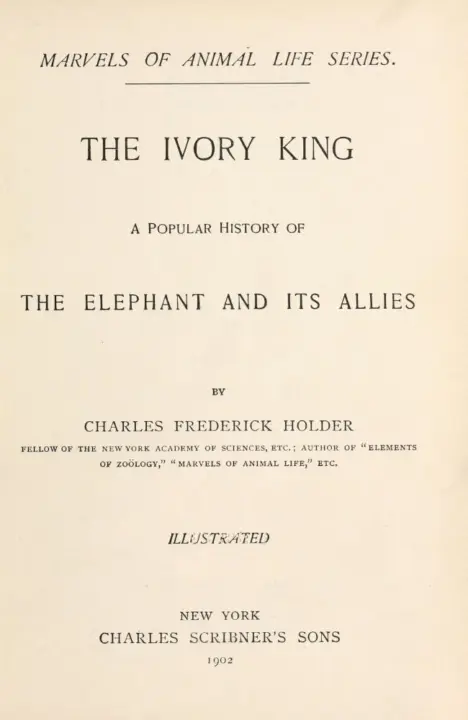
"The Ivory King: A Popular History of the Elephant and Its Allies" by Charles Frederick Holder is a historical account written in the late 19th century. This work explores the fascinating history, natural biology, and socio-economic significance of elephants, detailing their relationships with humans throughout time and across cultures. It examines not only the current status of elephants but also provides insights into their ancestors, such as the mammoth and mastodon, emphasizing the urgent need for conservation efforts. The opening of the book sets the stage by presenting the elephant as the "true king of beasts," highlighting its impressive history and the challenges it faces due to habitat loss and poaching. Holder discusses the past prominence of elephants in various civilizations, using poignant examples to illustrate their role in warfare and industry. He draws attention to the alarming rate at which elephants are being hunted for ivory, urging readers to consider the consequences of their impending extinction. The preface establishes a framework for the subsequent chapters, which promise a detailed exploration of elephants' natural history, intelligence, and interactions with humans and the environments they inhabit.
Introduction adapted from the source catalogue; source summaries may be automatically generated.
Free to read · English · 94,920 words · No account needed
MAKE TIME FOR A GOOD BOOK
On by default. Untick to stop anonymous reading totals. Each page counts after 10 seconds in view. How this works.
Anonymous counting is on unless you have switched it off.
FT. IN. Length in a direct line 14 3 Length following the curve of the spinal column 20 6 Width of the thorax at the seventh rib 3 5½ Elevation of the crest of the scapula 8 4 Elevation of the crest of the pelvis 8 4 Elevation of the head 8 11 Elevation of the spine of the second dorsal vertebra 8 10 Elevation of the spine of the eighth dorsal vertebra 9 3
In some of the mastodons found, remains of food have been discovered between the ribs: thus it has been determined that the huge creature existed when the country appeared much as it does to-day. The Mastodon giganteus fed upon the spruce and fir trees. The mastodons wandered over almost every country known, and their remains are very common in South America. Humboldt found them as far north as Santa Fe de Bogota, and they have been discovered as far south as Buenos Ayres. Their range in South America has been given from five degrees north to about thirty-seven degrees south; and they were probably not restricted to this area.
Like the elephants of the present day, they wandered to great elevations, even up to the borders of perpetual snow; and a tooth described by Cuvier was obtained by Humboldt, in a volcano, at an elevation of seventy-two hundred feet above the level of the sea. A fine collection of these South-American mastodons is exhibited in the museum at Santiago. They were found by a party of men in an attempt to drain Lake Tagua in the province of Colchagua, about one hundred miles south of Santiago, sixty from the Pacific, and fourteen hundred feet above the sea. A ditch was cut, to drain off the water; and, after it had been drawn off, the remains of the great animal were seen lying upon the bottom.
With these mastodons, there existed in North America an elephant, E. Columbi, which probably associated in herds with the mastodon, but were not as large. The mastodons were extremely ponderous, and exceeded the largest elephant of to-day in size, and, though resembling them in general appearance, differed in several marked features. The tusks often grew in a peculiar manner: two large, nearly straight ones appeared in the upper jaw, while one or two protruded from the lower. As a rule, these lower incisors were small; but in some instances they attained considerable size. Imagine an elephant eleven or more feet in height, with three or four enormous sharp ivory tusks, its trunk raised aloft, rushing at an enemy! surely, such an animal was the true king of beasts, even in these early days. The tusks of the mastodons assumed many strange shapes, and a herd of these great creatures must have presented a curious appearance. As in other proboscidians, the teeth consisted of incisors and molars. In the Mastodon turiensis of the pliocene time, found at Sismonda, the tusks of the upper jaw were nearly straight, though bending their points toward each other, long, sharp, and powerful. In a mastodon whose remains were found in Ohio (Mastodon Ohioticus), the tusks were long, gradually rising at the ends in a graceful curve; while in the lower jaw appeared a small single tusk. These lower incisors were present in the young of both sexes of this species, but were soon shed by the female, one being retained in the male; so that it was a three-tusked mastodon. In the Mastodon longirostris, there were, besides the two upper tusks, two long, slender tusks in the lower jaw, a defence more formidable than that possessed by any animal of to-day. In the elephant, the enamel is confined to the apex of the tusks; but in the huge mastodons They often had longitudinal bands of enamel, more or less spirally disposed upon their surface. The molar or grinding teeth of the mastodons appeared, much as in the elephants, in a horizontal succession: the front or worn-out teeth were pushed out or lost before the complete development of the posterior ones, which gradually moved forward to take the place of those which were worn out or ground away. The process was not as perfect as that in the present elephant, described in chapter first; as sometimes three teeth were in each jaw of the mastodon at the same time. The teeth are the chief points of distinction between the elephant and the mastodon; and they are readily recognized by the grinding surfaces of the molars, which have transverse ridges, their summits being divided into conical cusps, with smaller ones often clustered about them. The enamel is quite thick: the cementum, which is so plentiful in the teeth of elephants, is very scanty, never filling in the interspaces of the ridges; so that the teeth present a serrated edge.
Your reading position is saved on this browser. Take it to another device with a library code. Reading pages adapt to text, rather than matching a printed edition.
Charles Frederick Holder
BEHIND THE BOOK
This eBook is for the use of anyone anywhere in the United States and most other parts of the world at no cost and with almost no restrictions whatsoever. You may copy it, give it away or re-use it under the terms of the Project Gutenberg License included with this eBook or online at www.gutenberg.org. If you are not located in the United States, you will have to check the laws of the country where you are located before using this eBook. Read the source licence.
The original source file, including credits and licence, is retained by this library. Request an original-format copy at no charge. Please include the book title and Project Gutenberg identifier #66546.
KEEP YOUR CURIOSITY GOING
Cécile Tormay

Moritz Busch
John L. Ransom
Frances Wright
Cécile Tormay

Mabel Potter Daggett