
Half hours with the lower animals
Charles Frederick Holder
THE CLASSIC COLLECTION · 1886
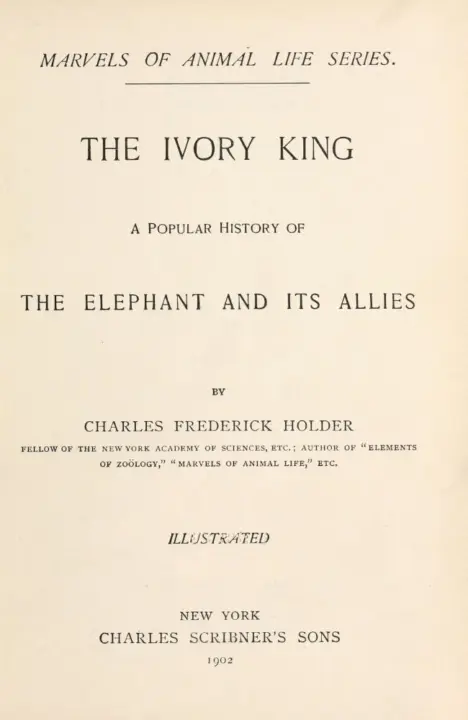
"The Ivory King: A Popular History of the Elephant and Its Allies" by Charles Frederick Holder is a historical account written in the late 19th century. This work explores the fascinating history, natural biology, and socio-economic significance of elephants, detailing their relationships with humans throughout time and across cultures. It examines not only the current status of elephants but also provides insights into their ancestors, such as the mammoth and mastodon, emphasizing the urgent need for conservation efforts. The opening of the book sets the stage by presenting the elephant as the "true king of beasts," highlighting its impressive history and the challenges it faces due to habitat loss and poaching. Holder discusses the past prominence of elephants in various civilizations, using poignant examples to illustrate their role in warfare and industry. He draws attention to the alarming rate at which elephants are being hunted for ivory, urging readers to consider the consequences of their impending extinction. The preface establishes a framework for the subsequent chapters, which promise a detailed exploration of elephants' natural history, intelligence, and interactions with humans and the environments they inhabit.
Introduction adapted from the source catalogue; source summaries may be automatically generated.
Free to read · English · 94,920 words · No account needed
MAKE TIME FOR A GOOD BOOK
On by default. Untick to stop anonymous reading totals. Each page counts after 10 seconds in view. How this works.
Anonymous counting is on unless you have switched it off.
“Having, therefore, made all these preparations, he sent ambassadors to Semiramis (as she was on her march towards him), to complain and upbraid her for beginning a war without any provocation or injury offered her; and by his private letters, taxed her with a dissolute course of life; and vowed (calling the gods to witness), that, if he conquered her, he would nail her to the cross. When she read the letter, she smiled, and said the Indian should presently have a trial of her valor by her actions. When she came up with her army to the river Indus, she found the enemy’s fleet drawn up in a line of battle; whereupon she forthwith drew up her own, and, having manned it with the stoutest soldiers, joined battle, yet so ordering the matter as to have her land-forces ready upon the shore, to be assisting as there should be occasion. After a long and sharp fight, with marks of valor on both sides, Semiramis was at length victorious, and sunk a thousand of the enemy’s vessels, and took a great number of prisoners. Puffed up with this success, she took in the cities and islands that lay in the river, and carried away an hundred thousand captives. After this, the Indian king drew off his army (as if he fled for fear), but in truth to decoy his enemies to pass the river. Semiramis, therefore (seeing all things fall out according to her wish), laid a broad bridge of boats (at a vast charge) over the river, and thereby passed over all her forces, leaving only threescore thousand to guard the bridge, and with the rest of her army pursued the Indians. She placed the mock-elephants in the front, that the enemy’s scouts might presently inform the king what multitudes of elephants she had in her army: and she was not deceived in her hopes; for when the spies gave an account to the Indians what a great multitude of these creatures were advancing towards them, they were all in amaze, inquiring among themselves, whence the Assyrians should be supplied with such a vast number of elephants: but the cheat could not long be concealed; for some of Semiramis’s soldiers, being laid by the heels for their carelessness upon the guard (through fear of further punishment), made their escape, and fled to the enemy, and undeceived them as to the elephants; upon which the Indian king was mightily encouraged, and caused notice of the delusion to be spread through the whole army, and then, forthwith, marched with all force against the Assyrians; Semiramis, on the other hand, doing the like. When they approached near one to another, Stabrobates, the Indian king, placed his horse and chariots in the vanguard, at a good distance before the main body of his army. The queen, having placed her mock-elephants at the like distance from her main body, valiantly received her enemy’s charge: but the Indian horse were most strangely terrified; for in regard, the phantasms at a distance seemed to be real elephants, the horses of the Indians (being inured to these creatures) pressed boldly and undauntedly forward; but when they came near, and saw another sort of beast than usual, and the smell and every thing else almost being strange and new to them, they broke in with great terror and confusion, one upon another, so that they cast some of their riders headlong to the ground, and ran away with others (as the lot happened) into the midst of their enemies; whereupon Semiramis, readily making use of her advantage, with a body of choice men, fell in upon them, and routed them, forcing them back to their main body: and though Stabrobates was something astonished at this unexpected defeat, yet he brought up his foot against the enemy, with his elephants in the front; he himself was in the right wing, mounted upon a stately elephant, and made a fierce charge upon the queen herself, who happened then to be opposite to him in the left. And though the mock-elephants in Semiramis’s army did the like, yet they stood the violent shock of the other but a little while: for the Indian beasts, being both exceeding strong and stout, easily bore down and destroyed all that opposed them, so that there was a great slaughter; for some they trampled under foot, others they rent in pieces with their teeth, and tossed up others with their trunks into the air. The ground, therefore, being covered with heaps of dead carcasses, and nothing but death and destruction to be seen on every hand, so that all were full of horror and amazement, none durst keep their order or ranks any longer. Upon which the whole Assyrian army fled outright: and the Indian king encountered with Semiramis, and first wounded her with an arrow in the arm, and afterwards with a dart (in wheeling about) in the shoulder; whereupon the queen (her wounds not being mortal) fled, and by the swiftness of her horse (which far exceeded the other that pursued her), she got off.”
Your reading position is saved on this browser. Take it to another device with a library code. Reading pages adapt to text, rather than matching a printed edition.
Charles Frederick Holder
BEHIND THE BOOK
This eBook is for the use of anyone anywhere in the United States and most other parts of the world at no cost and with almost no restrictions whatsoever. You may copy it, give it away or re-use it under the terms of the Project Gutenberg License included with this eBook or online at www.gutenberg.org. If you are not located in the United States, you will have to check the laws of the country where you are located before using this eBook. Read the source licence.
The original source file, including credits and licence, is retained by this library. Request an original-format copy at no charge. Please include the book title and Project Gutenberg identifier #66546.
KEEP YOUR CURIOSITY GOING
Cécile Tormay

Moritz Busch
John L. Ransom
Frances Wright
Cécile Tormay

Mabel Potter Daggett