
Half hours with the lower animals
Charles Frederick Holder
THE CLASSIC COLLECTION · 1886
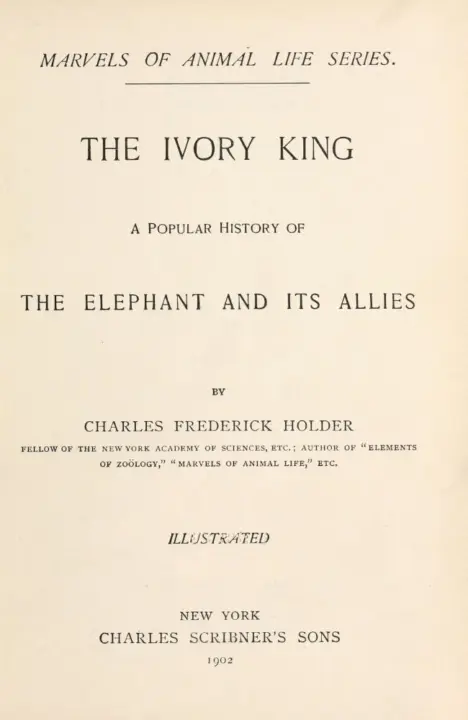
"The Ivory King: A Popular History of the Elephant and Its Allies" by Charles Frederick Holder is a historical account written in the late 19th century. This work explores the fascinating history, natural biology, and socio-economic significance of elephants, detailing their relationships with humans throughout time and across cultures. It examines not only the current status of elephants but also provides insights into their ancestors, such as the mammoth and mastodon, emphasizing the urgent need for conservation efforts. The opening of the book sets the stage by presenting the elephant as the "true king of beasts," highlighting its impressive history and the challenges it faces due to habitat loss and poaching. Holder discusses the past prominence of elephants in various civilizations, using poignant examples to illustrate their role in warfare and industry. He draws attention to the alarming rate at which elephants are being hunted for ivory, urging readers to consider the consequences of their impending extinction. The preface establishes a framework for the subsequent chapters, which promise a detailed exploration of elephants' natural history, intelligence, and interactions with humans and the environments they inhabit.
Introduction adapted from the source catalogue; source summaries may be automatically generated.
Free to read · English · 94,920 words · No account needed
MAKE TIME FOR A GOOD BOOK
On by default. Untick to stop anonymous reading totals. Each page counts after 10 seconds in view. How this works.
Anonymous counting is on unless you have switched it off.
Elephants were not always demoralized in these wars; and in another battle this same conqueror had the front of his army protected by a line of elephants, their towers filled with archers and Greek fire-flingers. At the word of command they started forward, their drivers ordering them to coil their trunks so that the sabres of the Mamelukes could not reach them.
The Syrians fled before them, and were crushed under foot; others were hurled forty or fifty feet into the air; the defeat being complete, and chiefly due to the elephants.
Timour’s curious experiment of adopting elephants in warfare, after he had witnessed their demoralization, was not without precedent, as Kublai Khan and Alexander did the same. Marco Polo gives a clear idea of the way elephants were used in battle:—
“It happened, that, in the year 1272, the Grand Khan sent an army into the countries of Vochang and Karazan, for their protection and defence against any attack that foreigners might attempt to make.... When the King of Mien and Bangala in India, who was powerful in the number of his subjects, in extent of territory, and in wealth, heard that an army of Tartars had arrived at Vochang, he took the resolution of advancing immediately to attack it, in order that by its destruction the Grand Khan should be deterred from again attempting to station a force upon the borders of his dominions. For this purpose he assembled a very large army, including a multitude of elephants (an animal with which his country abounds), upon whose backs were placed battlements, or castles, of wood, capable of containing the number of from twelve to sixteen in each. With these, and a numerous army of horse and foot, he took the road to Vochang, where the Grand Khan’s army lay, and, encamping at no great distance from it, intended to give his troops a few days of rest. The King of Mien, learning that the Tartars had descended into the plain, immediately put his army in motion, took up his ground at the distance of about a mile from the enemy, and made a disposition of his force, placing the elephants in the front, and the cavalry and infantry in two extended wings in their rear, but leaving between them a considerable interval. Here he took his own station, and proceeded to animate his men, and encouraging them to fight valiantly, assuring them of victory, as well from the superiority of their numbers, being four to one, as from their formidable body of armed elephants, whose shock the enemy, who had never before been engaged with such combatants, could by no means resist. Then, giving orders for sounding a prodigious number of warlike instruments, he advanced boldly with his whole army towards that of the Tartars, which remained firm, making no movement, but suffering them to approach their intrenchments. They then rushed out with great spirit and the utmost eagerness to engage; but it was soon found that the Tartar horses, unused to the sight of such huge animals, with their castles, were terrified, and, wheeling about, endeavored to fly, nor could their riders by any exertions restrain them; whilst the king, with the whole of his forces, was every moment gaining ground. As soon as the prudent commander perceived this unexpected disorder, without losing his presence of mind, he instantly adopted the measure of ordering his men to dismount, and their horses to be taken into the wood, where they were fastened to the trees. Being dismounted, the men, without loss of time, advanced on foot towards the line of elephants, and commenced a brisk discharge of arrows: whilst, on the other side, those who were stationed in the castles, and the rest of the king’s army, shot volleys in return, with great activity; but their arrows did not make the same impression as those of the Tartars, whose bows were drawn with a stronger arm. So incessant were the discharges of the latter, and all their weapons (according to the instructions of their commander) being directed against the elephants, these were soon covered with arrows, and, suddenly giving way, fell back upon their own people in the rear, who were thereby thrown into confusion. It soon became impossible for their drivers to manage them, either by force or address. Smarting under the pain of their wounds, and terrified by the shouting of the assailants, they were no longer governable, but, without guidance or control, ran about in all directions, until at length, impelled by rage and fear, they rushed into a part of the wood not occupied by the Tartars. The consequence of this was, that, from the closeness of the brandies of large trees, they broke, with loud crashes, the battlements, or castles, that were upon their backs, and involved in the destruction those who sat upon them. Upon seeing the rout of the elephants, the Tartars acquired fresh courage; and filing off by detachments, with perfect order and regularity, they remounted their horses, and joined their several divisions, when a sanguinary and dreadful combat was renewed. The battle ended in a complete victory.”
Your reading position is saved on this browser. Take it to another device with a library code. Reading pages adapt to text, rather than matching a printed edition.
Charles Frederick Holder
BEHIND THE BOOK
This eBook is for the use of anyone anywhere in the United States and most other parts of the world at no cost and with almost no restrictions whatsoever. You may copy it, give it away or re-use it under the terms of the Project Gutenberg License included with this eBook or online at www.gutenberg.org. If you are not located in the United States, you will have to check the laws of the country where you are located before using this eBook. Read the source licence.
The original source file, including credits and licence, is retained by this library. Request an original-format copy at no charge. Please include the book title and Project Gutenberg identifier #66546.
KEEP YOUR CURIOSITY GOING
Cécile Tormay

Moritz Busch
John L. Ransom
Frances Wright
Cécile Tormay

Mabel Potter Daggett