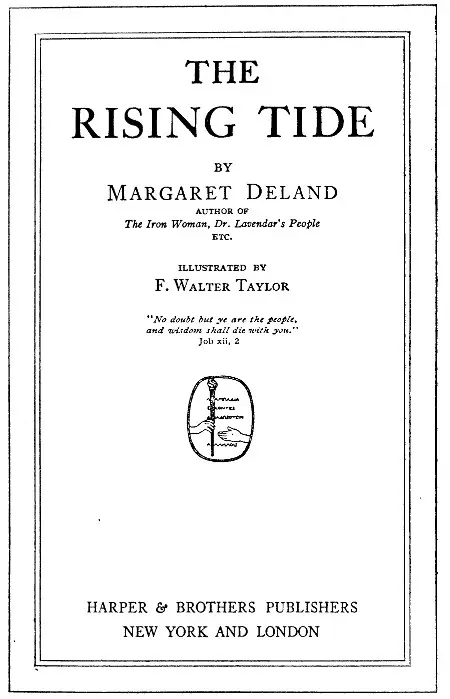
The Rising Tide
Margaret Wade Campbell Deland
THE CLASSIC COLLECTION · 1911
"The Iron Woman" by Margaret Wade Campbell Deland is a novel first published in installments from 1910 to 1911. Set in a fictional Ohio River town representing Pittsburgh, the story centers on Mrs. Maitland, a formidable widow who runs an iron mill. Her strict work ethic and disapproval of her son Blair's romantic choice create bitter conflict. As childhood friendships evolve into tangled love affairs involving Blair, Elizabeth Ferguson, and David, the characters face choices about loyalty, honor, and passion that will reshape their lives forever.
Introduction adapted from the source catalogue; source summaries may be automatically generated.
Free to read · English · 150,554 words · No account needed
MAKE TIME FOR A GOOD BOOK
On by default. Untick to stop anonymous reading totals. Each page counts after 10 seconds in view. How this works.
Anonymous counting is on unless you have switched it off.
John Blair, the father of the second Mrs. Maitland, an uneducated, extremely intelligent man, had risen from puddling to partnership in the Maitland Works. There had been no social relations between Mr. Maitland, Sr., and this new member of the firm, but the older man had a very intimate respect, and even admiration for John Blair. When he came to die he confided his son's interests to his partner with absolute confidence that they would be safe. "Herbert has no gumption, John," he said; "he wants to be an 'artist.' You've got to look after him." "I will, Mr. Maitland, I will," said John Blair, snuffling and blowing his nose on a big red pocket-handkerchief. He did look after him. He put Herbert's affairs ahead of his own, and he made it clear to his daughter, who in business matters was, curiously enough, his right-hand man, that "Maitland's boy" was always, as he expressed it, "to have the inside track."
"I ain't bothering about you, Sally; I'll leave you enough. And if I didn't, you could scratch gravel for yourself. But Maitland's boy ain't our kind. He must be taken care of."
When John Blair died, perhaps a sort of faithfulness to his wishes made his Sally "take care" of Herbert Maitland by marrying him. "His child certainly does need a mother," she thought;--"an intelligent mother, not a goose." By and by she told Herbert of his child's need; or at any rate helped him to infer it. And somehow, before he knew it, he married her. By inheritance they owned the Works between them; so really their marriage was, as the bride expressed it, "a very sensible arrangement"; and any sensible arrangement appealed to John Blair's daughter. But after a breathless six months of partnership--in business if in nothing else--Herbert Maitland, leaving behind him his little two-year-old Nannie, and an unborn boy of whose approaching advent he was ignorant, got out of the world as expeditiously as consumption could take him. Indeed, his wife had so jostled him and deafened him and dazed him that there was nothing for him to do but die--so that there might be room for her expanding energy. Yet she loved him; nobody who saw her in those first silent, agonized months could doubt that she loved him. Her pain expressed itself, not in moans or tears or physical prostration, but in work. Work, which had been an interest, became a refuge. Under like circumstances some people take to religion and some to drink; as Mrs. Maitland's religion had never been more than church-going and contributions to foreign missions, it was, of course, no help under the strain of grief; and as her temperament did not dictate the other means of consolation, she turned to work. She worked herself numb; very likely she had hours when she did not feel her loss. But she did not feel anything else. Not even her baby's little clinging hands, or his milky lips at her breast. She did her duty by him; she hired a reliable woman to take charge of him, and she was careful to appear at regular hours to nurse him. She ordered toys for him, and as she shared the naive conviction of her day that church-going and religion were synonymous, she began, when he was four years old, to take him to church. In her shiny, shabby black silk, which had been her Sunday costume ever since it had been purchased as part of her curiously limited trousseau she sat in a front pew, between the two children, and felt that she was doing her duty to both of them. A sense of duty without maternal instinct is not, perhaps, as baleful a thing as maternal instinct without a sense of duty, but it is sterile; and in the first few years of her bereavement, the big, suffering woman seemed to have nothing but duty to offer to her child. Nannie's puzzles began then. "Why don't Mamma hug my baby brother?" she used to ask the nurse, who had no explanation to offer. The baby brother was ready enough to hug Nannie, and his eager, wet little kisses on her rosy cheeks sealed her to his service while he was still in petticoats. Blair was three years old before, under the long atrophy of grief, Sarah Maitland's maternal instinct began to stir. When it did, she was chilled by the boy's shrinking from her as if from a stranger; she was chilled, too, by another sort of repulsion, which with the hideous candor of childhood he made no effort to conceal. One of his first expressions of opinion had been contained in the single word "uggy," accompanied by a finger pointed at his mother. Whenever she sneezed--and she was one of those people who cannot, or do not, moderate a sneeze--Blair had a nervous paroxysm. He would jump at the unexpected sound, then burst into furious tears. When she tried to draw his head down upon her scratchy black alpaca breast, he would say violently, "No, no! No, no!" at which she would push him roughly from her knee, and fall into hurt silence. Once, when he was five years old, she came in to dinner hot from a morning in the Works, her moist forehead grimy with dust, and bent over to kiss him; at which the little boy wrinkled up his nose and turned his face aside.
Your reading position is saved on this browser. Take it to another device with a library code. Reading pages adapt to text, rather than matching a printed edition.
Margaret Wade Campbell Deland

Margaret Wade Campbell Deland
Margaret Wade Campbell Deland

Margaret Wade Campbell Deland
BEHIND THE BOOK
This eBook is for the use of anyone anywhere in the United States and most other parts of the world at no cost and with almost no restrictions whatsoever. You may copy it, give it away or re-use it under the terms of the Project Gutenberg License included with this eBook or online at www.gutenberg.org. If you are not located in the United States, you will have to check the laws of the country where you are located before using this eBook. Read the source licence.
The original source file, including credits and licence, is retained by this library. Request an original-format copy at no charge. Please include the book title and Project Gutenberg identifier #6474.
KEEP YOUR CURIOSITY GOING
Coulson Kernahan

Maurice Baring
Frances Wright
Cécile Tormay

Frederic Jesup Stimson

W. H. P. (William Henry Pope) Jarvis