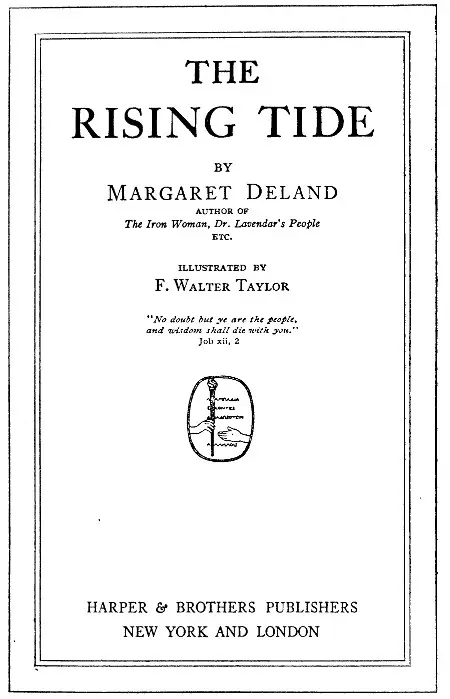
The Rising Tide
Margaret Wade Campbell Deland
THE CLASSIC COLLECTION · 1911
"The Iron Woman" by Margaret Wade Campbell Deland is a novel first published in installments from 1910 to 1911. Set in a fictional Ohio River town representing Pittsburgh, the story centers on Mrs. Maitland, a formidable widow who runs an iron mill. Her strict work ethic and disapproval of her son Blair's romantic choice create bitter conflict. As childhood friendships evolve into tangled love affairs involving Blair, Elizabeth Ferguson, and David, the characters face choices about loyalty, honor, and passion that will reshape their lives forever.
Introduction adapted from the source catalogue; source summaries may be automatically generated.
Free to read · English · 150,554 words · No account needed
MAKE TIME FOR A GOOD BOOK
On by default. Untick to stop anonymous reading totals. Each page counts after 10 seconds in view. How this works.
Anonymous counting is on unless you have switched it off.
They had respected Nannie's desire to be alone that night, but it was nearly twelve before she was really left to herself, and the house was silent. Robert Ferguson had made her go up-stairs to bed, and bidden the worn-out nurse sleep in the room next to her so that she would not be so entirely solitary. He himself did not go home until those soft and alien footsteps that cross our thresholds, and dare as business the offices that Love may not essay, had at last died away. Nannie, in her bedroom, sat wide-eyed, listening for those footsteps. Once she said to herself: "When they have gone--" and her heart pounded in her throat. At last "they" went; she heard the front door close; then, out in the street, another door banged softly; after that there was the sound of wheels.
"Now!" she said to herself. But still she did not move.... Was the nurse asleep? Was Harris up in his room in the garret? Was there any one downstairs--except Death? Death in Mrs. Maitland's bedroom. "For God's sake, lock her door!" Harris had said. And they locked it. We generally lock it. Heaven knows why! Why do we turn the key on that poor, broken, peaceful thing, as if it might storm out in the night, and carry us back with it into its own silence?
It was almost dawn--the high spring dawn that in May flushes even Mercer's skies at three o'clock in the morning, when, lamp in hand, Nannie Maitland opened her bedroom door and peered into the upper hall. Outside, the wind, which had begun to blow at sunset, was roaring around the old house; it rumbled in the chimneys, and a sudden gust tore at a loose shutter, and sent it banging back against the bricks. But in the house everything was still. The window over the front door was an arch of glimmering gray barred by the lines of the casement; but toward the well of the staircase there was nothing but darkness. Nannie put a hesitating foot across her own threshold, paused, then came gliding out into the hall; at the head of the stairs she looked down into a gulf of still blackness; the close, warm air of the house seemed to press against her face. She listened intently: no sound, except the muttering indifference of the wind about the house. Slowly, step by step, shivering and shrinking, she began to creep down-stairs. At the closed door of the dining-room--next to that other room which Harris had bidden them lock up; she stood for a long time, her fingers trembling on the knob; her lamp, shaking in her hand, cast a nimbus of light around her small gray figure. It seemed to her as if she could not turn that knob. Then, with gasp of effort, it was done, and she entered. Her first look was at that place on the floor, where for the last two days the pillows had been piled. The pillows were not there now; the room was in new, bleak order. Instantly, after that shrinking glance at the floor, she looked toward Mrs. Maitland's room, and her hand went to her throat as if she could not breathe. A moment afterward she began to creep across the floor, one terrified step dragging after another; she walked sidewise, always keeping her head turned toward that silent room. Just as she reached the big desk, the wind, sucking under the locked door, shook it with sly insinuation;--instantly she wheeled about, and stood, swaying with fright, her back against the desk. She stood there, panting, for a full minute. The terror of that furtively shaken door was agonizing. Then, very slowly, with a sidewise motion so that she could look toward the room, she put her lamp down on the top of the desk, and began, with constant bird-like glances over her shoulder, to search.... Yes; there it was! just where she herself had put it, slipped between the pages of a memorandum-book, so that if, in another gleam of consciousness, Blair's mother should ask for it, there need be no delay in getting it. When her fingers closed on it, she turned, swiftly, so that the room might not be behind her. Always watching the locked door, she groped for pen and ink and some sheets of paper, which she carried over to the table. Then she drew up a chair, folded back the sleeves of her wrapper, propped the memorandum-book--which had on the inside page the flowing signature of its owner--open before her. Then, slowly and steadily, she began to do the thing she had come to do. Instantly she was calmer. When a great gust of wind rumbled suddenly in the chimney, and a wraith of ashes blew out of the fireplace, she did not even raise her eyes; but once she looked over toward the room, and smiled, as if to say "It is all right. I am making it all right!"
Your reading position is saved on this browser. Take it to another device with a library code. Reading pages adapt to text, rather than matching a printed edition.
Margaret Wade Campbell Deland

Margaret Wade Campbell Deland
Margaret Wade Campbell Deland

Margaret Wade Campbell Deland
BEHIND THE BOOK
This eBook is for the use of anyone anywhere in the United States and most other parts of the world at no cost and with almost no restrictions whatsoever. You may copy it, give it away or re-use it under the terms of the Project Gutenberg License included with this eBook or online at www.gutenberg.org. If you are not located in the United States, you will have to check the laws of the country where you are located before using this eBook. Read the source licence.
The original source file, including credits and licence, is retained by this library. Request an original-format copy at no charge. Please include the book title and Project Gutenberg identifier #6474.
KEEP YOUR CURIOSITY GOING
Coulson Kernahan

Maurice Baring
Frances Wright
Cécile Tormay

Frederic Jesup Stimson

W. H. P. (William Henry Pope) Jarvis