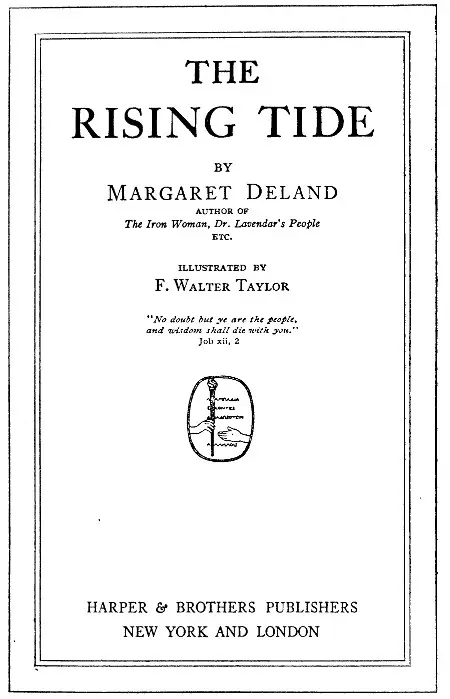
The Rising Tide
Margaret Wade Campbell Deland
THE CLASSIC COLLECTION · 1911
"The Iron Woman" by Margaret Wade Campbell Deland is a novel first published in installments from 1910 to 1911. Set in a fictional Ohio River town representing Pittsburgh, the story centers on Mrs. Maitland, a formidable widow who runs an iron mill. Her strict work ethic and disapproval of her son Blair's romantic choice create bitter conflict. As childhood friendships evolve into tangled love affairs involving Blair, Elizabeth Ferguson, and David, the characters face choices about loyalty, honor, and passion that will reshape their lives forever.
Introduction adapted from the source catalogue; source summaries may be automatically generated.
Free to read · English · 150,554 words · No account needed
MAKE TIME FOR A GOOD BOOK
On by default. Untick to stop anonymous reading totals. Each page counts after 10 seconds in view. How this works.
Anonymous counting is on unless you have switched it off.
"You don't suppose I'd bring you anywhere where you could get hurt?" her stepmother said, incredulously. She was astonished to the point of being pained. How could Herbert's girl be such a fool? She remembered that Blair used to call his sister the "'fraid-cat." "Good name," she thought, contemptuously. She made no allowance for the effect of this scene of night and fire, of stupendous shadows and crashing noises, upon a little bleached personality, which for all these years, had lived in the shadow of a nature so dominant and aggressive that, quite unconsciously, it sucked the color and the character out of any temperament feebler than itself. Sarah Maitland frowned, and said roughly, "Oh, you can go home, if you want to; Mr. Parks!" she called to the foreman; "just walk back to the house, if you please, with my daughter;" then she turned on her heel and went up to the furnace.
Nannie, clutching Parks's hand, stumbled out into the darkness. "It's perfectly awful!" she confided to the good-natured man, when he left her at her back door.
"Oh, you get used to it," he said, kindly. "You'd 'a knowed," he told one of his workmen afterward, "that there wasn't hide nor hair of her that belonged to the Old One. A slip of a thing, and scared to death of the noise."
The "Old One," after Nannie had gone, poked about for a moment or two,--"she noses into things, to save two cents," her men used to say, with reluctant admiration of the ruthless shrewdness that was instant to detect their shortcomings; then she went down the slight incline from the furnace hearth to the open stretch of molding-sand; there was a pile of rusty scrap at one side, and here, in the soft April darkness under the stars, she seated herself, looking absently at the furnace and the black, gnome-like figures of the helpers. She was thinking just what Parks had thought, that Nannie had none of her blood in her. "Afraid!" said Sarah Maitland. Well, Blair had never been afraid, she would say that for him; he was a fool, and pig-headed, and a loafer; but he wasn't a coward. He had even thought it fine, that scene of power, where civilization made itself before his very eyes! When would he think it fine enough to come in and go to work? Come in, and take his part in making civilization? Then she noticed the bending figure of the keeper opening the notch of the furnace; instantly there was a roar of sparks, and a blinding white gush of molten iron flowing like water down into the sand runner. The sudden, fierce illumination drowned the stars overhead, and brought into clear relief her own figure, sitting there on the pile of scrap watching the flowing iron. Tiny blue flames of escaping gas danced and shimmered on its ineffable rippling brightness, that cooled from dazzling snow to rose, then to crimson, and out in the sand, to glowing gray. Blair had called it "beautiful." Well, it was a pretty sight! She wished she had told him that she herself thought it pretty; but the fact was, it had never struck her before. "I suppose I don't notice pretty things very much," she thought, in some surprise. "Well, I've never had time for foolishness. Too busy making money for Blair." She sighed; after all, he wasn't going to have the money. She had been heaping up riches, and had not known who should gather them. She had been too busy to see pretty things. And why? That orphan asylums and reformatories--and David Richie's hospital--should have a few extra thousands! A month ago the fund she was making for David had reached the limit she had set for it, and only to-day she had brought the bank certificate of deposit home with her. She had felt a little glow of satisfaction when she locked it into the safe in her desk; she liked the consciousness of a good job finished. She was going to summon the youngster to Mercer, and tell him how he was to administer the fund; and if he put on any of his airs and graces about accepting money, she would shut him up mighty quick! "I'll write him to-morrow, if I've time," she had said. At the moment, the sense of achievement had exhilarated her; yet now, as she sat there on the heap of scrap, bending a pliant boring between her fingers, her pillar of fire roaring overhead from the chimneys of the furnaces, the achievement seemed flat enough. Why should she, to build a hospital for another woman's son, have worked so hard that she had never had time to notice the things her own son called "pretty"? Not his china beetles, of course, or truck like that; but the shimmering flow of her iron,--or even that picture, for which she was out of pocket $5,000. "I can see you might call it pretty, if it hadn't cost so much," she admitted. Yes, she had worked, she told herself, "as hard as a man," to earn money for Blair!--only to make him idle and to have him say that thing about her clothes which Goose Molly had said before he was born. "Wonder if I've been a fool?" she ruminated.
Your reading position is saved on this browser. Take it to another device with a library code. Reading pages adapt to text, rather than matching a printed edition.
Margaret Wade Campbell Deland
Margaret Wade Campbell Deland
Margaret Wade Campbell Deland

Margaret Wade Campbell Deland
BEHIND THE BOOK
This eBook is for the use of anyone anywhere in the United States and most other parts of the world at no cost and with almost no restrictions whatsoever. You may copy it, give it away or re-use it under the terms of the Project Gutenberg License included with this eBook or online at www.gutenberg.org. If you are not located in the United States, you will have to check the laws of the country where you are located before using this eBook. Read the source licence.
The original source file, including credits and licence, is retained by this library. Request an original-format copy at no charge. Please include the book title and Project Gutenberg identifier #6474.
KEEP YOUR CURIOSITY GOING
Coulson Kernahan

Maurice Baring
Frances Wright
Cécile Tormay

Frederic Jesup Stimson

W. H. P. (William Henry Pope) Jarvis