THE CLASSIC COLLECTION✦Peeps at People Being Certain Papers from the Writings of Anne Warrington WitherupCLASSIC FREE BOOKS
Peeps at People Being Certain Papers from the Writings of Anne Warrington Witherup
John Kendrick Bangs
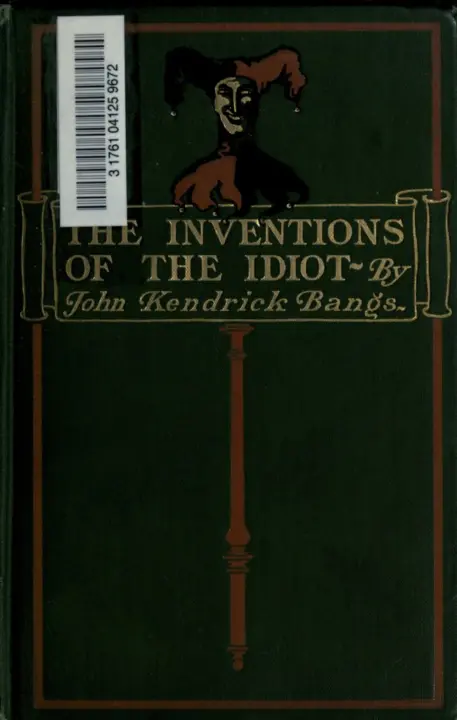
THE CLASSIC COLLECTION · 1903
"The Inventions of the Idiot" by John Kendrick Bangs is a comedic novel written in the late 19th century. The book centers around a character known as the Idiot, who lives in a boarding house and frequently engages in witty and humorous dialogues about societal norms, human nature, and various amusing inventions. Each chapter appears to explore different themes or satirical ideas while showcasing the unique viewpoints of the Idiot and his companions. At the start of the book, we are introduced to the Idiot's musings as he criticizes the culinary skills of the cook in his boarding house, demonstrating his knack for absurd and exaggerated arguments. He uses humor to highlight the challenges faced by civilized society, contrasting them with those of more barbaric cultures. Despite the initial conversation revolving around a poorly cooked meal, the dialogue quickly evolves into broader discussions about etiquette, the importance of good cooking, and how minor grievances can lead to wider societal discord. Through a series of humorous exchanges with fellow boarders, the Idiot's character is painted as a comical but insightful commentator on life, promising readers an entertaining exploration of his inventive and often nonsensical ideas.
Introduction adapted from the source catalogue; source summaries may be automatically generated.
Free to read · English · 26,865 words · No account needed
MAKE TIME FOR A GOOD BOOK
On by default. Untick to stop anonymous reading totals. Each page counts after 10 seconds in view. How this works.
Anonymous counting is on unless you have switched it off.
"A man's the biggest thing alive
When he has got to twenty-five;
And as for woman, she's a queen
Whose summers number just eighteen."
"That's a good idea," returned the Poet. "I'll make a note of that, and if I sell it I'll give you a commission."
"No, don't do that," said the Idiot, slyly. "I shall be satisfied to see
your name in print."
The Poet having accepted this sally in the spirit in which it was
intended, the Idiot resumed:
"But of course the Elixir and the Electrical Pills are as yet all in the air. We haven't even taken a step in that direction. Mr. Edison and other wizards have been too much occupied with electric lights and telephones and phonographs and transatlantic notions to pay any attention to schemes to prolong life and keep us, despite our years, perpetually young."
"I fancy they are likely to continue to do so," said the Doctor. "Whatever motive you may attribute to me for pooh-poohing your notions, I do so. No sane person wants to live forever, and if it were possible that all men might live forever, you'd soon find the world so crowded that the slighter actors in the human comedy would be shoved off the stage. There are enough people in the world now, without man's adding all future generations to their number and making death an impossibility."
"That's all nonsense," said the Idiot. "My Elixir wouldn't make death an impossibility. Any man who thought he'd had enough at the end of a thousand years could stop taking the Elixir and shuffle off the mortal coil. As a matter of fact, not more than ten per cent. of the people in the world would have any faith in the Elixir at all. I know people to-day who do not take advantage of the many patent remedies that are within their reach, preferring the mustard-plaster and catnip-tea of their forefathers. There's where human nature works again. I believe that if I were myself the discoverer of the formula for my mixture, and for an advertisement secured a letter from a man saying, 'I was dying of old age, having reached the advanced period of ninety-seven; I took two bottles of your Electrical Elixir and am now celebrating my twenty-fifth birthday again,' ninety-nine per cent. of the people who read it would laugh and think it had strayed out of the funny column. People lack confidence in their fellow-men--that's all; but if they were twenty-five and eighteen that would all be changed. We are very trustful at twenty-five and eighteen, which is one of the things I like about those respective ages. When I was twenty-five I believed in everybody, including myself. Now--well, I'm older. But enough of schemes, which I must admit are somewhat visionary--as the telephone would have seemed one hundred years ago. Let us come down to realities in electricity. I can't see why more is not made of the phonograph for the benefit of the public. Take a man like Chauncey M. De Choate. He goes here and he goes there to make speeches, when I've no doubt he'd much prefer to stay at home cutting coupons off his bonds. Why can't the phonograph voice do his duty? Instead of making the same speech over and over again, why can't some electrician so improve the phonograph that De Choate can say what he has to say through a funnel, have it impressed on a cylinder, duplicated and reduplicated and scattered broadcast over the world? If Mr. Edison could impart what poets call stentorian tones to the phonograph, he'd be doing a great and noble work. Again, for smaller things, like a dance, Why can't the phonograph be made useful at a ball? I attended one the other night, and when I wanted to dance the two-step the band played the polka; if I wished the polka it played a waltz. Some men can only dance the two-step--they don't know the waltz, the polka, or the schottische. Now why can't the phonograph come to the rescue? In almost any hotel in New York you can drop a nickel in a slot and hear Sousa's band on the phonograph. Why not extend the principle and have a phonograph for men who can dance nothing but the two-step, charged with 'The Washington Post March,' and supplied with four tubes with receivers to put in the ears of the listeners? Make it small enough for a man to carry in his pocket; then at a ball he could go up to a young lady, ask her to dance, put two of the receivers in her ears, two in his, and trip the light fantastic toe utterly independently of what other people were dancing. It's possible. Mr. Edison could do it in five minutes, and every one would be satisfied. It might be rather droll to see two people dancing the two-step while eight others were fastened on to a lanciers phonograph, and a dozen or more other couples were dancing respectively the waltz, schottische, and Virginia reel, but we'd soon get used to that, and no man need become a wall-flower because he couldn't dance the dance that happened to be on. Furthermore, you'd be able to do away with the musicians, who always cast a pall over dances because of their superiority to the rest of the world in general and the dancers in particular."
Your reading position is saved on this browser. Take it to another device with a library code. Reading pages adapt to text, rather than matching a printed edition.
John Kendrick Bangs
John Kendrick Bangs
John Kendrick Bangs
John Kendrick Bangs
BEHIND THE BOOK
This eBook is for the use of anyone anywhere in the United States and most other parts of the world at no cost and with almost no restrictions whatsoever. You may copy it, give it away or re-use it under the terms of the Project Gutenberg License included with this eBook or online at www.gutenberg.org. If you are not located in the United States, you will have to check the laws of the country where you are located before using this eBook. Read the source licence.
The original source file, including credits and licence, is retained by this library. Request an original-format copy at no charge. Please include the book title and Project Gutenberg identifier #33623.
KEEP YOUR CURIOSITY GOING
Coulson Kernahan

Maurice Baring
Frances Wright
Cécile Tormay

Frederic Jesup Stimson

W. H. P. (William Henry Pope) Jarvis