THE CLASSIC COLLECTION✦An outlaw’s diary: the CommuneCLASSIC FREE BOOKS
An outlaw’s diary: the Commune
Cécile Tormay
THE CLASSIC COLLECTION · 1915
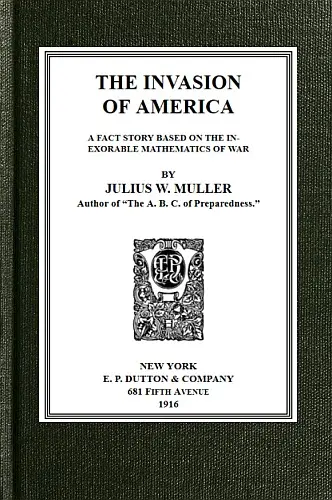
"The Invasion of America: A Fact Story Based on the Inexorable Mathematics of War" by Julius W. Muller is a historical account written in the early 20th century. The text explores a hypothetical invasion of the United States and examines the military implications of such an event, highlighting the country's unpreparedness for war. The narrative is constructed around a detailed portrayal of military maneuvers, strategies, and logistics that might occur during an invasion. The opening portion of the book sets the stage for an impending war, beginning with a joint military maneuver led by the President that reveals the vulnerabilities in America's defense. High-ranking officials discuss the strengths and weaknesses of the U.S. Army and Navy, emphasizing that the country is ill-equipped to face an invading force. As the coalition of enemy nations embarks on an assault, the narrative unfolds with a sense of urgency and dread as American cities brace for the potential landing of enemy troops. The detailed descriptions of military preparations illustrate not only the logistical challenges but also the societal panic and desire for protection that grips the nation in the face of war.
Introduction adapted from the source catalogue; source summaries may be automatically generated.
Free to read · English · 66,442 words · No account needed
MAKE TIME FOR A GOOD BOOK
On by default. Untick to stop anonymous reading totals. Each page counts after 10 seconds in view. How this works.
Anonymous counting is on unless you have switched it off.
[150] Practical completion of battery construction and armament, power plants, fire control, searchlight installation and supply of ammunition reported by Chief of Coast Artillery, September 19, 1914.
[151] Congress has appropriated comparatively little for the needs of
Guantanamo Harbor.
[152] Usually one of the first orders given to the occupants of
occupied territory.
[153] The practice laid down for our own army and followed in the
Insular campaigns.
[154] Paragraph 301, Rules of Land Warfare, U. S. A., 1914.
[155] This is one of the rules accepted among all nations and followed
by all armies.
[156] Issued during the Russo-Japanese War in Manchuria and cited by recent writers as acknowledged precedents.
[157] “While a military government continues as an instrument of warfare, used to promote the objects of invasion, its powers are practically boundless.”--Magoon, Law of Civil Government under Military Occupation, U. S. Bureau of Insular Affairs.
[158] Table 4, 13th Census, Volume 8. The Metropolitan District, as referred to in this sense, comprises Greater New York and the New Jersey manufacturing counties that contain Newark, Bayonne, Paterson, Hackensack, Passaic, Rutherford, etc.
[159] Spaight, an authority, says that “practically everything under the sun” may be requisitioned and cites the case of a boot-jack being demanded for army use. See quotation and rulings of U. S. Army.
[160] Under Hague Rule, Article LIII, it is held that “everything susceptible of military use” may be requisitioned, and modern army practice defines this as meaning anything from telegraph wire to canal boats.
[161] Not a large sum as compared with some imposts laid on quite small and unimportant towns in wars during the past century. One such levy was $1,000,000 from one town in one day, according to European writers.
[162] See case of seizure by Major General Otis of $100,000 from Philippine bankers, being money owned by insurgents and payable on presentation of a draft held by insurgents. Report, Charles E. Magoon, Law Officer, Division of Insular Affairs, 1902.
[163] List of non-assessable Federal property, N. Y., 1914.
[164] At present it is considered that one military flying machine in two months is good speed of production.
[165] Result of inquiry made by U. S. Army after tests on Texas border had developed the high value of motor trucks for war.
Your reading position is saved on this browser. Take it to another device with a library code. Reading pages adapt to text, rather than matching a printed edition.
BEHIND THE BOOK
This eBook is for the use of anyone anywhere in the United States and most other parts of the world at no cost and with almost no restrictions whatsoever. You may copy it, give it away or re-use it under the terms of the Project Gutenberg License included with this eBook or online at www.gutenberg.org. If you are not located in the United States, you will have to check the laws of the country where you are located before using this eBook. Read the source licence.
The original source file, including credits and licence, is retained by this library. Request an original-format copy at no charge. Please include the book title and Project Gutenberg identifier #52038.
KEEP YOUR CURIOSITY GOING
Cécile Tormay

Moritz Busch
John L. Ransom
Frances Wright
Cécile Tormay

Mabel Potter Daggett