THE CLASSIC COLLECTION✦An outlaw’s diary: the CommuneCLASSIC FREE BOOKS
An outlaw’s diary: the Commune
Cécile Tormay
THE CLASSIC COLLECTION · 1915
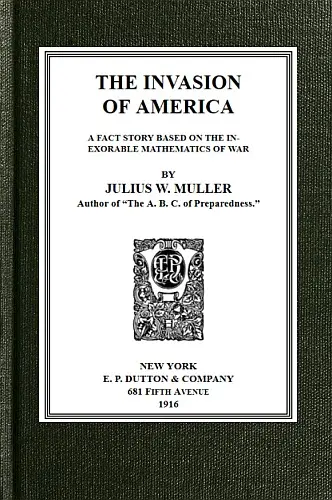
"The Invasion of America: A Fact Story Based on the Inexorable Mathematics of War" by Julius W. Muller is a historical account written in the early 20th century. The text explores a hypothetical invasion of the United States and examines the military implications of such an event, highlighting the country's unpreparedness for war. The narrative is constructed around a detailed portrayal of military maneuvers, strategies, and logistics that might occur during an invasion. The opening portion of the book sets the stage for an impending war, beginning with a joint military maneuver led by the President that reveals the vulnerabilities in America's defense. High-ranking officials discuss the strengths and weaknesses of the U.S. Army and Navy, emphasizing that the country is ill-equipped to face an invading force. As the coalition of enemy nations embarks on an assault, the narrative unfolds with a sense of urgency and dread as American cities brace for the potential landing of enemy troops. The detailed descriptions of military preparations illustrate not only the logistical challenges but also the societal panic and desire for protection that grips the nation in the face of war.
Introduction adapted from the source catalogue; source summaries may be automatically generated.
Free to read · English · 66,442 words · No account needed
MAKE TIME FOR A GOOD BOOK
On by default. Untick to stop anonymous reading totals. Each page counts after 10 seconds in view. How this works.
Anonymous counting is on unless you have switched it off.
Men said that from first to last the invading army had taken a sum not short of four billions of dollars. But whatever the sum, it was as nothing to the wound that had struck America near the heart--a brave Nation, a greatly capable Nation, made to grovel for her life because, in a world of men, she had failed to prepare for what men might do.
[1] The reader will recall Nast’s skeleton representing the Regular Army with the legend, “Match it for grit if you can” or words to that effect.
[2] Statement based on statistics.
[3] Authorities concede these matters.
[4] See War Department Reports, 1915.
[5] Taken from actual stations of various troops at various times. The army post system is considered indefensible among military men.
[6] Speed of embarkation of a mobilized and prepared army as calculated by European military staff officers.
[7] One thousand rifled cannon could be enumerated from the naval lists of less than four Powers. Less than four Powers could match our Navy with battleships.
[8] This is exactly what happened during the Spanish-American War.
[9] From U. S. War Department Reports for 1915 on Militia Organization.
[10] This statement does not betray a military secret. It is well known to all foreign governments that we cannot defend our coast defenses against land attack.
[11] Certain naval experts, basing their opinion on study of the recent naval battles, claim that a difference of as little as 10 per cent. in efficiency between fleets otherwise absolutely equal means inevitable destruction for the inferior fleet.
[12] A tactical necessity for an outnumbered fleet.
[13] This statement is based on official army calculations.
[14] From tabulated returns by the militia departments of twelve
Eastern States.
[15] From annual reports of rifle practice for 1914, militia
organizations.
[16] See tabulated returns published by War Department, 1915.
[17] Under-stated. Annual reports for 1915 show many practically
useless batteries.
[18] Annual report Militia Organization, 1915. (An Eastern seaboard
State.)
[19] Tables given in War Department statistics, 1915.
[20] Extracted from tabulated returns to War Department. (Report on Militia Organization, 1915.)
[21] Official figures: 12 Army aeroplanes, 13 Navy aeroplanes, no dirigibles, two aeroplanes not serviceable, total effective, 23.
[22] Block Island men helped in the capture of a troopship during the
War of the Revolution.
[23] A landing party seizing an outlying island for a base, as Block Island would infallibly be seized, always destroys everything that might enable the inhabitants to communicate with the mainland.
Your reading position is saved on this browser. Take it to another device with a library code. Reading pages adapt to text, rather than matching a printed edition.
BEHIND THE BOOK
This eBook is for the use of anyone anywhere in the United States and most other parts of the world at no cost and with almost no restrictions whatsoever. You may copy it, give it away or re-use it under the terms of the Project Gutenberg License included with this eBook or online at www.gutenberg.org. If you are not located in the United States, you will have to check the laws of the country where you are located before using this eBook. Read the source licence.
The original source file, including credits and licence, is retained by this library. Request an original-format copy at no charge. Please include the book title and Project Gutenberg identifier #52038.
KEEP YOUR CURIOSITY GOING
Cécile Tormay

Moritz Busch
John L. Ransom
Frances Wright
Cécile Tormay

Mabel Potter Daggett