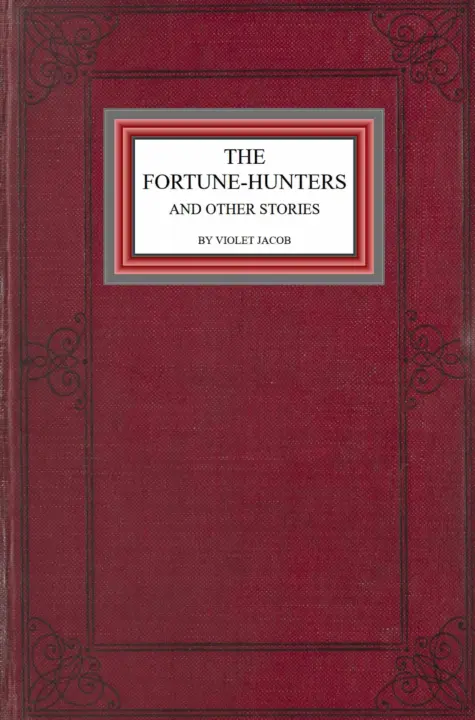
The fortune-hunters, and other stories
Violet Jacob

THE CLASSIC COLLECTION · 1904
"The Interloper" by Violet Jacob is a novel written in the early 20th century. Set against the scenic backdrop of the Scottish Lowlands, the novel begins with the return of the young protagonist, Gilbert Speid, to his ancestral home of Whanland. As he reconnects with the land and the remnants of his family, including a mysterious portrait of his mother, the narrative explores themes of legacy, identity, and the complexities of social relationships among genteel Scottish families. The opening of "The Interloper" introduces Gilbert Speid, who arrives at the decaying estate of Whanland, a place laden with his family's history. As he navigates his new role as the heir, he encounters various characters, including his family lawyer, Alexander Barclay, and his elderly relatives, the Misses Robertson, who illuminate aspects of his past through their recollections. The atmosphere is interwoven with themes of belonging and the weight of expectations, particularly as Gilbert grapples with the legacy left by his mother. Encounters with local figures, including the curious Lady Eliza Lamont, set the stage for further exploration of community dynamics and relationships that promise future intrigue.
Introduction adapted from the source catalogue; source summaries may be automatically generated.
Free to read · English · 99,403 words · No account needed
MAKE TIME FOR A GOOD BOOK
On by default. Untick to stop anonymous reading totals. Each page counts after 10 seconds in view. How this works.
Anonymous counting is on unless you have switched it off.
‘Good heavens! good heavens!’ he ejaculated.
He sprang up, unable to sit quiet, and found himself face to face with
Barclay.
‘My dear sir,’ exclaimed the lawyer, ‘what is the matter?’
‘Oh, nothing--nothing,’ said Crauford, rather startled by the sudden apparition. ‘Good-morning, Mr. Barclay; pray sit down.’
The lawyer was as inquisitive as a woman, and he complied immediately.
‘Pardon me,’ he said, ‘but I can hardly believe that. I sincerely hope it is nothing very serious.’
‘It is nothing that can be helped,’ said Fordyce hurriedly; ‘only a difficulty that I am in.’
‘Then I may have arrived in the nick of time,’ said Barclay. ‘Please remember it is my function to help people out of difficulties. Come, come--courage.’
He spoke with a familiarity of manner which Crauford might have resented had he been less absorbed in his misfortunes. He had an overwhelming longing to confide in someone.
‘What does the proverb say? “Two heads are better than one,” eh, Mr.
Fordyce?’
Crauford looked at him irresolutely.
‘I need hardly tell you that I shall be silent,’ said the lawyer in his most professional voice.
Fordyce had some of the instincts of a gentleman, and he hesitated a little before he could make up his mind to mention Cecilia’s name to a stranger like Barclay, but he was in such dire straits that a sympathizer was everything to him, and the fact that his companion knew so much of his uncle’s affairs made confidence seem safe. Besides which, he was not a quick reader of character.
‘You need not look upon me as a stranger,’ said the lawyer; ‘there is nothing that your uncle does not tell me.’
This half-truth seemed so plausible to Crauford that it opened the
floodgates of his heart.
‘You know Miss Raeburn, of course,’ he began.
Barclay bowed and dropped his eyes ostentatiously. The action seemed to imply that he knew her more intimately than anyone might suppose.
‘She is a very exceptional young lady. I had made up my mind to propose
to her.’
‘She has not a penny,’ broke in Barclay.
‘That is outside the subject,’ replied Fordyce, with something very much like dignity. ‘I wrote to my father, telling him of my intention, and yesterday I got his consent. He told me to expect a most liberal allowance, Mr. Barclay.’
‘Naturally, naturally; in your circumstances that would be a matter of
course.’
‘I thought it best to have Lady Eliza’s permission before doing anything further. I was right, was I not, sir?’
‘You acted in a most gentlemanly manner.’
Your reading position is saved on this browser. Take it to another device with a library code. Reading pages adapt to text, rather than matching a printed edition.
Violet Jacob
Violet Jacob
Violet Jacob
Violet Jacob
BEHIND THE BOOK
This eBook is for the use of anyone anywhere in the United States and most other parts of the world at no cost and with almost no restrictions whatsoever. You may copy it, give it away or re-use it under the terms of the Project Gutenberg License included with this eBook or online at www.gutenberg.org. If you are not located in the United States, you will have to check the laws of the country where you are located before using this eBook. Read the source licence.
The original source file, including credits and licence, is retained by this library. Request an original-format copy at no charge. Please include the book title and Project Gutenberg identifier #65800.
KEEP YOUR CURIOSITY GOING
Coulson Kernahan

Maurice Baring
Frances Wright
Cécile Tormay

Frederic Jesup Stimson

W. H. P. (William Henry Pope) Jarvis