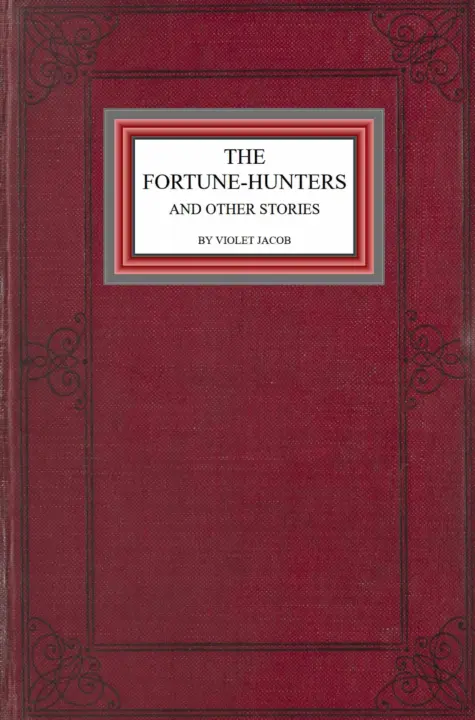
The fortune-hunters, and other stories
Violet Jacob

THE CLASSIC COLLECTION · 1904
"The Interloper" by Violet Jacob is a novel written in the early 20th century. Set against the scenic backdrop of the Scottish Lowlands, the novel begins with the return of the young protagonist, Gilbert Speid, to his ancestral home of Whanland. As he reconnects with the land and the remnants of his family, including a mysterious portrait of his mother, the narrative explores themes of legacy, identity, and the complexities of social relationships among genteel Scottish families. The opening of "The Interloper" introduces Gilbert Speid, who arrives at the decaying estate of Whanland, a place laden with his family's history. As he navigates his new role as the heir, he encounters various characters, including his family lawyer, Alexander Barclay, and his elderly relatives, the Misses Robertson, who illuminate aspects of his past through their recollections. The atmosphere is interwoven with themes of belonging and the weight of expectations, particularly as Gilbert grapples with the legacy left by his mother. Encounters with local figures, including the curious Lady Eliza Lamont, set the stage for further exploration of community dynamics and relationships that promise future intrigue.
Introduction adapted from the source catalogue; source summaries may be automatically generated.
Free to read · English · 99,403 words · No account needed
MAKE TIME FOR A GOOD BOOK
On by default. Untick to stop anonymous reading totals. Each page counts after 10 seconds in view. How this works.
Anonymous counting is on unless you have switched it off.
Robert Fullarton was standing silent by the mantelpiece looking out over the garden as Miss Hersey had done, and thinking of the same things; but whereas, with her, the remembrance was occasional, with him it was constant. He had hardly missed his Sunday visit once since the Sunday of which he thought, except when he was absent from home. It was a kind of painful comfort to him to see the objects which had surrounded her and which had never changed since that day. He came back into the present at the sound of Miss Hersey’s voice.
‘You have not brought your nephew with you,’ she said, motioning him to
a chair near her.
‘Ah, he is well occupied, ma’am,’ replied Robert, sitting down, ‘or, at least, he thinks he is. He has gone to Morphie kirk.’
‘One may be well occupied there also,’ said Miss Hersey, from the liberality of her Episcopalian point of view. ‘I did not know that he was a Presbyterian.’
‘Neither is he,’ said Fullarton, raising his eyebrows oddly, ‘but he has lately professed to admire that form of worship.’
Miss Robertson felt that there was the suspicion of something hidden in his words, and was a little uncomfortable. She did not like the idea of anything below the surface. The two women beside her, who were more accustomed to such allusions, smiled.
‘I do not understand, sir,’ said the old lady. ‘You seem to have some
other meaning.’
‘I fancy there is another meaning to his zeal, and that it is called Cecilia Raeburn,’ said Fullarton.
‘Oh, indeed!’ exclaimed one of the ladies, putting on an arch face, ‘that is an excellent reason for going to church.’
Robert saw that Miss Hersey was annoyed by her tone.
‘I dare say he profits by what he hears as much as another,’ he said. ‘One can hardly be surprised that a young fellow should like to walk some of the way home in such attractive company. There is no harm in that, is there, Miss Robertson?’
‘No, no,’ said Miss Hersey, reassured.
‘Mr. Crauford Fordyce has a fine property in Lanarkshire, I am told,’ said one of the ladies, who seldom took the trouble to conceal her train of thought.
‘His father has,’ replied Fullarton.
Gilbert had entered quietly, and, in the babble of voices, Miss Hersey had not heard him announced. Having paid his respects to her sister, he did not disturb her, seeing she was occupied; but, for the last few minutes, he had been standing behind Fullarton in the angle of a tall screen. His face was dark.
‘Ah, Gilbert,’ exclaimed the old lady; ‘I was wondering where you could
be.’
Your reading position is saved on this browser. Take it to another device with a library code. Reading pages adapt to text, rather than matching a printed edition.
Violet Jacob
Violet Jacob
Violet Jacob
Violet Jacob
BEHIND THE BOOK
This eBook is for the use of anyone anywhere in the United States and most other parts of the world at no cost and with almost no restrictions whatsoever. You may copy it, give it away or re-use it under the terms of the Project Gutenberg License included with this eBook or online at www.gutenberg.org. If you are not located in the United States, you will have to check the laws of the country where you are located before using this eBook. Read the source licence.
The original source file, including credits and licence, is retained by this library. Request an original-format copy at no charge. Please include the book title and Project Gutenberg identifier #65800.
KEEP YOUR CURIOSITY GOING
Coulson Kernahan

Maurice Baring
Frances Wright
Cécile Tormay

Frederic Jesup Stimson

W. H. P. (William Henry Pope) Jarvis