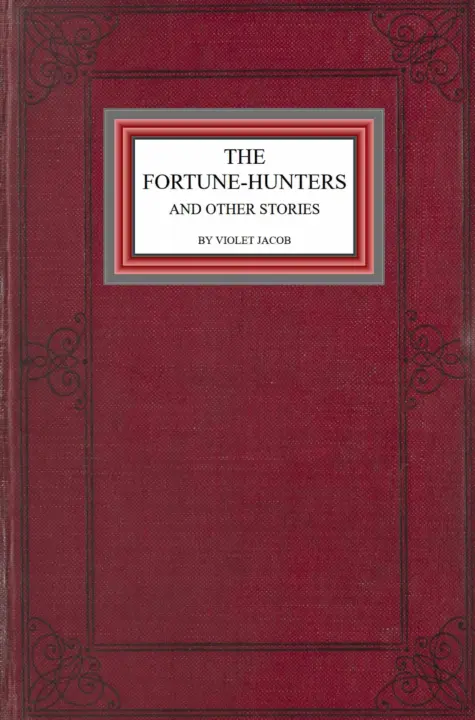
The fortune-hunters, and other stories
Violet Jacob

THE CLASSIC COLLECTION · 1904
"The Interloper" by Violet Jacob is a novel written in the early 20th century. Set against the scenic backdrop of the Scottish Lowlands, the novel begins with the return of the young protagonist, Gilbert Speid, to his ancestral home of Whanland. As he reconnects with the land and the remnants of his family, including a mysterious portrait of his mother, the narrative explores themes of legacy, identity, and the complexities of social relationships among genteel Scottish families. The opening of "The Interloper" introduces Gilbert Speid, who arrives at the decaying estate of Whanland, a place laden with his family's history. As he navigates his new role as the heir, he encounters various characters, including his family lawyer, Alexander Barclay, and his elderly relatives, the Misses Robertson, who illuminate aspects of his past through their recollections. The atmosphere is interwoven with themes of belonging and the weight of expectations, particularly as Gilbert grapples with the legacy left by his mother. Encounters with local figures, including the curious Lady Eliza Lamont, set the stage for further exploration of community dynamics and relationships that promise future intrigue.
Introduction adapted from the source catalogue; source summaries may be automatically generated.
Free to read · English · 99,403 words · No account needed
MAKE TIME FOR A GOOD BOOK
On by default. Untick to stop anonymous reading totals. Each page counts after 10 seconds in view. How this works.
Anonymous counting is on unless you have switched it off.
‘You know nothing about it. Miss Raeburn was Lady Eliza’s relation and she called her her niece. And why do you say “was”? She is not dead.’
‘I don’t know; I suppose, because we need not trouble about her any more. Do tell me what she was like, Crauford, I have so often wanted to know. Do, do, dear Crauford!’
‘If I tell you a great many things, will you promise to keep them entirely to yourself?’ he enquired, in an access of gracious elder brotherhood. He longed for a confidant.
‘Oh, yes! yes!’ cried Agneta, running her arm through his, ‘I will not
even tell Mary.’
‘I think she has seen the folly of her refusal,’ said he, gravely. ‘I saw her a few weeks ago; in fact, I renewed my offer, but she said she could not listen to me so soon after her aunt’s death. I am going back next January and I have reason to suppose, in fact, Barc---- I am almost sure she will accept me then. I trust you will receive her kindly, Agneta. I shall look to you.’
Between gratification at his words and apprehension for the future his sister was almost struck dumb.
‘What will Mama say?’ she exclaimed when she found her tongue.
‘I am afraid it does not much matter what Mama says,’ replied Crauford, with playful intrepidity.
He knew very well that he would not be at Fordyce to hear.
But there was no use in meeting troubles half-way and Agneta was dying
to know more.
‘Is she tall, brother?’
‘Rather tall,’ he replied. ‘She has a beautiful figure--very slender.’
‘As thin as Lady Maria?’
‘Good gracious, no!’ exclaimed Crauford.
‘And what is her hair like, dark or fair?’
‘Rather dark, but not black.’
‘And her eyes?’
‘Remarkable eyes--in fact, rather too extraordinary. Not quite usual.’
‘She does not squint?’ cried Agneta, seized with horror.
‘Should I wish for a wife who squinted?’ asked he, rather huffily.
‘No, no, of course not; don’t be angry, Crauford. Why do you not like
her eyes?’
‘Oh, I do like them; only I wish they were more like other people’s, wider open and bluer; you will see her for yourself, Agneta. There was another man who wanted to marry her not long ago, a sulky-looking fellow called Speid; but she soon sent him away and he has gone off to Spain.’
‘Because of her? Did he really?’ exclaimed Agneta, taking a long breath as she recognised the desperate matters life could contain.
Your reading position is saved on this browser. Take it to another device with a library code. Reading pages adapt to text, rather than matching a printed edition.
Violet Jacob
Violet Jacob
Violet Jacob
Violet Jacob
BEHIND THE BOOK
This eBook is for the use of anyone anywhere in the United States and most other parts of the world at no cost and with almost no restrictions whatsoever. You may copy it, give it away or re-use it under the terms of the Project Gutenberg License included with this eBook or online at www.gutenberg.org. If you are not located in the United States, you will have to check the laws of the country where you are located before using this eBook. Read the source licence.
The original source file, including credits and licence, is retained by this library. Request an original-format copy at no charge. Please include the book title and Project Gutenberg identifier #65800.
KEEP YOUR CURIOSITY GOING
Coulson Kernahan

Maurice Baring
Frances Wright
Cécile Tormay

Frederic Jesup Stimson

W. H. P. (William Henry Pope) Jarvis