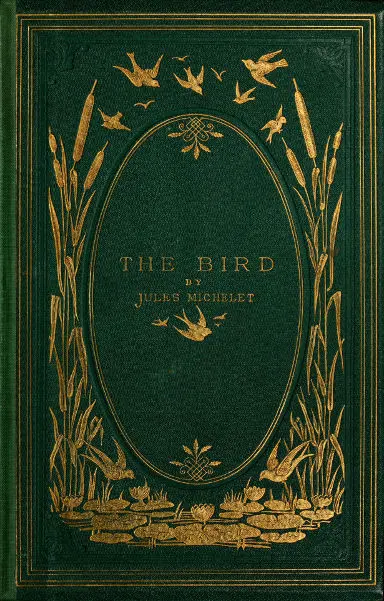
The Bird
Jules Michelet
THE CLASSIC COLLECTION · 1875
"The Insect" by Jules Michelet is a scientific publication written in the mid-19th century. The work delves into the fascinating world of insects, exploring their roles within the broader context of nature, drawing poetic connections between the insect world and human existence. It celebrates the intricate lives and interactions of these small creatures, while also reflecting upon the larger tapestry of life. At the start of the book, the author introduces the vastness and complexity of the insect world, emphasizing its profound impact on the ecosystem and the interconnectedness of all forms of life. Through vivid imagery and philosophical musings, Michelet expresses his fascination and reverence for these often-overlooked beings, suggesting that they hold both beauty and mystery. He illustrates his passionate observations, recounting personal experiences that reveal a deep empathy for the insect realm, setting the stage for an in-depth exploration of their lives in the chapters to follow.
Introduction adapted from the source catalogue; source summaries may be automatically generated.
Free to read · English · 81,169 words · No account needed
MAKE TIME FOR A GOOD BOOK
On by default. Untick to stop anonymous reading totals. Each page counts after 10 seconds in view. How this works.
Anonymous counting is on unless you have switched it off.
The first class is, in truth and reality, the people. But in this people you find two industrial divisions, two great bodies of workmen. The one executes all the more arduous tasks, such as the transportation of heavy burdens, and the far and perilous hunt after provisions,--and, at need, carry on war. The other, nearly always at home, receives the materials, superintends the domestic economy, and undertakes the principal duty of the republic,--the education of the young.
The two corporations, that of the purveyors and warriors,--that of the nurses and tutors,--are, in every tribe, of unequal size, but identical in species, colour, and organization.
Between the big warriors and the little industrials the moral equality seems perfect. If there were any difference, we should say that the class of the little ants, who build up the city and train up the people, is the more important, the life, genius, and soul of the state; the one which of itself could, at need, constitute the republic.
M. Huber has discovered two species (the red-brown and red) who do not possess this essential class, this fundamental element of the ant communities. It would not surprise us if the accessory or warrior class were wanting. But here, in reality, it is the basis which we find deficient,--the vital foundation,--the raison d'être. We are, therefore, not so much astonished at the depraved resource by which these red ants subsist, as at the monstrous lacuna which compels them to adopt it.
There is a mystery in the matter which we cannot at present explain, but which would probably be cleared up if we could arrive at a knowledge of the general history of the species, its changes, and migrations. Who does not know the modification effected in animals, both externally and internally, in their forms and their manners, by the displacements they undergo? Who, for example, would recognize the brother of our bull-dog--of the St. Bernard--of the giant dog of Persia, which could strangle lions--in that abortion, the Havannah dog, so weak and frail, that even in a torrid climate Nature has clothed it with a thick fleece, which conceals it, and converts it into an enigma?
The animal, when transplanted, may become a monster.
The ants also may have had their revolutions, their moral and physical changes, in proportion, as the globe, everywhere becoming inhabitable, has favoured their migrations. Several species, in the beautiful American climates, have preserved the honey-making industry; our own are ignorant of it, and are compelled to have recourse to the grubs; thence arises an art and a progress,--the art of breeding, preserving, and pasturing cattle.
Your reading position is saved on this browser. Take it to another device with a library code. Reading pages adapt to text, rather than matching a printed edition.
Jules Michelet
Jules Michelet
Jules Michelet
BEHIND THE BOOK
This eBook is for the use of anyone anywhere in the United States and most other parts of the world at no cost and with almost no restrictions whatsoever. You may copy it, give it away or re-use it under the terms of the Project Gutenberg License included with this eBook or online at www.gutenberg.org. If you are not located in the United States, you will have to check the laws of the country where you are located before using this eBook. Read the source licence.
The original source file, including credits and licence, is retained by this library. Request an original-format copy at no charge. Please include the book title and Project Gutenberg identifier #44287.
KEEP YOUR CURIOSITY GOING

John Muir

Asa Gray
Asa Gray

Florence Nightingale
Elizabeth Robins Pennell
Denison Olmsted