THE CLASSIC COLLECTION✦The school and societyCLASSIC FREE BOOKS
The school and society
John Dewey
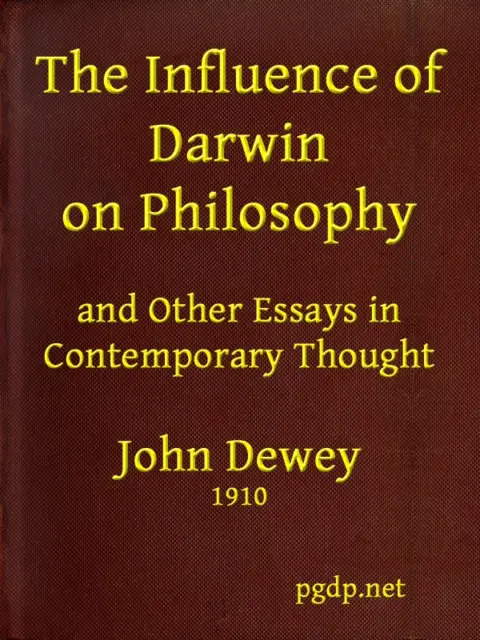
THE CLASSIC COLLECTION · 1910
"The Influence of Darwin on Philosophy, and Other Essays in Contemporary Thought" by John Dewey is a collection of philosophical essays written in the early 20th century. This work explores the impact of Darwinian ideas on contemporary philosophy and intellectual thought, exposing the shifts in perspectives regarding knowledge, morality, and the essential characteristics of human experience. Dewey's essays aim to illustrate how these evolutionary concepts challenge traditional notions of fixed truths and stable moral values. At the start of the collection, Dewey presents a preface discussing the transformative influence of Darwin's "Origin of Species" on philosophy and the sciences. He emphasizes that Darwin's work initiated a vigorous intellectual revolt against long-held beliefs in fixed forms and absolute truths, inviting a new mode of thinking that acknowledges change and evolution as inherent to knowledge and moral considerations. This opening portion lays the groundwork for understanding the interconnectedness of various philosophical movements and highlights the necessity for philosophy to adapt in light of modern scientific inquiries.
Introduction adapted from the source catalogue; source summaries may be automatically generated.
Free to read · English · 69,721 words · No account needed
MAKE TIME FOR A GOOD BOOK
On by default. Untick to stop anonymous reading totals. Each page counts after 10 seconds in view. How this works.
Anonymous counting is on unless you have switched it off.
Putting the matter in terms that are independent of history, experiences of failure, disappointment, non-fulfilment of the function of meaning and contention may lead the individual to the path of science--to more careful and extensive investigation of the things themselves, with a view to detecting specific sources of error, and guarding against them, and regulating, so far as possible, the conditions under which objects are bearers of meanings beyond themselves. But impatient of such slow and tentative methods (which insure not infallibility but increased probability of valid conclusions), by reason of disappointment a person may turn epistemologist. He may then take the discrepancy, the failure of the smell to execute its own intended meaning, as a wholesale, rather than as a specific fact: as evidence of a contrast in general between things meaning and things meant, instead of as evidence of the need of a more cautious and thorough inspection of odors and execution of operations indicated by them. One may then say: Woe is me; smells are only my smells, subjective states existing in an order of being made out of consciousness, while roses exist in another order made out of a radically different sort of stuff; or, odors are made out of “finite” consciousness as their stuff, while the real things, the objects which fulfil them, are made out of an “infinite” consciousness as their material. Hence some purely metaphysical tie has to be called in to bring them into connection with each other. And yet this tie does not concern knowledge; it does not make the meaning of one odor any more correct than that of another, nor enable us to discriminate relative degrees of correctness. As a principle of control, this transcendental connection is related to all alike, and hence condemns and justifies all alike.[16]
It is interesting to note that the transcendentalist almost invariably first falls into the psychological fallacy; and then having himself taken the psychologist’s attitude (the attitude which is interested in meanings as themselves self-inclosed “ideas”) accuses the empiricist whom he criticises of having confused mere psychological existence with logical validity. That is, he begins by supposing that the smell of our illustration (and all the cognitional objects for which this is used as a symbol) is a purely mental or psychical state, so that the question of logical reference or intention is the problem of how the merely mental can “know” the extra-mental. But from a strictly empirical point of view, the smell which knows is no more merely mental than is the rose known. We may, if we please, say that the smell when involving conscious meaning or intention is “mental,” but this term “mental” does not denote some separate type of existence--existence as a state of consciousness. It denotes only the fact that the smell, a real and non-psychical object, now exercises an intellectual function. This new property involves, as James has pointed out, an additive relation--a new property possessed by a non-mental object, when that object, occurring in a new context, assumes a further office and use.[17] To be “in the mind” means to be in a situation in which the function of intending is directly concerned.[18] Will not some one who believes that the knowing experience is ab origine a strictly “mental” thing, explain how, as matter of fact, it does get a specific, extra-mental reference, capable of being tested, confirmed, or refuted? Or, if he believes that viewing it as merely mental expresses only the form it takes for psychological analysis, will he not explain why he so persistently attributes the inherently “mental” characterization of it to the empiricist whom he criticises? An object becomes meaning when used empirically in a certain way; and, under certain circumstances, the exact character and worth of this meaning becomes an object of solicitude. But the transcendental epistemologist with his purely psychical “meanings” and his purely extra-empirical “truths” assumes a Deus ex Machina whose mechanism is preserved a secret. And as if to add to the arbitrary character of his assumption, he has to admit that the transcendental a priori faculty by which mental states get objective reference does not in the least help us to discriminate, in the concrete, between an objective reference that is false and one that is valid.
Your reading position is saved on this browser. Take it to another device with a library code. Reading pages adapt to text, rather than matching a printed edition.
John Dewey
John Dewey
John Dewey
John Dewey
BEHIND THE BOOK
This eBook is for the use of anyone anywhere in the United States and most other parts of the world at no cost and with almost no restrictions whatsoever. You may copy it, give it away or re-use it under the terms of the Project Gutenberg License included with this eBook or online at www.gutenberg.org. If you are not located in the United States, you will have to check the laws of the country where you are located before using this eBook. Read the source licence.
The original source file, including credits and licence, is retained by this library. Request an original-format copy at no charge. Please include the book title and Project Gutenberg identifier #51525.
KEEP YOUR CURIOSITY GOING

David Patterson (Spirit) Hatch

David Patterson (Spirit) Hatch

David Patterson (Spirit) Hatch
Coulson Kernahan

Ralph Waldo Emerson

Maurice Baring