THE CLASSIC COLLECTION✦The school and societyCLASSIC FREE BOOKS
The school and society
John Dewey
THE CLASSIC COLLECTION · 1910
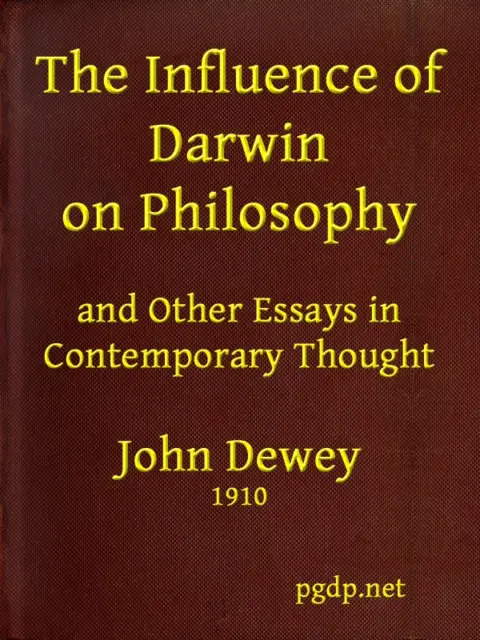
"The Influence of Darwin on Philosophy, and Other Essays in Contemporary Thought" by John Dewey is a collection of philosophical essays written in the early 20th century. This work explores the impact of Darwinian ideas on contemporary philosophy and intellectual thought, exposing the shifts in perspectives regarding knowledge, morality, and the essential characteristics of human experience. Dewey's essays aim to illustrate how these evolutionary concepts challenge traditional notions of fixed truths and stable moral values. At the start of the collection, Dewey presents a preface discussing the transformative influence of Darwin's "Origin of Species" on philosophy and the sciences. He emphasizes that Darwin's work initiated a vigorous intellectual revolt against long-held beliefs in fixed forms and absolute truths, inviting a new mode of thinking that acknowledges change and evolution as inherent to knowledge and moral considerations. This opening portion lays the groundwork for understanding the interconnectedness of various philosophical movements and highlights the necessity for philosophy to adapt in light of modern scientific inquiries.
Introduction adapted from the source catalogue; source summaries may be automatically generated.
Free to read · English · 69,721 words · No account needed
MAKE TIME FOR A GOOD BOOK
On by default. Untick to stop anonymous reading totals. Each page counts after 10 seconds in view. How this works.
Anonymous counting is on unless you have switched it off.
Social ethics in inclusive sense is the correlative science. Dealing not with the form or mode or machinery of action, it attempts rather to make out its filling and make up the values that are necessary to constitute an experience which is worth while. The sociologist, like the psychologist, often presents himself as a camp follower of genuine science and philosophy, picking up scraps here and there and piecing them together in somewhat of an aimless fashion--fortunate indeed, if not vague and over-ambitious. Yet social ethics represents the attempt to translate philosophy from a general and therefore abstract method into a working and specific method; it is the change from inquiring into the nature of value in general to inquiring as to the particular values that ought to be realized in the life of every one, and as to the conditions which render possible this realization.
There are those who will see in this conception of the outcome of a four-hundred-year discussion concerning the nature and possibility of knowledge a derogation from the high estate of philosophy. There are others who will see in it a sign that philosophy, after wandering aimlessly hither and yon in a wilderness without purpose or outcome, has finally come to its senses--has given up metaphysical absurdities and unverifiable speculations, and become a purely positive science of phenomena. But there are yet others who will see in this movement the fulfilment of its vocation, the clear consciousness of a function that it has always striven to perform; and who will welcome it as a justification of the long centuries when it appeared to sit apart, far from the common concerns of man, busied with discourse of essence and cause, absorbed in argument concerning subject and object, reason and sensation. To such this outcome will appear the inevitable sequel of the saying of Socrates that “an unexamined life is not one fit to be led by man”; and a better response to his injunction “Know thyself.”
Absolutism, 18, 25, 98, 102, 109-110, 121-123, 130-132;
Essay IV., 142-153, 176, 180-181
Acquaintance, and knowledge, 79-82
Action, and problem of knowledge, Essay XI., 271-304
A priori, 206-213, 292-294
Appearance, and reality, 26-28, 118-121
Aristotle, referred to, 5, 32, 35, 37, 48, 50, 78, 221, 278
Assurance, 85-88
Awareness, 93
Behavior, and intelligence, 44
Belief, Essay VI., 169-197
Bosanquet, B., 281
Bradley, F. H., Essay IV., 112-153
Change, its supposed unreality, 1;
in modern science, 8-9;
and law, 72;
and thought, 133;
of truth, 153;
of experience, 222-224, 259-260;
Christianity, metaphysic of, 178
Cognitive, 84-85, 230-233
Conflict, and thinking, 116-117, 126-127, 132, 148-149
Consistency, as criterion, 128-136
Consciousness, as end of nature, 34-35;
is partial, 43;
and knowledge, 79-80, 102, 171;
Essay X., 242-270;
non-existence of, 247-248
Correspondence, 158
Cosmology, and morals, 54
Custom, as background of morals, 48, 52
Your reading position is saved on this browser. Take it to another device with a library code. Reading pages adapt to text, rather than matching a printed edition.
John Dewey
John Dewey
John Dewey
John Dewey
BEHIND THE BOOK
This eBook is for the use of anyone anywhere in the United States and most other parts of the world at no cost and with almost no restrictions whatsoever. You may copy it, give it away or re-use it under the terms of the Project Gutenberg License included with this eBook or online at www.gutenberg.org. If you are not located in the United States, you will have to check the laws of the country where you are located before using this eBook. Read the source licence.
The original source file, including credits and licence, is retained by this library. Request an original-format copy at no charge. Please include the book title and Project Gutenberg identifier #51525.
KEEP YOUR CURIOSITY GOING

David Patterson (Spirit) Hatch

David Patterson (Spirit) Hatch

David Patterson (Spirit) Hatch
Coulson Kernahan

Ralph Waldo Emerson

Maurice Baring