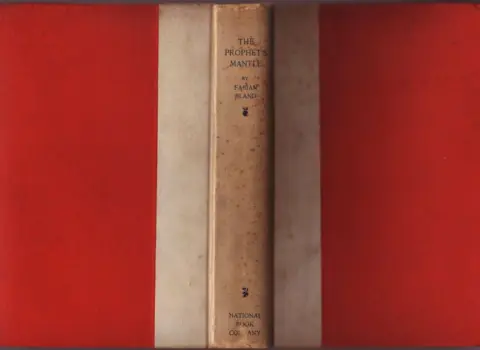
The Prophet’s Mantle
E. (Edith) Nesbit & Hubert Bland
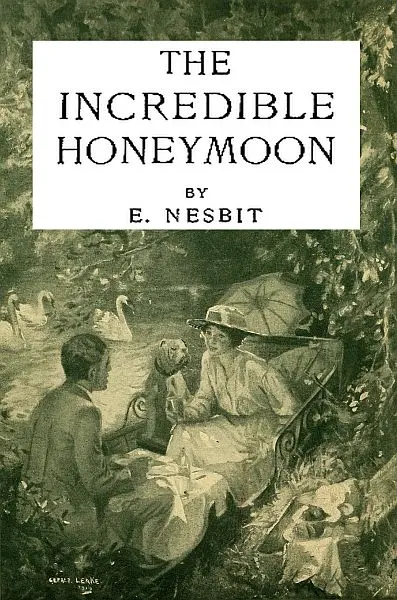
THE CLASSIC COLLECTION · 1916
"The Incredible Honeymoon" by E. Nesbit is a novel written in the early 20th century. The story centers around Edward Basingstoke, a young man with dreams of adventure who, through a series of unexpected events, finds himself on a path leading to romance. The book explores the themes of love, chance, and the allure of adventure against the backdrop of Edward's mundane life as an engineer. At the start of the novel, the narrative introduces the protagonist, Edward Basingstoke, who longs for a life filled with excitement beyond his dreary job. After receiving an inheritance from his late uncle, he abruptly leaves his engineering position to seek adventure, meeting a friend who encourages him to embrace his dreams. In a twist of fate, Edward encounters a girl in a park, which sets off a chain of romantic misadventures that may lead to a more thrilling and fulfilling life than he ever imagined. The opening chapters illustrate Edward’s whimsical character and foreshadow the entangled scenarios of fate and romance that will unfold throughout the story.
Introduction adapted from the source catalogue; source summaries may be automatically generated.
Free to read · English · 67,605 words · No account needed
MAKE TIME FOR A GOOD BOOK
On by default. Untick to stop anonymous reading totals. Each page counts after 10 seconds in view. How this works.
Anonymous counting is on unless you have switched it off.
"Do you think he knows?" the widow asked.
"Of course he knows. He knows everything's going to be all right, only he hates to see you miserable. He knows it's only a little time, really, before you and he will be together again, and happy for ever and ever."
"I wish I could believe that."
"You must, because it's true. I expect he's been praying for you, and that's why you met us--because, you know, I'm certain my"--she hesitated, but the word came instead of "brother," which was what she thought she meant to say--"my husband will think of something for you to do to earn your living; he's so clever. And I suppose the business--"
Yes. The business had gone to pieces. Fashions change so, and the widow had not known how to follow the fashions in needlework. There was only enough left to pay the creditors, but every one had been paid, and with the pound or two left over she had lived, trying to get needle work, or even, at last, charring or washing. But it had all been no good; nothing had been any good.
"And now," said Katherine, "everything's going to be good. You'll see. Edward will think of something. Don't cry any more. You must not cry. I can't bear it, dear. Don't."
"I'm only crying for joy," said the woman whose life was over. "Even if he doesn't think of anything, I can't ever despair again, and you being like you have to me."
But when Edward came back he had thought of something. His old nurse, it seemed, was in temporary charge of a house that wanted a housekeeper, and he was sure Mrs. Burbidge understood housekeeping.
Mrs. Burbidge owned to an understanding of plain cooking and plain housekeeping. Also needlework, both the plain and the fine. "But not where butlers are kept," she said, apprehensively.
"This is a farm-house," said Edward. "Not a butler within miles."
"My father was a farmer, in Somerset," said Mrs. Burbidge, "but, oh, sir, you don't know anything about me. Suppose I was a fraud like you read of in the newspapers. But the vicar at home would speak for me."
"Your face speaks for you," said Katherine, and within half an hour all was settled--the old nurse telegraphed to, money found for such modest outfit as even a farmer's housekeeper must have, the train fixed that should take the widow to London, the little hotel named where she should spend a night, and the train decided on that should take her in the morning to the farm-house that needed a housekeeper.
"It's no use me saying anything," said Mrs. Burbidge, at parting,
"but--"
Your reading position is saved on this browser. Take it to another device with a library code. Reading pages adapt to text, rather than matching a printed edition.
E. (Edith) Nesbit & Hubert Bland
E. (Edith) Nesbit
E. (Edith) Nesbit
E. (Edith) Nesbit
BEHIND THE BOOK
This eBook is for the use of anyone anywhere in the United States and most other parts of the world at no cost and with almost no restrictions whatsoever. You may copy it, give it away or re-use it under the terms of the Project Gutenberg License included with this eBook or online at www.gutenberg.org. If you are not located in the United States, you will have to check the laws of the country where you are located before using this eBook. Read the source licence.
The original source file, including credits and licence, is retained by this library. Request an original-format copy at no charge. Please include the book title and Project Gutenberg identifier #41354.
KEEP YOUR CURIOSITY GOING
Wilfrid Scawen Blunt
Wilfrid Scawen Blunt

E. W. (Edgar Watson) Howe
Coulson Kernahan

Maurice Baring
Frances Wright