READ · DISCOVER · ENJOYClassic literature · Always free
The Iliad of Homer Translated into English Blank Verse by William Cowper — digital edition cover

THE CLASSIC COLLECTION · 1860

The Iliad of Homer Translated into English Blank Verse by William Cowper

"The Iliad of Homer" by Homer is an ancient Greek epic poem composed around the late 8th or early 7th century BC. Set during the final weeks of the decade-long Trojan War, it traces the devastating anger of Achilles, the greatest Greek warrior, sparked by a fierce quarrel with King Agamemnon. As pride and wrath drive the conflict, the poem moves between sweeping battlefield scenes and intimate human moments, while the Olympian gods themselves intervene in mortal affairs, shaping the fates of heroes and determining the destiny of Troy.

Introduction adapted from the source catalogue; source summaries may be automatically generated.

Start reading ↓

Free to read · English · 175,336 words · No account needed

MAKE TIME FOR A GOOD BOOK

The Iliad of Homer Translated into English Blank Verse by William Cowper

On by default. Untick to stop anonymous reading totals. Each page counts after 10 seconds in view. How this works.

Anonymous counting is on unless you have switched it off.

The Iliad of Homer Translated into English Blank Verse by William Cowper

Back to the fleet, Tydides! Can’st not see
That Jove ordains not, now, the victory thine?
The son of Saturn glorifies to-day
This Trojan, and, if such his will, can make
The morrow ours; but vain it is to thwart165
The mind of Jove, for he is Lord of all.
To him the valiant Diomede replied.
Thou hast well said, old warrior! but the pang
That wrings my soul, is this. The public ear
In Ilium shall from Hector’s lips be told—170
I drove Tydides—fearing me he fled.
So shall he vaunt, and may the earth her jaws
That moment opening swallow me alive!
Him answer’d the Gerenian warrior old.
What saith the son of Tydeus, glorious Chief?175
Should Hector so traduce thee as to call
Thee base and timid, neither Trojan him
Nor Dardan would believe, nor yet the wives
Of numerous shielded warriors brave of Troy,
Widow’d by thy unconquerable arm.180
So saying, he through the fugitives his steeds
Turn’d swift to flight. Then Hector and his host
With clamor infinite their darts wo-wing’d
Shower’d after them, and Hector, mighty Chief
Majestic, from afar, thus call’d aloud.185
Tydides! thee the Danaï swift-horsed
Were wont to grace with a superior seat,
The mess of honor, and the brimming cup,
But now will mock thee. Thou art woman now.
Go, timorous girl! Thou never shalt behold190
Me flying, climb our battlements, or lead
Our women captive. I will slay thee first.
He ceased. Then Diomede in dread suspense
Thrice purposed, turning, to withstand the foe,
And thrice in thunder from the mountain-top195
Jove gave the signal of success to Troy.
When Hector thus the Trojans hail’d aloud.
Trojans and Lycians, and close-warring sons
Of Dardanus, oh summon all your might,
Now, now be men! I know that from his heart200
Saturnian Jove glory and bright success
For me prepares, but havoc for the Greeks.
Fools! they shall find this wall which they have raised
Too weak to check my course, a feeble guard
Contemptible; such also is the trench;205
My steeds shall slight it with an easy leap.
But when ye see me in their fleet arrived,
Remember fire. Then bring me flaming brands
That I may burn their galleys and themselves
Slaughter beside them, struggling in the smoke.[8]210
He spake, and thus encouraged next his steeds.
Xanthus! Podargus! and ye generous pair
Æthon and glossy Lampus! now requite
Mine, and the bounty of Andromache,
Far-famed Eëtion’s daughter; she your bowl215
With corn fresh-flavor’d and with wine full oft
Hath mingled, your refreshment seeking first
Ere mine, who have a youthful husband’s claim.[9]
Now follow! now be swift; that we may seize
The shield of Nestor, bruited to the skies220
As golden all, trappings and disk alike.
Now from the shoulders of the equestrian Chief
Tydides tear we off his splendid mail,
The work of Vulcan.[10] May we take but these,
I have good hope that, ere this night be spent,225
The Greeks shall climb their galleys and away.
So vaunted he, but Juno with disdain
His proud boast heard, and shuddering in her throne,
Rock’d the Olympian; turning then toward
The Ocean’s mighty sovereign, thus she spake.230
Alas! earth-shaking sovereign of the waves,
Feel’st thou no pity of the perishing Greeks?
Yet Greece, in Helice, with gifts nor few
Nor sordid, and in Ægæ, honors thee,
Whom therefore thou shouldst prosper. Would we all235
Who favor Greece associate to repulse
The Trojans, and to check loud-thundering Jove,
On Ida seated he might lour alone.
To whom the Sovereign, Shaker of the Shores,
Indignant. Juno! rash in speech! what word240
Hath ’scaped thy lips? never, with my consent,
Shall we, the powers subordinate, in arms
With Jove contend. He far excels us all.
So they. Meantime, the trench and wall between,[11]
The narrow interval with steeds was fill’d245
Close throng’d and shielded warriors. There immew’d
By Priameian Hector, fierce as Mars,
They stood, for Hector had the help of Jove.
And now with blazing fire their gallant barks
He had consumed, but Juno moved the mind250
Of Agamemnon, vigilant himself,
To exhortation of Achaia’s host.
Through camp and fleet the monarch took his way,
And, his wide robe imperial in his hand,
High on Ulysses’ huge black galley stood,255
The central ship conspicuous; thence his voice
Might reach the most remote of all the line
At each extreme, where Ajax had his tent
Pitch’d, and Achilles, fearless of surprise.
Thence, with loud voice, the Grecians thus he hail’d.260
Oh shame to Greece! Warriors in show alone!
Where is your boasted prowess? Ye profess’d
Vain-glorious erst in Lemnos, while ye fed
Plenteously on the flesh of beeves full-grown,
And crown’d your beakers high, that ye would face265
Each man a hundred Trojans in the field—
Ay, twice a hundred—yet are all too few
To face one Hector now; nor doubt I aught
But he shall soon fire the whole fleet of Greece.
Jove! Father! what great sovereign ever felt270
Thy frowns as I? Whom hast thou shamed as me?
Yet I neglected not, through all the course
Of our disasterous voyage (in the hope
That we should vanquish Troy) thy sacred rites,
But where I found thine altar, piled it high275
With fat and flesh of bulls, on every shore.
But oh, vouchsafe to us, that we at least
Ourselves, deliver’d, may escape the sword,
Nor let their foes thus tread the Grecians down!
He said. The eternal father pitying saw280
His tears, and for the monarch’s sake preserved
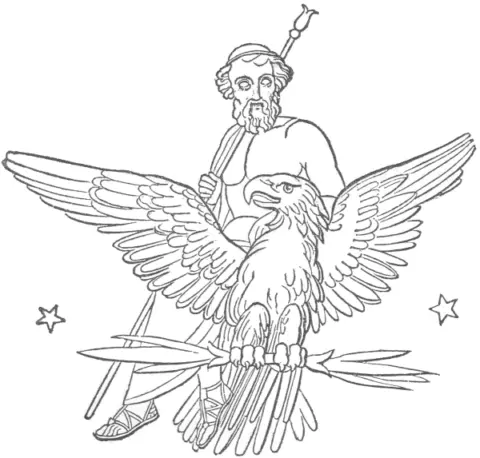
The people. Instant, surest of all signs,
He sent his eagle; in his pounces strong
A fawn he bore, fruit of the nimble hind,
Which fast beside the beauteous altar raised285
To Panomphæan[12] Jove sudden he dropp’d.[13]
They, conscious, soon, that sent from Jove he came,
More ardent sprang to fight. Then none of all
Those numerous Chiefs could boast that he outstripp’d
Tydides, urging forth beyond the foss290
His rapid steeds, and rushing to the war.
He, foremost far, a Trojan slew, the son
Of Phradmon, Ageläus; as he turn’d
His steeds to flight, him turning with his spear
Through back and bosom Diomede transpierced.295
And with loud clangor of his arms he fell.
Then, royal Agamemnon pass’d the trench
And Menelaus; either Ajax, then,
Clad with fresh prowess both; them follow’d, next,
Idomeneus, with his heroic friend300
In battle dread as homicidal Mars,
Meriones; Evæmon’s son renown’d
Succeeded, bold Eurypylus; and ninth
Teucer, wide-straining his impatient bow.
He under covert fought of the broad shield305
Of Telamonian Ajax; Ajax high
Upraised his shield; the hero from beneath
Took aim, and whom his arrow struck, he fell;
Then close as to his mother’s side a child
For safety creeps, Teucer to Ajax’ side310
Retired, and Ajax shielded him again.
Whom then slew Teucer first, illustrious Chief?
Orsilochus, and Ophelestes, first,
And Ormenus he slew, then Dætor died,
Chromius and Lycophontes brave in fight315
With Amopaon Polyæmon’s son,
And Melanippus. These, together heap’d,
All fell by Teucer on the plain of Troy.
The Trojan ranks thinn’d by his mighty bow
The King of armies Agamemnon saw320
Well-pleased, and him approaching, thus began.
Brave Telamonian Teucer, oh, my friend,
Thus shoot, that light may visit once again
The Danaï, and Telamon rejoice!
Thee Telamon within his own abode325
Rear’d although spurious; mount him, in return,
Although remote, on glory’s heights again.
I tell thee, and the effect shall follow sure,
Let but the Thunderer and Minerva grant
The pillage of fair Ilium to the Greeks,330
And I will give to thy victorious hand,
After my own, the noblest recompense,
A tripod or a chariot with its steeds,
Or some fair captive to partake thy bed.
To whom the generous Teucer thus replied.335
Atrides! glorious monarch! wherefore me
Exhortest thou to battle? who myself
Glow with sufficient ardor, and such strength
As heaven affords me spare not to employ.
Since first we drove them back, with watchful eye340
Their warriors I have mark’d; eight shafts my bow
Hath sent long-barb’d, and every shaft, well-aim’d.
The body of some Trojan youth robust
Hath pierced, but still you ravening wolf escapes.
He said, and from the nerve another shaft345
Impatient sent at Hector; but it flew
Devious, and brave Gorgythion struck instead.
Him beautiful Castianira, brought
By Priam from Æsyma, nymph of form
Celestial, to the King of Ilium bore.350
As in the garden, with the weight surcharged
Of its own fruit, and drench’d by vernal rains
The poppy falls oblique, so he his head
Hung languid, by his helmet’s weight depress’d.[14]
Then Teucer yet an arrow from the nerve355
Dispatch’d at Hector, with impatience fired
To pierce him; but again his weapon err’d
Turn’d by Apollo, and the bosom struck
Of Archeptolemus, his rapid steeds
To battle urging, Hector’s charioteer.360
He fell, his fiery coursers at the sound
Recoil’d, and lifeless where he fell he lay.
Deep sorrow for his charioteer the mind
O’erwhelm’d of Hector, yet he left the slain,
And seeing his own brother nigh at hand,365
Cebriones, him summon’d to the reins,
Who with alacrity that charge received.
Then Hector, leaping with a dreadful shout
From his resplendent chariot, grasp’d a stone,
And rush’d on Teucer, vengeance in his heart.370
Teucer had newly fitted to the nerve
An arrow keen selected from the rest,
And warlike Hector, while he stood the cord
Retracting, smote him with that rugged rock
Just where the key-bone interposed divides375
The neck and bosom, a most mortal part.
It snapp’d the bow-string, and with numbing force
Struck dead his hand; low on his knees he dropp’d,
And from his opening grasp let fall the bow.
Then not unmindful of a brother fallen380
Was Ajax, but, advancing rapid, stalk’d
Around him, and his broad shield interposed,
Till brave Alaster and Mecisteus, son
Of Echius, friends of Teucer, from the earth
Upraised and bore him groaning to the fleet.385
And now again fresh force Olympian Jove
Gave to the Trojans; right toward the foss
They drove the Greeks, while Hector in the van
Advanced, death menacing in every look.
As some fleet hound close-threatening flank or haunch390
Of boar or lion, oft as he his head
Turns flying, marks him with a steadfast eye,
So Hector chased the Grecians, slaying still
The hindmost of the scatter’d multitude.
But when, at length, both piles and hollow foss395
They had surmounted, and no few had fallen
By Trojan hands, within their fleet they stood
Imprison’d, calling each to each, and prayer
With lifted hands, loud offering to the Gods.
With Gorgon looks, meantime, and eyes of Mars,400
Hector impetuous his mane-tossing steeds
From side to side before the rampart drove,
When white-arm’d Juno pitying the Greeks,
In accents wing’d her speech to Pallas turn’d.
Alas, Jove’s daughter! shall not we at least405
In this extremity of their distress
Care for the Grecians by the fatal force
Of this one Chief destroy’d? I can endure
The rage of Priameïan Hector now
No longer; such dire mischiefs he hath wrought.410
Whom answer’d thus Pallas, cærulean-eyed.
—And Hector had himself long since his life
Resign’d and rage together, by the Greeks
Slain under Ilium’s walls, but Jove, my sire,
Mad counsels executing and perverse,415
Me counterworks in all that I attempt,
Nor aught remembers how I saved ofttimes
His son enjoin’d full many a task severe
By King Eurystheus; to the Gods he wept,
And me Jove sent in haste to his relief.420
But had I then foreseen what now I know,
When through the adamantine gates he pass’d
To bind the dog of hell, by the deep floods
Hemm’d in of Styx, he had return’d no more.
But Thetis wins him now; her will prevails,425
And mine he hates; for she hath kiss’d his knees
And grasp’d his beard, and him in prayer implored
That he would honor her heroic son
Achilles, city-waster prince renown’d.
’Tis well—the day shall come when Jove again430
Shall call me darling, and his blue-eyed maid
As heretofore;—but thou thy steeds prepare,
While I, my father’s mansion entering, arm
For battle. I would learn by trial sure,
If Hector, Priam’s offspring famed in fight435
(Ourselves appearing in the walks of war)
Will greet us gladly. Doubtless at the fleet
Some Trojan also, shall to dogs resign
His flesh for food, and to the fowls of heaven.

Your reading position is saved on this browser. Take it to another device with a library code. Reading pages adapt to text, rather than matching a printed edition.

More from this author

BEHIND THE WORDS

About Homer

Homer (-750–-650). Explore The story of the Iliad, Odysseus, the Hero of Ithaca Adapted from the Third Book of the Primary Schools of Athens, Greece, The Iliad of Homer Translated into English Blank Verse by William Cowper in this collection. These books span children’s books, fantasy & fairy tales, adventure.

Explore this author’s books →

THE READERS’ VERDICT

How did this story stay with you?

Not rated yet
Your rating for The Iliad of Homer Translated into English Blank Verse by William Cowper

Be the first to share your verdict.

One rating per browser, which you can change or remove. A necessary browser identifier remembers your vote. How ratings work

A GOOD STORY DESERVES COMPANY

Pass this book along.

A great read is even better when it’s shared.

SEND A LITTLE INSPIRATION

Share this book

BEHIND THE BOOK

Edition & source details.

Title
The Iliad of Homer Translated into English Blank Verse by William Cowper
Author
Homer
Source edition imprint
1860
Digital edition publisher
Project Gutenberg
Gutenberg release date
2005-08-05
Language
English
Source edition imprint
New York, D. Appleton & Co., 346 & 348 Broadway, 1860
Source identifier
Project Gutenberg #16452
Contributors
M. A. (Mary Ann) Dwight (ann); Robert Southey (edt); William Cowper (trl)

Public-domain source & licence

This eBook is for the use of anyone anywhere in the United States and most other parts of the world at no cost and with almost no restrictions whatsoever. You may copy it, give it away or re-use it under the terms of the Project Gutenberg License included with this eBook or online at www.gutenberg.org. If you are not located in the United States, you will have to check the laws of the country where you are located before using this eBook. Read the source licence.

Full source licence and obtaining an original copy

The original source file, including credits and licence, is retained by this library. Request an original-format copy at no charge. Please include the book title and Project Gutenberg identifier #16452.

the full Project Gutenberg License must appear
prominently whenever any copy of a Project Gutenberg work (any work
on which the phrase “Project Gutenberg” appears, or with which the
phrase “Project Gutenberg” is associated) is accessed, displayed,
performed, viewed, copied or distributed:

This eBook is for the use of anyone anywhere in the United States and most
other parts of the world at no cost and with almost no restrictions
whatsoever. You may copy it, give it away or re-use it under the terms
of the Project Gutenberg™ License included with this eBook or online
at www.gutenberg.org. If you
are not located in the United States, you will have to check the laws
of the country where you are located before using this eBook.

1.E.2. If an individual Project Gutenberg electronic work is
derived from texts not protected by U.S. copyright law (does not
contain a notice indicating that it is posted with permission of the
copyright holder), the work can be copied and distributed to anyone in
the United States without paying any fees or charges. If you are
redistributing or providing access to a work with the phrase “Project
Gutenberg” associated with or appearing on the work, you must comply
either with the requirements of paragraphs 1.E.1 through 1.E.7 or
obtain permission for the use of the work and the Project Gutenberg
trademark as set forth in paragraphs 1.E.8 or 1.E.9.

1.E.3. If an individual Project Gutenberg electronic work is posted
with the permission of the copyright holder, your use and distribution
must comply with both paragraphs 1.E.1 through 1.E.7 and any
additional terms imposed by the copyright holder. Additional terms
will be linked to the Project Gutenberg License for all works
posted with the permission of the copyright holder found at the
beginning of this work.

1.E.4. Do not unlink or detach or remove the full Project Gutenberg
License terms from this work, or any files containing a part of this
work or any other work associated with Project Gutenberg.

1.E.5. Do not copy, display, perform, distribute or redistribute this
electronic work, or any part of this electronic work, without
prominently displaying the sentence set forth in paragraph 1.E.1 with
active links or immediate access to the full terms of the Project
Gutenberg License.

1.E.6. You may convert to and distribute this work in any binary,
compressed, marked up, nonproprietary or proprietary form, including
any word processing or hypertext form. However, if you provide access
to or distribute copies of a Project Gutenberg work in a format
other than “Plain Vanilla ASCII” or other format used in the official
version posted on the official Project Gutenberg website
(www.gutenberg.org), you must, at no additional cost, fee or expense
to the user, provide a copy, a means of exporting a copy, or a means
of obtaining a copy upon request, of the work in its original “Plain
Vanilla ASCII” or other form. Any alternate format must include the
full Project Gutenberg License as specified in paragraph 1.E.1.

1.E.7. Do not charge a fee for access to, viewing, displaying,
performing, copying or distributing any Project Gutenberg works
unless you comply with paragraph 1.E.8 or 1.E.9.

1.E.8. You may charge a reasonable fee for copies of or providing
access to or distributing Project Gutenberg electronic works
provided that:

• You pay a royalty fee of 20% of the gross profits you derive from
the use of Project Gutenberg works calculated using the method
you already use to calculate your applicable taxes. The fee is owed
to the owner of the Project Gutenberg trademark, but he has
agreed to donate royalties under this paragraph to the Project
Gutenberg Literary Archive Foundation. Royalty payments must be paid
within 60 days following each date on which you prepare (or are
legally required to prepare) your periodic tax returns. Royalty
payments should be clearly marked as such and sent to the Project
Gutenberg Literary Archive Foundation at the address specified in
Section 4, “Information about donations to the Project Gutenberg
Literary Archive Foundation.”

• You provide a full refund of any money paid by a user who notifies
you in writing (or by e-mail) within 30 days of receipt that s/he
does not agree to the terms of the full Project Gutenberg™
License. You must require such a user to return or destroy all
copies of the works possessed in a physical medium and discontinue
all use of and all access to other copies of Project Gutenberg™
works.

• You provide, in accordance with paragraph 1.F.3, a full refund of
any money paid for a work or a replacement copy, if a defect in the
electronic work is discovered and reported to you within 90 days of
receipt of the work.

• You comply with all other terms of this agreement for free
distribution of Project Gutenberg™ works.


1.E.9. If you wish to charge a fee or distribute a Project
Gutenberg™ electronic work or group of works on different terms than
are set forth in this agreement, you must obtain permission in writing
from the Project Gutenberg Literary Archive Foundation, the manager of
the Project Gutenberg™ trademark. Contact the Foundation as set
forth in Section 3 below.

1.F.

1.F.1. Project Gutenberg volunteers and employees expend considerable
effort to identify, do copyright research on, transcribe and proofread
works not protected by U.S. copyright law in creating the Project
Gutenberg™ collection. Despite these efforts, Project Gutenberg™
electronic works, and the medium on which they may be stored, may
contain “Defects,” such as, but not limited to, incomplete, inaccurate
or corrupt data, transcription errors, a copyright or other
intellectual property infringement, a defective or damaged disk or
other medium, a computer virus, or computer codes that damage or
cannot be read by your equipment.

1.F.2. LIMITED WARRANTY, DISCLAIMER OF DAMAGES - Except for the “Right
of Replacement or Refund” described in paragraph 1.F.3, the Project
Gutenberg Literary Archive Foundation, the owner of the Project
Gutenberg™ trademark, and any other party distributing a Project
Gutenberg™ electronic work under this agreement, disclaim all
liability to you for damages, costs and expenses, including legal
fees. YOU AGREE THAT YOU HAVE NO REMEDIES FOR NEGLIGENCE, STRICT
LIABILITY, BREACH OF WARRANTY OR BREACH OF CONTRACT EXCEPT THOSE
PROVIDED IN PARAGRAPH 1.F.3. YOU AGREE THAT THE FOUNDATION, THE
TRADEMARK OWNER, AND ANY DISTRIBUTOR UNDER THIS AGREEMENT WILL NOT BE
LIABLE TO YOU FOR ACTUAL, DIRECT, INDIRECT, CONSEQUENTIAL, PUNITIVE OR
INCIDENTAL DAMAGES EVEN IF YOU GIVE NOTICE OF THE POSSIBILITY OF SUCH
DAMAGE.

1.F.3. LIMITED RIGHT OF REPLACEMENT OR REFUND - If you discover a
defect in this electronic work within 90 days of receiving it, you can
receive a refund of the money (if any) you paid for it by sending a
written explanation to the person you received the work from. If you
received the work on a physical medium, you must return the medium
with your written explanation. The person or entity that provided you
with the defective work may elect to provide a replacement copy in
lieu of a refund. If you received the work electronically, the person
or entity providing it to you may choose to give you a second
opportunity to receive the work electronically in lieu of a refund. If
the second copy is also defective, you may demand a refund in writing
without further opportunities to fix the problem.

1.F.4. Except for the limited right of replacement or refund set forth
in paragraph 1.F.3, this work is provided to you ‘AS-IS’, WITH NO
OTHER WARRANTIES OF ANY KIND, EXPRESS OR IMPLIED, INCLUDING BUT NOT
LIMITED TO WARRANTIES OF MERCHANTABILITY OR FITNESS FOR ANY PURPOSE.

1.F.5. Some states do not allow disclaimers of certain implied
warranties or the exclusion or limitation of certain types of
damages. If any disclaimer or limitation set forth in this agreement
violates the law of the state applicable to this agreement, the
agreement shall be interpreted to make the maximum disclaimer or
limitation permitted by the applicable state law. The invalidity or
unenforceability of any provision of this agreement shall not void the
remaining provisions.

1.F.6. INDEMNITY - You agree to indemnify and hold the Foundation, the
trademark owner, any agent or employee of the Foundation, anyone
providing copies of Project Gutenberg™ electronic works in
accordance with this agreement, and any volunteers associated with the
production, promotion and distribution of Project Gutenberg™
electronic works, harmless from all liability, costs and expenses,
including legal fees, that arise directly or indirectly from any of
the following which you do or cause to occur: (a) distribution of this
or any Project Gutenberg work, (b) alteration, modification, or
additions or deletions to any Project Gutenberg work, and (c) any
Defect you cause.

Section 2. Information about the Mission of Project Gutenberg

Project Gutenberg is synonymous with the free distribution of
electronic works in formats readable by the widest variety of
computers including obsolete, old, middle-aged and new computers. It
exists because of the efforts of hundreds of volunteers and donations
from people in all walks of life.

Volunteers and financial support to provide volunteers with the
assistance they need are critical to reaching Project Gutenberg’s
goals and ensuring that the Project Gutenberg collection will
remain freely available for generations to come. In 2001, the Project
Gutenberg Literary Archive Foundation was created to provide a secure
and permanent future for Project Gutenberg and future
generations. To learn more about the Project Gutenberg Literary
Archive Foundation and how your efforts and donations can help, see
Sections 3 and 4 and the Foundation information page at www.gutenberg.org.

Section 3. Information about the Project Gutenberg Literary Archive Foundation

The Project Gutenberg Literary Archive Foundation is a non-profit
501(c)(3) educational corporation organized under the laws of the
state of Mississippi and granted tax exempt status by the Internal
Revenue Service. The Foundation’s EIN or federal tax identification
number is 64-6221541. Contributions to the Project Gutenberg Literary
Archive Foundation are tax deductible to the full extent permitted by
U.S. federal laws and your state’s laws.

The Foundation’s business office is located at 41 Watchung Plaza #516,
Montclair NJ 07042, USA, +1 (862) 621-9288. Email contact links and up
to date contact information can be found at the Foundation’s website
and official page at www.gutenberg.org/contact

Section 4. Information about Donations to the Project Gutenberg
Literary Archive Foundation

Project Gutenberg™ depends upon and cannot survive without widespread
public support and donations to carry out its mission of
increasing the number of public domain and licensed works that can be
freely distributed in machine-readable form accessible by the widest
array of equipment including outdated equipment. Many small donations
($1 to $5,000) are particularly important to maintaining tax exempt
status with the IRS.

The Foundation is committed to complying with the laws regulating
charities and charitable donations in all 50 states of the United
States. Compliance requirements are not uniform and it takes a
considerable effort, much paperwork and many fees to meet and keep up
with these requirements. We do not solicit donations in locations
where we have not received written confirmation of compliance. To SEND
DONATIONS or determine the status of compliance for any particular state
visit www.gutenberg.org/donate.

While we cannot and do not solicit contributions from states where we
have not met the solicitation requirements, we know of no prohibition
against accepting unsolicited donations from donors in such states who
approach us with offers to donate.

International donations are gratefully accepted, but we cannot make
any statements concerning tax treatment of donations received from
outside the United States. U.S. laws alone swamp our small staff.

Please check the Project Gutenberg web pages for current donation
methods and addresses. Donations are accepted in a number of other
ways including checks, online payments and credit card donations. To
donate, please visit: www.gutenberg.org/donate.

Section 5. General Information About Project Gutenberg electronic works

Professor Michael S. Hart was the originator of the Project
Gutenberg concept of a library of electronic works that could be
freely shared with anyone. For forty years, he produced and
distributed Project Gutenberg eBooks with only a loose network of
volunteer support.

Project Gutenberg eBooks are often created from several printed
editions, all of which are confirmed as not protected by copyright in
the U.S. unless a copyright notice is included. Thus, we do not
necessarily keep eBooks in compliance with any particular paper
edition.

Most people start at our website which has the main PG search
facility: www.gutenberg.org.

This website includes information about Project Gutenberg,
including how to make donations to the Project Gutenberg Literary
Archive Foundation, how to help produce our new eBooks, and how to
subscribe to our email newsletter to hear about new eBooks.


KEEP YOUR CURIOSITY GOING

Your next chapter awaits.

Your privacy choices

Reading is always free. You can change these settings at any time.

Book banners link to our books on simonward.net. They do not use advertising cookies or tracking.

Privacy & cookie policy · Reading data and privacy controls