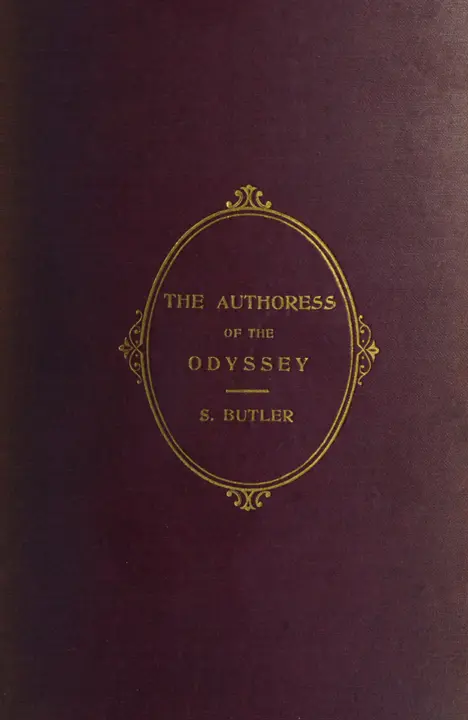
The Authoress of the Odyssey Where and when she wrote, who she was, the use she made of the Iliad, and how the poem grew under her hands
Samuel Butler
THE CLASSIC COLLECTION · 1904
"The Humour of Homer and Other Essays" by Samuel Butler is a collection of essays written in the late 19th century that explores themes related to literature, art, and science, with a particular focus on humor in classical works. The book contains a significant essay titled "The Humour of Homer," which discusses the comedic aspects of Homer's epics, particularly the Iliad and the Odyssey, while also questioning the traditional interpretations and authorship of these texts. The essays reflect Butler's unique perspective as a critic and a thinker of his time, aiming to shed light on the nature of creativity and the human experience through the lens of humor. The opening of the collection presents an introduction by R. A. Streatfeild that discusses Butler's intentions in his essays and their historical context, providing a biographical backdrop for his analysis of Homer. Butler begins his exploration of Homer's works by emphasizing the importance of understanding the poet not only as a revered figure but as a relatable, flawed human being. He delves into the characters of the Iliad, particularly focusing on Achilles' relationship with the gods and his mother, Thetis, while highlighting the humor and wit in their interactions. This sets the stage for a broader discussion about the nature of humanity as mirrored in ancient texts, questioning traditional interpretations and inviting readers to adopt a more nuanced view of both Homer and the themes within his works.
Introduction adapted from the source catalogue; source summaries may be automatically generated.
Free to read · English · 91,391 words · No account needed
MAKE TIME FOR A GOOD BOOK
On by default. Untick to stop anonymous reading totals. Each page counts after 10 seconds in view. How this works.
Anonymous counting is on unless you have switched it off.
I will add no more however on this head. The leading characteristics of the Iliad, as we saw, were love, war, and plunder. The leading idea of the Odyssey is the infatuation of man, and the key-note is struck in the opening paragraph, where we are told how the sailors of Ulysses must needs, in spite of every warning, kill and eat the cattle of the sun-god, and perished accordingly.
A few lines lower down the same note is struck with even greater emphasis. The gods have met in council, and Jove happens at the moment to be thinking of AEgisthus, who had met his death at the hand of Agamemnon's son Orestes, in spite of the solemn warning that Jove had sent him through the mouth of Mercury. It does not seem necessary for Jove to turn his attention to Clytemnestra, the partner of AEgisthus's guilt. Of this lady we are presently told that she was naturally of an excellent disposition, and would never have gone wrong but for the loss of the protector in whose charge Agamemnon had left her. When she was left alone without an adviser-- well, if a base designing man took to flattering and misleading her--what else could be expected? The infatuation of man, with its corollary, the superior excellence of woman, is the leading theme; next to this come art, religion, and, I am almost ashamed to add, money. There is no love-business in the Odyssey except the return of a bald elderly married man to his elderly wife and grown-up son after an absence of twenty years, and furious at having been robbed of so much money in the meantime. But this can hardly be called love-business; it is at the utmost domesticity. There is a charming young princess, Nausicaa, but though she affects a passing tenderness for the elderly hero of her creation as soon as Minerva has curled his bald old hair for him and tittivated him up all over, she makes it abundantly plain that she will not look at a single one of her actual flesh and blood admirers. There is a leading young gentleman, Telemachus, who is nothing if he is not [Greek], or canny, well-principled, and discreet; he has an amiable and most sensible young male friend who says that he does not like crying at meal times--he will cry in the forenoon on an empty stomach as much as anyone pleases, but he cannot attend properly to his dinner and cry at the same time. Well, there is no lady provided either for this nice young man or for Telemachus. They are left high and dry as bachelors. Two goddesses indeed, Circe and Calypso, do one after the other take possession of Ulysses, but the way in which he accepts a situation which after all was none of his seeking, and which it is plain he does not care two straws about, is, I believe, dictated solely by a desire to exhibit the easy infidelity of Ulysses himself in contrast with the unswerving constancy and fidelity of his wife Penelope. Throughout the Odyssey the men do not really care for women, nor the women for men; they have to pretend to do so now and again, but it is a got-up thing, and the general attitude of the sexes towards one another is very much that of Helen, who says that her husband Menelaus is really not deficient in person or understanding: or again of Penelope herself, who, on being asked by Ulysses on his return what she thought of him, said that she did not think very much of him nor very little of him; in fact, she did not think much about him one way or the other. True, later on she relents and becomes more effusive; in fact, when she and Ulysses sat up talking in bed and Ulysses told her the story of his adventures, she never went to sleep once. Ulysses never had to nudge her with his elbow and say, "Come, wake up, Penelope, you are not listening"; but, in spite of the devotion exhibited here, the love-business in the Odyssey is artificial and described by one who had never felt it, whereas in the Iliad it is spontaneous and obviously genuine, as by one who knows all about it perfectly well. The love-business in fact of the Odyssey is turned on as we turn on the gas--when we cannot get on without it, but not otherwise.
Your reading position is saved on this browser. Take it to another device with a library code. Reading pages adapt to text, rather than matching a printed edition.
Samuel Butler
Samuel Butler
Samuel Butler
Samuel Butler
BEHIND THE BOOK
This eBook is for the use of anyone anywhere in the United States and most other parts of the world at no cost and with almost no restrictions whatsoever. You may copy it, give it away or re-use it under the terms of the Project Gutenberg License included with this eBook or online at www.gutenberg.org. If you are not located in the United States, you will have to check the laws of the country where you are located before using this eBook. Read the source licence.
The original source file, including credits and licence, is retained by this library. Request an original-format copy at no charge. Please include the book title and Project Gutenberg identifier #12651.
KEEP YOUR CURIOSITY GOING

David Patterson (Spirit) Hatch

David Patterson (Spirit) Hatch

David Patterson (Spirit) Hatch
Cécile Tormay

Moritz Busch
John L. Ransom