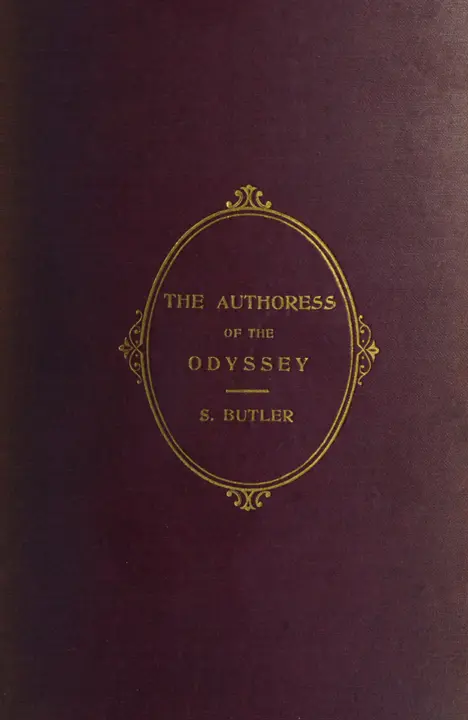
The Authoress of the Odyssey Where and when she wrote, who she was, the use she made of the Iliad, and how the poem grew under her hands
Samuel Butler
THE CLASSIC COLLECTION · 1904
"The Humour of Homer and Other Essays" by Samuel Butler is a collection of essays written in the late 19th century that explores themes related to literature, art, and science, with a particular focus on humor in classical works. The book contains a significant essay titled "The Humour of Homer," which discusses the comedic aspects of Homer's epics, particularly the Iliad and the Odyssey, while also questioning the traditional interpretations and authorship of these texts. The essays reflect Butler's unique perspective as a critic and a thinker of his time, aiming to shed light on the nature of creativity and the human experience through the lens of humor. The opening of the collection presents an introduction by R. A. Streatfeild that discusses Butler's intentions in his essays and their historical context, providing a biographical backdrop for his analysis of Homer. Butler begins his exploration of Homer's works by emphasizing the importance of understanding the poet not only as a revered figure but as a relatable, flawed human being. He delves into the characters of the Iliad, particularly focusing on Achilles' relationship with the gods and his mother, Thetis, while highlighting the humor and wit in their interactions. This sets the stage for a broader discussion about the nature of humanity as mirrored in ancient texts, questioning traditional interpretations and inviting readers to adopt a more nuanced view of both Homer and the themes within his works.
Introduction adapted from the source catalogue; source summaries may be automatically generated.
Free to read · English · 91,391 words · No account needed
MAKE TIME FOR A GOOD BOOK
On by default. Untick to stop anonymous reading totals. Each page counts after 10 seconds in view. How this works.
Anonymous counting is on unless you have switched it off.
{190} M. Ruppen's words run: "1687 wurde die Kapelle zur hohen Stiege gebaut, 1747 durch Zusatz vergrossert und 1755 mit Orgeln ausgestattet. Anton Ruppen, ein geschickter Steinhauer und Maurermeister leitete den Kapellebau, und machte darin das kleinere Altarlein. Bei der hohen Stiege war fruher kein Gebetshauslein; nur ein wunderthatiges Bildlein der Mutter Gottes stand da in einer Mauer vor dem fromme Hirten und viel andachtiges Volk unter freiem Himmel beteten.
"1709 wurden die kleinen Kapellelein die 15 Geheimnisse des Psalters vorstellend auf dem Wege zur hohen Stiege gebaut. Jeder Haushalter des Viertels Fee ubernahm den Bau eines dieser Geheimnisskapellen, und ein besonderer Gutthater dieser frommen Unternehmung war Heinrich Andenmatten, nachhet Bruder der Gesellschaft Jesu."
{195} The story of Tabachetti's insanity and imprisonment is very doubtful, and it is difficult to make his supposed visit to Saas fit in with the authentic facts of his life. Cavaliere Negri, to whose pamphlet on Tabachetti I have already referred the reader, mentions neither. Tabachetti left his native Dinant in 1585, and from that date until his death he appears to have lived chiefly at Varallo and Crea. In 1588 he was working at Crea; in 1590 he was at Varallo and again in 1594, 1599, and 1602. He died in 1615, possibly during a visit to Varallo, though his home at the time was at Costigliole, near Asti.--R. A. S.
{196} This is thus chronicled by M. Ruppen: "1589 den 9 September war eine Wassergrosse, die viel Schaden verursachte. Die Thalstrasse, die von den Steinmatten an bis zur Kirche am Ufer der Visp lag, wurde ganz zerstort. Man ward gezwungen eine neue Strasse in einiger Entfernung vom Wasser durch einen alten Fussweg auszuhauen welche vier und einerhalben Viertel der Klafter, oder 6 Schuh und 9 Zoll breit sollte" (p. 43).
{209} A lecture delivered at the Working Men's College in Great Ormond Street, March 15th, 1890; rewritten and delivered again at the Somerville Club, February 13th, 1894.
{210} Correlation of Forces, Longmans, 1874, p. 15.
{230} Three Lectures on the Science of Language, Longmans, 1889, p.
4.
{234} Science of Thought, Longmans, 1887, p. 9.
{245} Published in the Universal Review, April, May, and June,
1890.
{259a} Voyages of the "Adventure" and "Beagle," iii. p. 237.
{259b} Luck or Cunning, pp. 170, 180.
{260} Journals of the Proceedings of the Linnean Society (Zoology,
vol. iii.), 1859, p. 62.
{261} Darwinism (Macmillan, 1889), p. 129.
{263} See Nature, March 6, 1890.
{265} Origin of Species, sixth edition, 1888, vol. i. p. 168.
{266} Origin of Species, sixth edition, 1888, vol. ii. p. 261.
Your reading position is saved on this browser. Take it to another device with a library code. Reading pages adapt to text, rather than matching a printed edition.
Samuel Butler
Samuel Butler
Samuel Butler
Samuel Butler
BEHIND THE BOOK
This eBook is for the use of anyone anywhere in the United States and most other parts of the world at no cost and with almost no restrictions whatsoever. You may copy it, give it away or re-use it under the terms of the Project Gutenberg License included with this eBook or online at www.gutenberg.org. If you are not located in the United States, you will have to check the laws of the country where you are located before using this eBook. Read the source licence.
The original source file, including credits and licence, is retained by this library. Request an original-format copy at no charge. Please include the book title and Project Gutenberg identifier #12651.
KEEP YOUR CURIOSITY GOING

David Patterson (Spirit) Hatch

David Patterson (Spirit) Hatch

David Patterson (Spirit) Hatch
Cécile Tormay

Moritz Busch
John L. Ransom