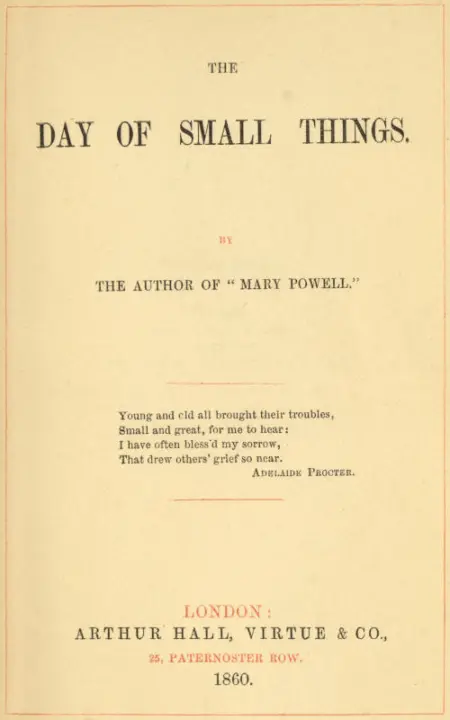
The Day of Small Things
Anne Manning
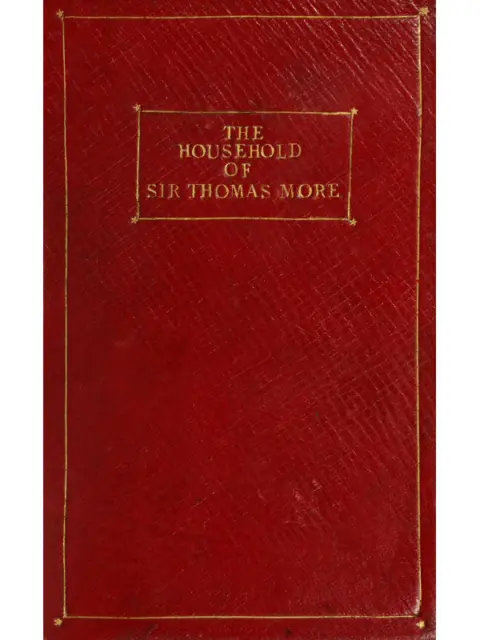
THE CLASSIC COLLECTION · 1852
"The Household of Sir Thomas More" by Anne Manning is a historical novel written in the late 19th century. It presents an imaginative portrait of the life and family of Sir Thomas More, focusing particularly on his eldest daughter, Margaret. The narrative attempts to capture the domestic life of this prominent historical figure and the dynamics of his family, highlighting the intersections of education, piety, and the intellectual atmosphere of the time. At the start of the book, the tone is set through the eyes of Margaret, who is advised by her tutor, Mr. Gunnel, to keep a journal of important family events. As she begins to write, she recounts her daily life and interactions, particularly the vibrant personalities within her household, including her father and the renowned scholar Erasmus. The opening depicts the warmth and complexity of family life, filled with playful banter, the pursuit of knowledge, and community life, as seen during a visit from Erasmus. The narrative establishes a historical context while emphasizing the themes of education, virtue, and familial love, painting a vivid picture of More's household and its unique culture during a turbulent period in history.
Introduction adapted from the source catalogue; source summaries may be automatically generated.
Free to read · English · 41,746 words · No account needed
MAKE TIME FOR A GOOD BOOK
On by default. Untick to stop anonymous reading totals. Each page counts after 10 seconds in view. How this works.
Anonymous counting is on unless you have switched it off.
"Oh, my first Speech, Sweetheart, was, 'What, my Goodness, Mr. More! I marvell how that you, who were always counted a wise Man, should now soe play the Fool as to lie here in this close, filthy Prison, shut up with Mice and Rats, when you mighte be abroade and at your Liberty, with the Favour of King and Council, and return to your righte fayr House, your Books and Gallery, and your Wife, Children, and Household, if soe be you onlie woulde but do what the Bishops and best learned of the Realm have, without Scruple, done alreadie.'"
"And what sayd he, Mother, to that?" ...
"Why, then, Sweetheart, he chucks me under the Chin and sayeth, 'I prithee, good Mistress Alice, to tell me one Thing.' ... Soe then I say, 'What Thing?' Soe then he sayeth, 'Is not this House, Sweetheart, as nigh Heaven as mine own?' Soe then I jerk my Head away and say, 'Tilly-valley! Tilly-valley!'"
Sayth Bess, "Sure, Mother, that was cold Comfort.... And what next?"
"Why, then I said, 'Bone Deus, Man! Bone Deus! will this Gear never be left?' So then he sayth, 'Well then, Mrs. Alice, if it be soe, 'tis mighty well, but, for my Part, I see no greate Reason why I shoulde much joy in my gay House, or in Aniething belonging thereunto, when, if I shoulde be but seven Years buried underground, and then arise and come thither agayn, I shoulde not fail to find Some therein that woulde bid me get out of Doors, and tell me 'twas none o' mine. What Cause have I, then, to care soe greatlie for a House that woulde soe soone forget its Master?'"
"And then, Mother? and then?"
"Soe then, Sweetheart, he sayth, 'Come tell me, Mrs. Alice, how long do you think we might reckon on living to enjoy it?' Soe I say, 'Some twenty Years, forsooth.' 'In faith,' says he, 'had you said some thousand Years, it had beene Somewhat; and yet he were a very bad Merchant that woulde put himselfe in Danger to lose Eternity for a thousand Years ... how much the rather if we are not sure to enjoy it one Day to an End?' Soe then he puts me off with Questions, How is Will? and Daisy? and Rupert? and this one? and t'other one? and the Peacocks? and Rabbits? and have we elected a new King of the Cob-loaf yet? and has Tom found his Hoop? and is the Hasp of the Buttery-hatch mended yet? and how goes the Court? and what was the Text o' Sunday? and have I practised the Viol? and how are we off for Money? and why can't he see Meg? Then he asks for this Book and t'other Book, but I've forgot their Names, and he sayth he's kept mighty short of Meat, though 'tis little he eats, but his Man John a Wood is gay an' hungry, and 'tis worth a World to see him at a salt Herring. Then he gives me Counsell of this and that, and puts his Arm about me and says, 'Come, let us pray;' but while he kept praying for one and t'other, I kept a-counting of his gray Hairs; he'd none a Month agone. And we're scarce off our Knees, when I'm fetched away; and I say, 'When will you change your Note, and act like a wise Man?' and he sayth, 'When? when?' looking very profound; 'why, ... when Gorse is out of Blossom and Kissing out of Fashion.' Soe puts me forthe by the Shoulders with a Laugh, calling after me, 'Remember me over and over agayn to them alle, and let me see Meg.'"
Your reading position is saved on this browser. Take it to another device with a library code. Reading pages adapt to text, rather than matching a printed edition.
Anne Manning
Anne Manning
Anne Manning
Anne Manning
BEHIND THE BOOK
This eBook is for the use of anyone anywhere in the United States and most other parts of the world at no cost and with almost no restrictions whatsoever. You may copy it, give it away or re-use it under the terms of the Project Gutenberg License included with this eBook or online at www.gutenberg.org. If you are not located in the United States, you will have to check the laws of the country where you are located before using this eBook. Read the source licence.
The original source file, including credits and licence, is retained by this library. Request an original-format copy at no charge. Please include the book title and Project Gutenberg identifier #45187.
KEEP YOUR CURIOSITY GOING
Cécile Tormay

Moritz Busch
Coulson Kernahan
John L. Ransom

Maurice Baring
Frances Wright