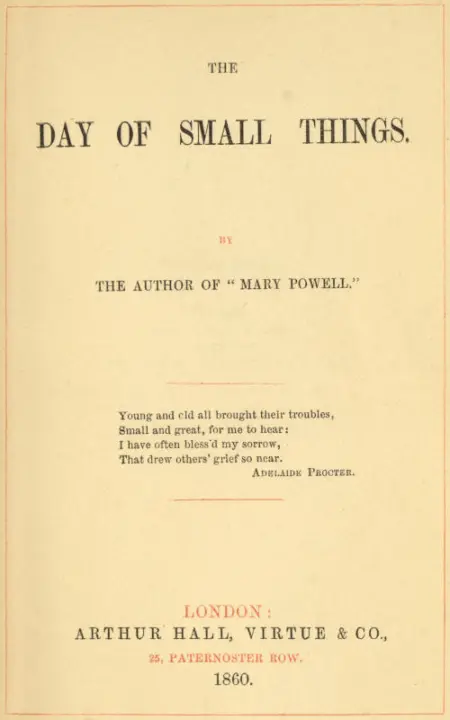
The Day of Small Things
Anne Manning
THE CLASSIC COLLECTION · 1852
"The Household of Sir Thomas More" by Anne Manning is a historical novel written in the late 19th century. It presents an imaginative portrait of the life and family of Sir Thomas More, focusing particularly on his eldest daughter, Margaret. The narrative attempts to capture the domestic life of this prominent historical figure and the dynamics of his family, highlighting the intersections of education, piety, and the intellectual atmosphere of the time. At the start of the book, the tone is set through the eyes of Margaret, who is advised by her tutor, Mr. Gunnel, to keep a journal of important family events. As she begins to write, she recounts her daily life and interactions, particularly the vibrant personalities within her household, including her father and the renowned scholar Erasmus. The opening depicts the warmth and complexity of family life, filled with playful banter, the pursuit of knowledge, and community life, as seen during a visit from Erasmus. The narrative establishes a historical context while emphasizing the themes of education, virtue, and familial love, painting a vivid picture of More's household and its unique culture during a turbulent period in history.
Introduction adapted from the source catalogue; source summaries may be automatically generated.
Free to read · English · 41,746 words · No account needed
MAKE TIME FOR A GOOD BOOK
On by default. Untick to stop anonymous reading totals. Each page counts after 10 seconds in view. How this works.
Anonymous counting is on unless you have switched it off.
Father delighteth in sparring with Patteson far more than in jesting with the King, whom he alwaies looks on as a Lion that may, any Minute, fall on him and rend him. Whereas, with t'other, he ungirds his Mind. Their Banter commonly exceeds not Pleasantrie, but Patteson is ne'er without an Answer; and although, maybe, each amuses himselfe now and then with thinking, "I'll put him up with such a Question," yet, once begun, the Skein runs off the Reel without a Knot, and shews the excellent Nature of both, soe free are they alike from Malice and Over-license. Sometimes theire Cuts are neater than common Listeners apprehend. I've seene Rupert and Will, in fencing, make theire Swords flash in the Sun at every Parry and Thrust; agayn, owing to some Change in mine owne Position, or the Decline of the Sun, the Scintillations have escaped me, though I've known their Rays must have been emitted in some Quarter alle the same.
Patteson, with one of Argus's cast Feathers in his Hand, is at this Moment beneath my Lattice, astride on a Stone Balustrade; while Bessy, whom he much affects, is sitting on the Steps, feeding her Peacocks. Sayth Patteson, "Canst tell me, Mistress, why Peacocks have soe manie Eyes in theire Tails, and yet can onlie see with two in theire Heads?"
"Because those two make them soe vain alreadie, Fool," says Bess, "that were they always beholding theire owne Glory, they woulde be intolerable."
"And besides that," says Patteson, "the less we see or heare, either, of what passes behind our Backs, the better for us, since Knaves will make Mouths at us then, for as glorious as we may be. Canst tell me, Mistress, why the Peacock was the last Bird that went into the Ark?"
"First tell me, Fool," returns Bess, "how thou knowest that it was
soe?"
"Nay, a Fool may ask a Question would puzzle a Wiseard to answer," rejoyns Patteson; "I mighte ask you, for example, where they got theire fresh Kitchen-stuff in the Ark, or whether the Birds ate other than Grains, or the wild Beasts other than Flesh. It needs must have been a Granary."
"We ne'er shew ourselves such Fools," says Bess, "as in seeking to know more than is written. They had enough, if none to spare, and we scarce can tell how little is enough for bare Sustenance in a State of perfect Inaction. If the Creatures were kept low, they were all the less fierce."
"Well answered, Mistress," says Patteson, "but tell me, why do you
wear two Crosses?"
"Nay, Fool," returns Bess, "I wear but one."
Your reading position is saved on this browser. Take it to another device with a library code. Reading pages adapt to text, rather than matching a printed edition.
Anne Manning
Anne Manning
Anne Manning
Anne Manning
BEHIND THE BOOK
This eBook is for the use of anyone anywhere in the United States and most other parts of the world at no cost and with almost no restrictions whatsoever. You may copy it, give it away or re-use it under the terms of the Project Gutenberg License included with this eBook or online at www.gutenberg.org. If you are not located in the United States, you will have to check the laws of the country where you are located before using this eBook. Read the source licence.
The original source file, including credits and licence, is retained by this library. Request an original-format copy at no charge. Please include the book title and Project Gutenberg identifier #45187.
KEEP YOUR CURIOSITY GOING
Cécile Tormay

Moritz Busch
Coulson Kernahan
John L. Ransom

Maurice Baring
Frances Wright