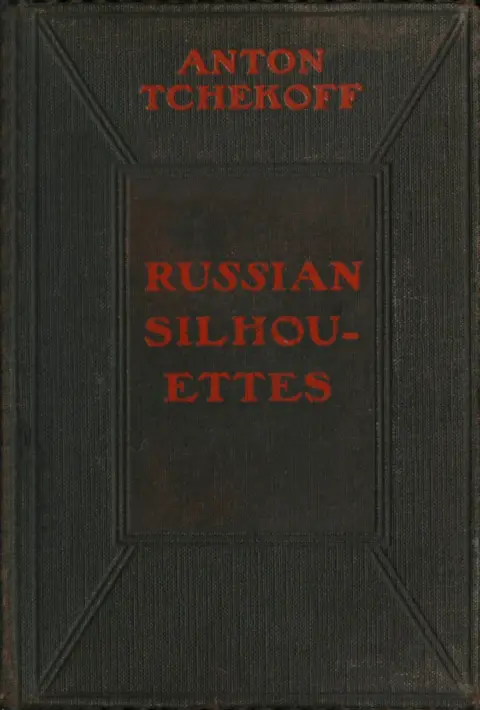
Russian Silhouettes: More Stories of Russian Life
Anton Pavlovich Chekhov
THE CLASSIC COLLECTION · 1917
"The House with the Mezzanine and Other Stories" by Anton Pavlovich Chekhov is a collection of short stories written in the late 19th century. The stories explore various aspects of human experience and emotion, often reflecting on social issues, personal relationships, and the complexities of life. The opening story introduces a painter and his interactions with a landowner and a family rooted in their local community, setting a tone that emphasizes both introspection and social commentary. At the start of the first story, the narrator describes his idle life on a country estate, where he has little to do but reflect on his surroundings and the people he encounters. He meets a charming family, the Volchaninovs, where he develops a complex relationship with Lydia, the elder daughter, who passionately believes in social reform, contrasting with the narrator’s apathy towards social engagement. As the narrator spends more time with the family, different dynamics unfold, revealing themes of love, disappointment, and the stark divergence between the ideals of action and the paralysis found in comfort and privilege. This opening portion hints at deeper explorations of class, personal ambition, and the tension between art and activism that may resonate throughout the collection.
Introduction adapted from the source catalogue; source summaries may be automatically generated.
Free to read · English · 63,068 words · No account needed
MAKE TIME FOR A GOOD BOOK
On by default. Untick to stop anonymous reading totals. Each page counts after 10 seconds in view. How this works.
Anonymous counting is on unless you have switched it off.
"Believe, believe me, I implore you," she said. "I love a pure, honest life, and sin is revolting to me. I don't know myself what I am doing. Simple people say: 'The devil entrapped me,' and I can say of myself: 'The Evil One tempted me.'"
"Don't, don't," he murmured.
He looked into her staring, frightened eyes, kissed her, spoke quietly and tenderly, and gradually quieted her and she was happy again, and they both began to laugh.
Later, when they went out, there was not a soul on the quay; the town with its cypresses looked like a city of the dead, but the sea still roared and broke against the shore; a boat swung on the waves; and in it sleepily twinkled the light of a lantern.
They found a cab and drove out to the Oreanda.
"Just now in the hall," said Gomov, "I discovered your name written on the board--von Didenitz. Is your husband a German?"
"No. His grandfather, I believe, was a German, but he himself is an
Orthodox Russian."
At Oreanda they sat on a bench, not far from the church, looked down at the sea and were silent. Talta was hardly visible through the morning mist. The tops of the hills were shrouded in motionless white clouds. The leaves of the trees never stirred, the cicadas trilled, and the monotonous dull sound of the sea, coming up from below, spoke of the rest, the eternal sleep awaiting us. So the sea roared when there was neither Talta nor Oreanda, and so it roars and will roar, dully, indifferently when we shall be no more. And in this continual indifference to the life and death of each of us, lives pent up, the pledge of our eternal salvation, of the uninterrupted movement of life on earth and its unceasing perfection. Sitting side by side with a young woman, who in the dawn seemed so beautiful, Gomov, appeased and enchanted by the sight of the fairy scene, the sea, the mountains, the clouds, the wide sky, thought how at bottom, if it were thoroughly explored, everything on earth was beautiful, everything, except what we ourselves think and do when we forget the higher purposes of life and our own human dignity.
A man came up--a coast-guard--gave a look at them, then went away. He, too, seemed mysterious and enchanted. A steamer came over from Feodossia, by the light of the morning star, its own lights already put out.
"There is dew on the grass," said Anna Sergueyevna after a silence.
"Yes. It is time to go home."
They returned to the town.
Your reading position is saved on this browser. Take it to another device with a library code. Reading pages adapt to text, rather than matching a printed edition.
Anton Pavlovich Chekhov
Anton Pavlovich Chekhov
BEHIND THE BOOK
This eBook is for the use of anyone anywhere in the United States and most other parts of the world at no cost and with almost no restrictions whatsoever. You may copy it, give it away or re-use it under the terms of the Project Gutenberg License included with this eBook or online at www.gutenberg.org. If you are not located in the United States, you will have to check the laws of the country where you are located before using this eBook. Read the source licence.
The original source file, including credits and licence, is retained by this library. Request an original-format copy at no charge. Please include the book title and Project Gutenberg identifier #27411.
KEEP YOUR CURIOSITY GOING

Charles G. (Charles Griffith) Ross
Hannah Webster Foster

Emily Lawless
Edwin Hamlin Carr

Charles De Lano Hine
Andrew Ure