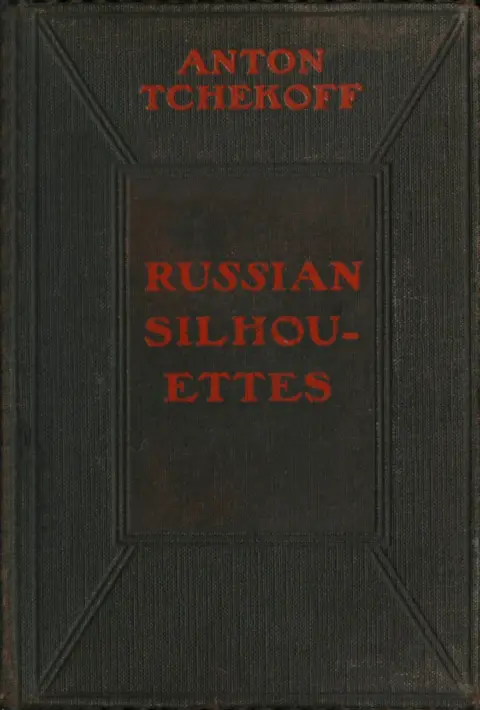
Russian Silhouettes: More Stories of Russian Life
Anton Pavlovich Chekhov
THE CLASSIC COLLECTION · 1917
"The House with the Mezzanine and Other Stories" by Anton Pavlovich Chekhov is a collection of short stories written in the late 19th century. The stories explore various aspects of human experience and emotion, often reflecting on social issues, personal relationships, and the complexities of life. The opening story introduces a painter and his interactions with a landowner and a family rooted in their local community, setting a tone that emphasizes both introspection and social commentary. At the start of the first story, the narrator describes his idle life on a country estate, where he has little to do but reflect on his surroundings and the people he encounters. He meets a charming family, the Volchaninovs, where he develops a complex relationship with Lydia, the elder daughter, who passionately believes in social reform, contrasting with the narrator’s apathy towards social engagement. As the narrator spends more time with the family, different dynamics unfold, revealing themes of love, disappointment, and the stark divergence between the ideals of action and the paralysis found in comfort and privilege. This opening portion hints at deeper explorations of class, personal ambition, and the tension between art and activism that may resonate throughout the collection.
Introduction adapted from the source catalogue; source summaries may be automatically generated.
Free to read · English · 63,068 words · No account needed
MAKE TIME FOR A GOOD BOOK
On by default. Untick to stop anonymous reading totals. Each page counts after 10 seconds in view. How this works.
Anonymous counting is on unless you have switched it off.
"My father is sick. When he dies, my mother and my wife have promised to
come here."
"What do you want your mother and your wife for?" asked Brains. "Just foolishness, my friend. It's the devil tempting you, plague take him. Don't listen to the Evil One. Don't give way to him. When he talks to you about women you should answer him sharply: 'I don't want them!' When he talks of freedom, you should stick to it and say: 'I don't want it. I want nothing! No father, no mother, no wife, no freedom, no home, no love! I want nothing.' Plague take 'em all."
Brains took a swig at his bottle and went on:
"My brother, I am not an ordinary peasant. I don't come from the servile masses. I am the son of a deacon, and when I was a free man at Rursk, I used to wear a frock coat, and now I have brought myself to such a point that I can sleep naked on the ground and eat grass. God give such a life to everybody. I want nothing. I am afraid of nobody and I think there is no man richer or freer than I. When they sent me here from Russia I set my teeth at once and said: 'I want nothing!' The devil whispers to me about my wife and my kindred, and about freedom and I say to him: 'I want nothing!' I stuck to it, and, you see, I live happily and have nothing to grumble at. If a man gives the devil the least opportunity and listens to him just once, then he is lost and has no hope of salvation: he will be over ears in the mire and will never get out. Not only peasants the like of you are lost, but the nobly born and the educated also. About fifteen years ago a certain nobleman was sent here from Russia. He had had some trouble with his brothers and had made a forgery in a will. People said he was a prince or a baron, but perhaps he was only a high official--who knows? Well, he came here and at once bought a house and land in Moukhzyink. 'I want to live by my own work,' said he, 'in the sweat of my brow, because I am no longer a nobleman but an exile.' 'Why,' said I. 'God help you, for that is good.' He was a young man then, ardent and eager; he used to mow and go fishing, and he would ride sixty miles on horseback. Only one thing was wrong; from the very beginning he was always driving to the post-office at Guyrin. He used to sit in my boat and sigh: 'Ah! Simeon, it is a long time since they sent me any money from home.' 'You are better without money, Vassili Sergnevich,' said I. 'What's the good of it? You just throw away the past, as though it had never happened, as though it were only a dream, and start life afresh. Don't listen to the devil,' I said, 'he won't do you any good, and he will only tighten the noose. You want money now, but in a little while you will want something else, and then more and more. If,' said I, 'you want to be happy you must want nothing. Exactly.... If,' I said, 'fate has been hard on you and me, it is no good asking her for charity and falling at her feet. We must ignore her and laugh at her.' That's what I said to him.... Two years later I ferried him over and he rubbed his hands and laughed. 'I'm going,' said he, 'to Guyrin to meet my wife. She has taken pity on me, she says, and she is coming here. She is very kind and good.' And he gave a gasp of joy. Then one day he came with his wife, a beautiful young lady with a little girl in her arms and a lot of luggage. And Vassili Andreich kept turning and looking at her and could not look at her or praise her enough. 'Yes, Simeon, my friend, even in Siberia people live.' Well, thought I, all right, you won't be content. And from that time on, mark you, he used to go to Guyrin every week to find out if money had been sent from Russia. A terrible lot of money was wasted. 'She stays here,' said he, 'for my sake, and her youth and beauty wither away here in Siberia. She shares my bitter lot with me,' said he, 'and I must give her all the pleasure I can for it....' To make his wife happier he took up with the officials and any kind of rubbish. And they couldn't have company without giving food and drink, and they must have a piano and a fluffy little dog on the sofa--bad cess to it.... Luxury, in a word, all kinds of tricks. My lady did not stay with him long. How could she? Clay, water, cold, no vegetables, no fruit; uneducated people and drunkards, with no manners, and she was a pretty pampered young lady from the metropolis.... Of course she got bored. And her husband was no longer a gentleman, but an exile--quite a different matter. Three years later, I remember, on the eve of the Assumption, I heard shouts from the other bank. I went over in the ferry and saw my lady, all wrapped up, with a young gentleman, a government official, in a troika.... I ferried them across, they got into the carriage and disappeared, and I saw no more of them. Toward the morning Vassili Andreich came racing up in a coach and pair. 'Has my wife been across, Simeon, with a gentleman in spectacles?' 'She has,' said I, 'but you might as well look for the wind in the fields.' He raced after them and kept it up for five days and nights. When he came back he jumped on to the ferry and began to knock his head against the side and to cry aloud. 'You see,' said I, 'there you are.' And I laughed and reminded him: 'Even in Siberia people live.' But he went on beating his head harder than ever.... Then he got the desire for freedom. His wife had gone to Russia and he longed to go there to see her and take her away from her lover. And he began to go to the post-office every day, and then to the authorities of the town. He was always sending applications or personally handing them to the authorities, asking to have his term remitted and to be allowed to go, and he told me that he had spent over two hundred roubles on telegrams. He sold his land and mortgaged his house to the money-lenders. His hair went grey, he grew round-shouldered, and his face got yellow and consumptive-looking. He used to cough whenever he spoke and tears used to come to his eyes. He spent eight years on his applications, and at last he became happy again and lively: he had thought of a new dodge. His daughter, you see, had grown up. He doted on her and could never take his eyes off her. And, indeed, she was very pretty, dark and clever. Every Sunday he used to go to church with her at Guyrin. They would stand side by side on the ferry, and she would smile and he would devour her with his eyes. 'Yes, Simeon,' he would say. 'Even in Siberia people live. Even in Siberia there is happiness. Look what a fine daughter I have. You wouldn't find one like her in a thousand miles' journey.' 'She's a nice girl,' said I. 'Oh, yes.' ... And I thought to myself: 'You wait.... She is young. Young blood will have its way; she wants to live and what life is there here?' And she began to pine away.... Wasting, wasting away, she withered away, fell ill and had to keep to her bed.... Consumption. That's Siberian happiness, plague take it; that's Siberian life.... He rushed all over the place after the doctors and dragged them home with him. If he heard of a doctor or a quack three hundred miles off he would rush off after him. He spent a terrific amount of money on doctors and I think it would have been much better spent on drink. All the same she had to die. No help for it. Then it was all up with him. He thought of hanging himself, and of trying to escape to Russia. That would be the end of him. He would try to escape: he would be caught, tried, penal servitude, flogging."
Your reading position is saved on this browser. Take it to another device with a library code. Reading pages adapt to text, rather than matching a printed edition.
Anton Pavlovich Chekhov
Anton Pavlovich Chekhov
BEHIND THE BOOK
This eBook is for the use of anyone anywhere in the United States and most other parts of the world at no cost and with almost no restrictions whatsoever. You may copy it, give it away or re-use it under the terms of the Project Gutenberg License included with this eBook or online at www.gutenberg.org. If you are not located in the United States, you will have to check the laws of the country where you are located before using this eBook. Read the source licence.
The original source file, including credits and licence, is retained by this library. Request an original-format copy at no charge. Please include the book title and Project Gutenberg identifier #27411.
KEEP YOUR CURIOSITY GOING

Charles G. (Charles Griffith) Ross
Hannah Webster Foster

Emily Lawless
Edwin Hamlin Carr

Charles De Lano Hine
Andrew Ure