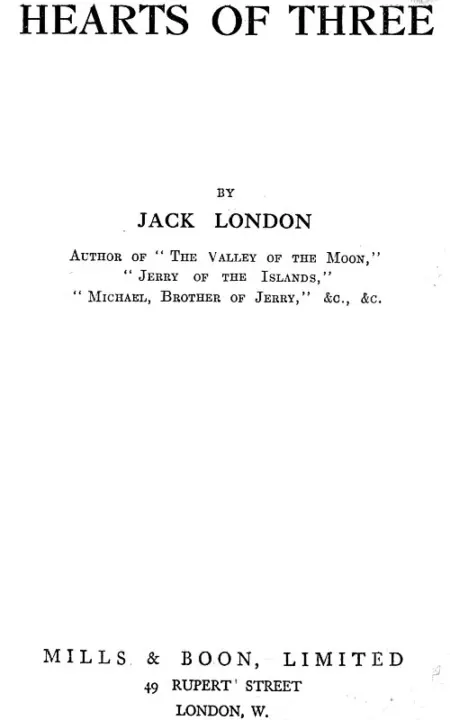
Hearts of three
Jack London
THE CLASSIC COLLECTION · 1912
"The House of Pride, and Other Tales of Hawaii" by Jack London is a collection of stories written in the early 20th century. The tales delve into the lives of individuals living in Hawaii, exploring themes of identity, class, and the impacts of colonialism. The characters grapple with their desires, societal expectations, and the complexities of their connections to both place and family. The opening of the first story introduces Percival Ford, a wealthy and self-proclaimed spiritual aristocrat, attending a farewell dance for army personnel about to leave for Alaska. Despite his status, Ford feels out of place among the officers and their wives, manifesting a sense of disapproval towards their carefree lifestyles. As he reflects on his austere upbringing under the influence of his father, the esteemed Isaac Ford, Percival grapples with his own insecurities and moral viewpoints. The complex relationship with his half-brother Joe Garland, who embodies the carefree spirit Ford despises, becomes central to the narrative. This initial encounter sets the stage for a deeper exploration of family ties, identity, and societal roles as the story unfolds.
Introduction adapted from the source catalogue; source summaries may be automatically generated.
Free to read · English · 30,346 words · No account needed
MAKE TIME FOR A GOOD BOOK
On by default. Untick to stop anonymous reading totals. Each page counts after 10 seconds in view. How this works.
Anonymous counting is on unless you have switched it off.
"Why, he's--" John broke off and looked about him helplessly. "Hadn't you better ask somebody else? Everybody thought you knew. We always thought . . . "
"Yes, go ahead."
"We always thought that that was why you had it in for him."
Photographs and miniatures of Isaac Ford were trooping through his son's brain, and ghosts of Isaac Ford seemed in the air about hint "I wish you good night, sir," he could hear the clerk saying, and he saw him beginning to limp away.
"John," he called abruptly.
John came back and stood near him, blinking and nervously moistening his
lips.
"You haven't told me yet, you know."
"Oh, about Joe Garland?"
"Yes, about Joe Garland. Who is he?"
"He's your brother, sir, if I say it who shouldn't."
"Thank you, John. Good night."
"And you didn't know?" the old man queried, content to linger, now that the crucial point was past.
"Thank you, John. Good night," was the response.
"Yes, sir, thank you, sir. I think it's going to rain. Good night,
sir."
Out of the clear sky, filled only with stars and moonlight, fell a rain so fine and attenuated as to resemble a vapour spray. Nobody minded it; the children played on, running bare-legged over the grass and leaping into the sand; and in a few minutes it was gone. In the south-east, Diamond Head, a black blot, sharply defined, silhouetted its crater-form against the stars. At sleepy intervals the surf flung its foam across the sands to the grass, and far out could be seen the black specks of swimmers under the moon. The voices of the singers, singing a waltz, died away; and in the silence, from somewhere under the trees, arose the laugh of a woman that was a love-cry. It startled Percival Ford, and it reminded him of Dr. Kennedy's phrase. Down by the outrigger canoes, where they lay hauled out on the sand, he saw men and women, Kanakas, reclining languorously, like lotus-eaters, the women in white holokus; and against one such holoku he saw the dark head of the steersman of the canoe resting upon the woman's shoulder. Farther down, where the strip of sand widened at the entrance to the lagoon, he saw a man and woman walking side by side. As they drew near the light lanai, he saw the woman's hand go down to her waist and disengage a girdling arm. And as they passed him, Percival Ford nodded to a captain he knew, and to a major's daughter. Smoke of life, that was it, an ample phrase. And again, from under the dark algaroba tree arose the laugh of a woman that was a love-cry; and past his chair, on the way to bed, a bare-legged youngster was led by a chiding Japanese nurse-maid. The voices of the singers broke softly and meltingly into an Hawaiian love-song, and officers and women, with encircling arms, were gliding and whirling on the lanai; and once again the woman laughed under the algaroba trees.
Your reading position is saved on this browser. Take it to another device with a library code. Reading pages adapt to text, rather than matching a printed edition.
Jack London
Jack London
Jack London
Jack London
BEHIND THE BOOK
This eBook is for the use of anyone anywhere in the United States and most other parts of the world at no cost and with almost no restrictions whatsoever. You may copy it, give it away or re-use it under the terms of the Project Gutenberg License included with this eBook or online at www.gutenberg.org. If you are not located in the United States, you will have to check the laws of the country where you are located before using this eBook. Read the source licence.
The original source file, including credits and licence, is retained by this library. Request an original-format copy at no charge. Please include the book title and Project Gutenberg identifier #2416.
KEEP YOUR CURIOSITY GOING
Coulson Kernahan

Maurice Baring
Frances Wright
Cécile Tormay

Frederic Jesup Stimson

W. H. P. (William Henry Pope) Jarvis