My pets
Marshall Saunders
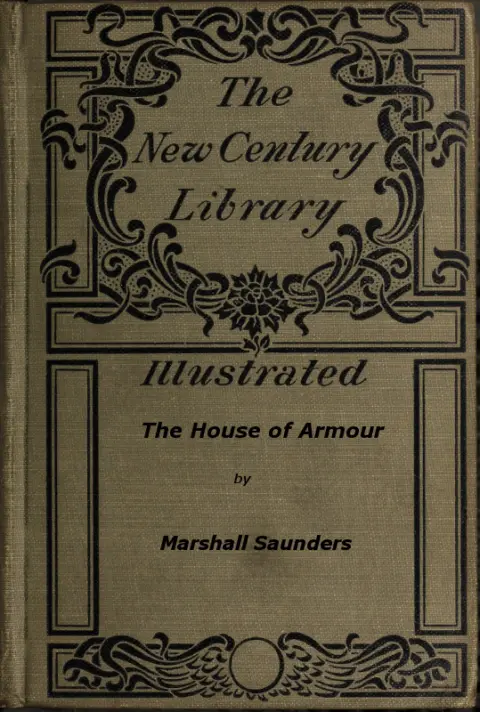
THE CLASSIC COLLECTION · 1897
"The House of Armour" by Marshall Saunders is a novel written in the late 19th century. The narrative follows Vivienne Delavigne, a young girl returning to her native Nova Scotia from abroad, and her experiences as she reintegrates into a life complicated by her past and her guardians, the Armour family. The book explores themes of identity, cultural heritage, and the social dynamics of the time. The opening of the story sets the scene with a passenger ship entering the picturesque harbor of Halifax. Vivienne is introduced as an enthusiastic character reflecting on her childhood memories of the place. Alongside her is Captain Macartney, who is intrigued by her passion for her homeland. Their dialogue hints at deeper themes of nationalism and personal connection, especially as Vivienne reveals her longing for belonging amid her recent losses. The chapter intriguingly establishes the setting, character dynamics, and themes that will likely evolve throughout the novel, inviting readers into Vivienne's journey as she navigates her complex emotions and relationships.
Introduction adapted from the source catalogue; source summaries may be automatically generated.
Free to read · English · 116,963 words · No account needed
MAKE TIME FOR A GOOD BOOK
On by default. Untick to stop anonymous reading totals. Each page counts after 10 seconds in view. How this works.
Anonymous counting is on unless you have switched it off.
“You encourage them, I fancy,” said the officer in his smooth, polished tones. “They would not come if you did not do so. I hope you have others, rich ones, to counterbalance them.”
“Yes,” gruffly, “I have.”
“And you bleed them to make up for the losses you sustain through penniless patients. Ha, ha, Camperdown,” and Captain Macartney laughed the pleasant, mellifluous laugh of a man of culture and fashion.
Camperdown looked benevolently at him. “Never mind me. Talk about yourself. What are you making of your life? You’re getting older. Have you married?”
“No, but I am thinking of it,” gravely and with the faintest shade of conceit. “My stepmother urges me to it, and the advice is agreeable, for I have fallen in love.”
“Does she reciprocate?” and Dr. Camperdown bit his moustache more savagely than ever in order to restrain a smile.
“Not entirely; but—you remember the time I broke my leg, Camperdown,
five years ago?”
“Yes, a compound fracture.”
“The time,” scornfully, “that I was fool enough to let Flora Colonibel twist me ’round her little finger.”
“Exactly.”
“I was taken to the Armours’ house you remember, and was fussed over and petted till I loathed the sight of her.”
“Yes,” dryly, “as much as you had previously admired it.”
“By Jove, yes,” said the other with a note of lazy contempt in his voice; “and but for that broken leg, Flora Colonibel would have been Flora Macartney now.”
“Very likely,” said Camperdown grimly; “but what are you harking back to that old story for?”
“It is an odd thing,” went on Captain Macartney with some show of warmth, “that, tame cat as I became out at Pinewood, and bored to death as I was with confidences and family secrets, from the old colonial days down, that one thing only was never revealed to me.”
“What was that?”
“The fact that the family possessed a kind of ward or adopted daughter, who was being educated abroad.”
“So—they did not tell you that?”
“Not a syllable of it,” and Captain Macartney eyed keenly the uncommunicative face before him.
“Why should they have told you?” said Dr. Camperdown.
“Why—why,” echoed his visitor in some confusion, his face growing furiously red, “for the very good reason that that is the girl with whom I have chosen to fall in love.”
Camperdown shrugged his huge shoulders. “How did they know you’d fall in love with the daughter of their poor devil of a bookkeeper?”
Your reading position is saved on this browser. Take it to another device with a library code. Reading pages adapt to text, rather than matching a printed edition.
Marshall Saunders
Marshall Saunders
Marshall Saunders
Marshall Saunders
BEHIND THE BOOK
This eBook is for the use of anyone anywhere in the United States and most other parts of the world at no cost and with almost no restrictions whatsoever. You may copy it, give it away or re-use it under the terms of the Project Gutenberg License included with this eBook or online at www.gutenberg.org. If you are not located in the United States, you will have to check the laws of the country where you are located before using this eBook. Read the source licence.
The original source file, including credits and licence, is retained by this library. Request an original-format copy at no charge. Please include the book title and Project Gutenberg identifier #53697.
KEEP YOUR CURIOSITY GOING
Coulson Kernahan

Maurice Baring
Frances Wright
Cécile Tormay

Frederic Jesup Stimson

W. H. P. (William Henry Pope) Jarvis