THE CLASSIC COLLECTION✦The man in the street: Papers on American topicsCLASSIC FREE BOOKS
The man in the street: Papers on American topics
Meredith Nicholson
THE CLASSIC COLLECTION · 1900
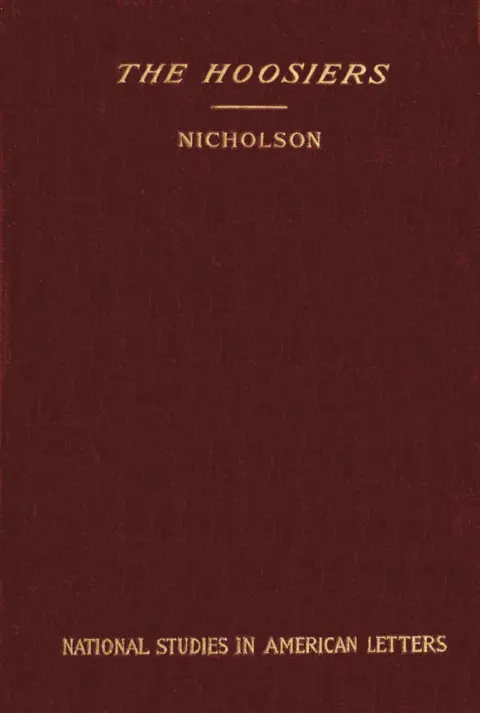
"The Hoosiers" by Meredith Nicholson is a historical account written in the late 19th century. The work examines the cultural, social, and literary evolution of Indiana, highlighting the state's development and the various forces that shaped it over time. Nicholson presents a nuanced portrayal of the Hoosier identity, countering common stereotypes about the inhabitants with a deeper understanding of their contributions to American culture. At the start of "The Hoosiers," the author sets the stage for a comprehensive exploration of Indiana's historical context, emphasizing how the state's origins and early inhabitants influenced its intellectual life. He discusses the complex relationship between the Hoosiers’ pioneering past and their eventual emergence as a community capable of substantive literary and cultural output. The opening chapters introduce the state's formation and early demographics, providing a backdrop for the subsequent discussion about the development of education and cultural enlightenment in Indiana. Through a meticulous review of historical influences and prominent figures, Nicholson argues that the progress of Indiana should be recognized not merely as a series of literary achievements but as a collective effort to uplift the community's general cultivation.
Introduction adapted from the source catalogue; source summaries may be automatically generated.
Free to read · English · 51,323 words · No account needed
MAKE TIME FOR A GOOD BOOK
On by default. Untick to stop anonymous reading totals. Each page counts after 10 seconds in view. How this works.
Anonymous counting is on unless you have switched it off.
When General Wallace returned to Crawfordsville at the close of the war he was thirty-eight; he had served creditably in one war and with enviable distinction in a second, and he turned to the arts of peace from a military experience that had given him wide reputation and acquaintance among public men of the Civil War period. He began industriously to reëstablish himself in his law practice, and varied his occupation with study and literary work. “The Man at Arms,” his youthful attempt at “A Tale of the Tenth Century,” had disappeared during his absence in Mexico; but the ambition to write a romance of the invasion of Cortez, and his manuscript beginnings of it, had survived two wars, and he now set about finishing the story. He had at this time no definite ambition to become an author, and he gave his evenings to the writing of “The Fair God” with little idea of ever publishing it. After its completion he carried it East with him on a business journey. Whitelaw Reid gave him an introduction to a Boston publisher, and the result was the appearance of the tale in 1873. He had spent in all about twelve years on the book, part having been written, as already stated, in his boyhood; and the author’s faithfulness to his early purpose through many years that had brought new duties and obligations is in keeping with his whole character.
The scenes of “The Fair God” were unfamiliar to the novel reader, and the very names in the book were somewhat disconcerting; but the tale was received in the beginning with a fair degree of interest, and it has ever since enjoyed a steady sale. The subsequent success of “Ben Hur” directed attention anew to General Wallace’s earlier tale, but the romance was something more than an amateur effort, and time has not diminished its entertaining qualities. As a picture of Aztecan civilization it is accurate, and the incidents are related in an orderly and natural manner that holds the attention. The devotion of the people to their religion is impressive; but the tale is essentially a military romance. The battle scenes following the appearance of Cortez and his Spaniards are described with an animation and an amplitude that impart to the reader the sense of beholding a series of great spectacles. The book is rich in those surprises which it is the business of the romancer to produce; and the chapters descriptive of the battle towers (mantas) which were among the European’s resources, and of the retreat of the invaders, are noisy with the clang of battle. The prophecies of the mystic priest Mualox, who sees through the eyes of a child the coming of the Spaniards, are interesting; and curiously enough they had their origin in an incident of General Wallace’s own experience in Indiana, showing how the imagination may play upon the commonplace. When he lived at Covington, he formed the acquaintance of a tailor who was deeply interested in the occult sciences, and who once invited General Wallace to his shop to witness manifestations of his powers. The tailor placed his apprentice under a kind of hypnotic influence, and told General Wallace to take the boy’s hand and to follow in his own mind some route with whose details he was familiar. General Wallace obeyed, mentally reviewing a highway that led to the house of a farmer client. The boy’s lips moved, and he coherently described the road, and presently the farmhouse, just as General Wallace saw them; then he abruptly ceased to follow the leader’s train of thought. He said that it was night; that some one came out of the house with a light, walked about inspecting the barnyard, and then returned to the house. The boy had now become exhausted; the tailor revived him, and General Wallace went on to his home. A few days later, when the countryman whose farm had figured in the incident came to town, General Wallace asked him if he had been at home at the hour mentioned; he replied that he had been at home and asleep. Further questioning elicited the statement that at about the time of the experiment at the tailor shop he had been aroused by noises in the barnyard, and that, fearing some marauder was after his fowls, he had taken a light and gone out to see that all was secure.
Your reading position is saved on this browser. Take it to another device with a library code. Reading pages adapt to text, rather than matching a printed edition.
Meredith Nicholson
Meredith Nicholson
Meredith Nicholson

Meredith Nicholson
BEHIND THE BOOK
This eBook is for the use of anyone anywhere in the United States and most other parts of the world at no cost and with almost no restrictions whatsoever. You may copy it, give it away or re-use it under the terms of the Project Gutenberg License included with this eBook or online at www.gutenberg.org. If you are not located in the United States, you will have to check the laws of the country where you are located before using this eBook. Read the source licence.
The original source file, including credits and licence, is retained by this library. Request an original-format copy at no charge. Please include the book title and Project Gutenberg identifier #66276.
KEEP YOUR CURIOSITY GOING
Cécile Tormay

Moritz Busch
John L. Ransom
Frances Wright
Cécile Tormay

Mabel Potter Daggett