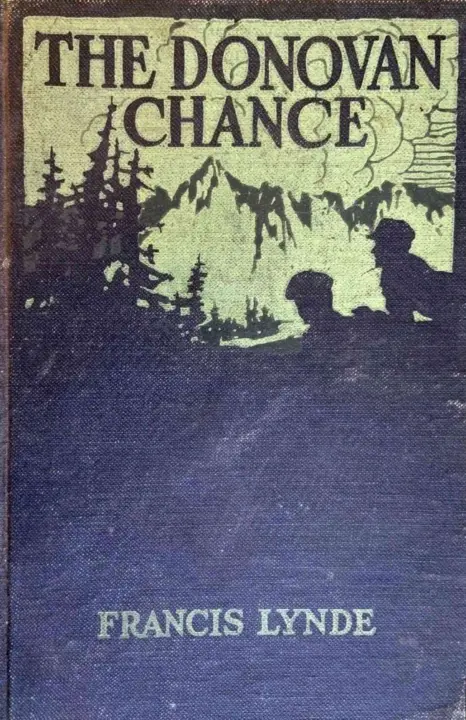
The Donovan chance
Francis Lynde
THE CLASSIC COLLECTION · 1913
"The Honorable Senator Sage-Brush" by Francis Lynde is a novel written in the early 20th century. The story revolves around Evan Blount, the son of a prominent senator, who finds himself at a crossroads in his life following a romantic rejection by a woman named Patricia. As he grapples with his feelings of disappointment and familial connections in the West, he must navigate a complex political landscape that involves powerful railroad interests and his father's influence. At the start of the novel, Blount is introduced as a disconsolate young man attending a social event at a country club, recently spurned by his love interest. He encounters his old friend Gantry, who provides insights into the political turmoil connected to his father's career, suggesting a call for Blount to return to their native West. A telegram from his father urging him to come home further complicates his indecision, igniting both his ambitions and the historical weight of his family's legacy as he prepares to confront the realities of his father's position and the socio-political challenges in their home state. Through dynamic dialogues between Blount and Gantry, the reader is deftly introduced to the legislative conflicts that will shape the narrative moving forward.
Introduction adapted from the source catalogue; source summaries may be automatically generated.
Free to read · English · 98,065 words · No account needed
MAKE TIME FOR A GOOD BOOK
On by default. Untick to stop anonymous reading totals. Each page counts after 10 seconds in view. How this works.
Anonymous counting is on unless you have switched it off.
"You say that as if you'd been taking a few lessons," he laughed. Then, with the friendly impudence which only a college comradeship could excuse: "Is she here to-night?"
"No," said Blount, unguardedly making the response which admitted so
much more than it said.
"Tell me about her," Gantry begged. "I don't often read a love story,
but I like to hear 'em."
If it had been any one but Gantry, Blount would probably have had a sharp attack of reticence, with outward symptoms unmistakable to the dullest. But the time, the surroundings, and the exceeding newness of Patricia's "No" combined to break down the barriers of reserve.
"There isn't much to tell, Dick," he began half humorously, half in ill-concealed self-pity. "I've known her for a year, and I've loved her from the first day. That is Chapter One; and Chapter Two ends the story with one small word. She says 'No.'"
"The dickens she does!" said Gantry, in hearty sympathy. Then: "But that's a good sign, isn't it? Haven't I heard somewhere that they always say 'No' at first?"
Blount laughed in spite of himself. Gantry, the Dick Gantry of the college period, had always been a man's man, gay, light-hearted, and care-free to the outward eye, but in reality one who was carrying burdens of poverty and distress which might well have crushed an older and a stronger man. There had been no time for sentiment then, and Blount wondered if there had been in any later period.
"I am afraid I can't get any comfort out of that suggestion," he
returned. "When Miss Patricia Anners says 'No,' I am quite sure she
means it."
"Think so?" said Gantry, still sympathetic. "Well, I suppose you are the best judge. Tough, isn't it, old man? What's the obstacle?--if you can tell it without tearing the bandages off and saying 'Ouch!'"
"It is Miss Anners's career."
"H'm," was the doubtful comment; "I'm afraid you'll have to elaborate that a little for me. I'm not up in the 'career' classification."
"She has been studying at home and abroad in preparation for social-settlement work in the large cities. Of course, I knew about it; but I thought--I hoped--"
"You hoped it was only a young woman's fad--which it probably is,"
Gantry cut in.
"Y-yes; I'm afraid that was just what I did hope, Dick. But I couldn't talk against it. Confound it all, you can't go about smashing ideals for the people you love best!"
"Rich?" queried Gantry.
"Oh, no. Her father has the chair of paleontology, and never gets within speaking distance of the present century. The mother has been dead many years."
Your reading position is saved on this browser. Take it to another device with a library code. Reading pages adapt to text, rather than matching a printed edition.
Francis Lynde
Francis Lynde
Francis Lynde
Francis Lynde
BEHIND THE BOOK
This eBook is for the use of anyone anywhere in the United States and most other parts of the world at no cost and with almost no restrictions whatsoever. You may copy it, give it away or re-use it under the terms of the Project Gutenberg License included with this eBook or online at www.gutenberg.org. If you are not located in the United States, you will have to check the laws of the country where you are located before using this eBook. Read the source licence.
The original source file, including credits and licence, is retained by this library. Request an original-format copy at no charge. Please include the book title and Project Gutenberg identifier #16573.
KEEP YOUR CURIOSITY GOING
Coulson Kernahan

Maurice Baring
Frances Wright
Cécile Tormay

Frederic Jesup Stimson

W. H. P. (William Henry Pope) Jarvis