
The Truth About an Author
Arnold Bennett
THE CLASSIC COLLECTION · 1910
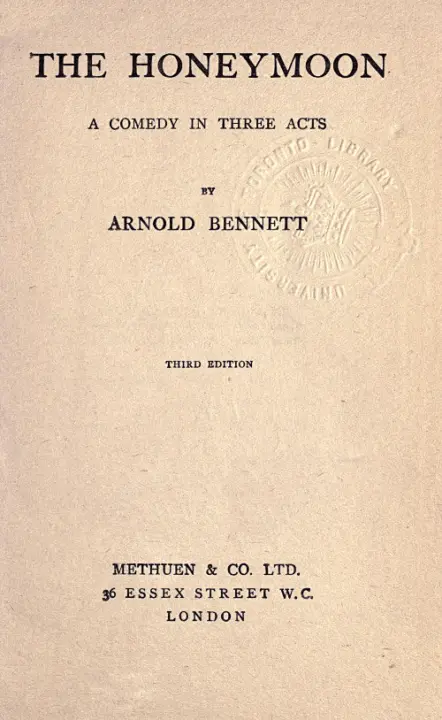
"The Honeymoon: A Comedy in Three Acts" by Arnold Bennett is a play written in the early 20th century. The piece revolves around the newlywed couple, Cedric and Flora Haslam, as they navigate their first few hours of marriage during a seaside honeymoon. The dialogue is lively and humorous, exploring themes of love, family expectations, and the complications that arise from the couple's respective famous parents. The opening of the play sets the stage at a charming seaside hotel where Cedric, a renowned aviator, and Flora, a widow, share playful banter while attempting to plan their honeymoon adventures. Despite the excitement of their marriage, both characters reveal a sense of nervousness as they discuss where they should go next, with Flora resisting the idea of being recognized in Paris due to their famous families. Their conversation is punctuated by moments of intimacy and light conflicts, presenting a comedic tableau of modern metropolitan life interrupted by the realities of fame and familial obligations. The comedic tension is further deepened by the arrival of characters related to their respective families, hinting at complications that will unfold later in the story.
Introduction adapted from the source catalogue; source summaries may be automatically generated.
Free to read · English · 23,405 words · No account needed
MAKE TIME FOR A GOOD BOOK
On by default. Untick to stop anonymous reading totals. Each page counts after 10 seconds in view. How this works.
Anonymous counting is on unless you have switched it off.
MRS. R. HASLAM. And wasn't that enough for you, my man?
FRAMPINGTON. (Starting slightly at the appellation.) It was too much. I naturally wanted to be locked up for the right thing. The truth is the Inspector thought I was drunk--probably because I was so calm. One of the constables said I--er--smelt of drink.
MRS. R. HASLAM. And did you?
FRAMPINGTON. Certainly not. Beyond half-a-pint of Bordeaux at the Ritz, I assure you I had had nothing whatever.
FLORA. The Ritz?
FRAMPINGTON. Why not, madam?
FLORA. As you say, why not!
FRAMPINGTON. It was handy for Vine Street, and this being my last night of freedom, you see---- As a novelist, Mrs. Haslam, you will understand I had a natural desire to do myself well.
MRS. R. HASLAM. The only thing I understand is that you seem to have come here for the pleasure of hearing yourself talk.
FRAMPINGTON. (Rising simply.) I beg your pardon. I came here to ask the Bishop to accompany me to the police-station as corroborative evidence. When your servant told me he wasn't here, the idea occurred to me that perhaps some member of your family wouldn't mind going with me--just to identify me.
MRS. R. HASLAM. Charlie, you'd better go on your way to the office.
CHARLES. That's all very well, but----
FRAMPINGTON. It would be very good of you. But I really think we ought to try another police-station. Bow Street would be better--more classical--if it isn't too much off your beat.
FLORA. Why don't you go to Liverpool Street?
FRAMPINGTON. But Liverpool Street is not a police-station.
FLORA. No. But it's a railway station. Chelmsford isn't the only place it leads to. There's Harwich, for instance, the continent---- (Smiles.)
MRS. R. HASLAM. (In a low voice.) Really, Flora! Christianity can
be carried too far.
FRAMPINGTON. (To FLORA.) I should be caught. And, honestly, I prefer the new experience which lies before me. It can't last long. And new experiences are my hobby.
FLORA. But this is serious. You mayn't get a long sentence, but when you're discharged from prison you'll be a social outcast.
FRAMPINGTON. Oh, no, I shan't. In two years time I come into twenty
thousand pounds.
FLORA. I see.
FRAMPINGTON. (To CHARLES.) May I count on your help? (Bowing adieu to MRS. R. HASLAM.) Madam. (To FLORA.) Mrs. Lloyd, your sympathy is very remarkable, and I appreciate it. Please accept my sincerest apologies for any temporary inconvenience I may have caused you. I assure you, this morning I didn't realise until afterwards the awful seriousness of what I'd done.
FLORA. Neither did I. Well, good luck! (Shakes hands with him to the deep astonishment of MRS. REACH HASLAM.)
Your reading position is saved on this browser. Take it to another device with a library code. Reading pages adapt to text, rather than matching a printed edition.
Arnold Bennett

Arnold Bennett
Arnold Bennett
Arnold Bennett
BEHIND THE BOOK
This eBook is for the use of anyone anywhere in the United States and most other parts of the world at no cost and with almost no restrictions whatsoever. You may copy it, give it away or re-use it under the terms of the Project Gutenberg License included with this eBook or online at www.gutenberg.org. If you are not located in the United States, you will have to check the laws of the country where you are located before using this eBook. Read the source licence.
The original source file, including credits and licence, is retained by this library. Request an original-format copy at no charge. Please include the book title and Project Gutenberg identifier #50331.
KEEP YOUR CURIOSITY GOING
Maurice Baring
W. B. (William Butler) Yeats
Edward Martyn

John Brougham & Charlotte Brontë
Marguerite Merington
Leonid Andreyev