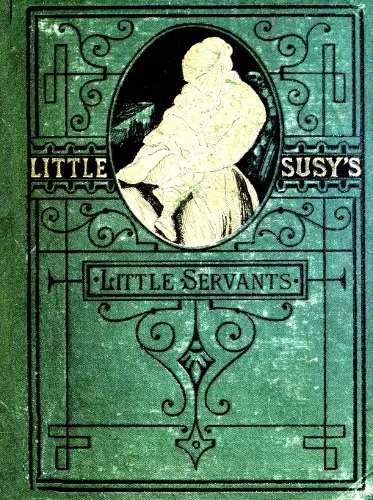
Little Susy’s Little Servants
E. (Elizabeth) Prentiss
THE CLASSIC COLLECTION · 1876
"The Home at Greylock" by E. Prentiss is a novel written in the late 19th century. The story revolves around Mrs. Grey and her daughter Maud, exploring themes of love, loss, and the complexities of familial relationships. The narrative delves into Mrs. Grey's deep bond with Maud, the challenges they face, and the implications of Maud's untimely death on their lives and the lives of their family members. At the start of the novel, we are introduced to Mrs. Grey, a devoted mother to seven children, all of whom have grown and married, except for her youngest daughter, Maud. The opening chapters vividly depict the loving relationship between Mrs. Grey and Maud, highlighting their shared joys and responsibilities. The story takes a poignant turn with Maud's tragic fate, presenting Mrs. Grey's struggle with grief while also showcasing her resilience and unwavering faith as she copes with the loss. As family members gather to support her in this time of sorrow, the narrative hints at Mrs. Grey's desire to open her home to a new life, reflective of her unyielding spirit and capacity for love amidst heartache.
Introduction adapted from the source catalogue; source summaries may be automatically generated.
Free to read · English · 77,004 words · No account needed
MAKE TIME FOR A GOOD BOOK
On by default. Untick to stop anonymous reading totals. Each page counts after 10 seconds in view. How this works.
Anonymous counting is on unless you have switched it off.
What heart lay developed under the lad's vest died within him. This, then, was the penalty that lay before him; his crime was to kill his mother!
"Who says she's going to die?" he asked, roughly.
"No one says so, but I know she is. Read that."
Bob took the little note the child handed him, and read it in silence:
Not very long ago your energetic little hands undertook to arrange my bureau drawers for me. Coming in suddenly I misunderstood the disorder of my room, and drove you from it angrily. It was wrong; I am sorry for it; I have asked God to forgive me, and now I ask you to forgive your poor, faulty
"I'll bet she is going to die," said Bob. "Never knew her to do anything like that before. I've been an awfully horrid fellow. I wish I hadn't."
"I've been horrid, too," said Julia. "And I wish I hadn't."
"You've been splendid compared with me," said Bob.
"Let's go and tell Esther," suggested Julia.
"What for? She won't care."
"You seem to think she's a heathen Chinee," said Julia.
"So she is, sometimes. But not always."
Esther was accordingly taken into confidence, and expressed a wish to box their ears for a pair of ninnies, until she read the note, which struck terror to her heart.
"I don't feel at all nice," she said. "Though I'm not as bad as many girls. I know Mrs. Mather pays Melville five dollars a month if she isn't saucy to her. And Jane Waite tells fibs. And Jemima Watson threw her mother's watch on the floor and stamped on it."
"What for?"
"Because she couldn't get an example right. Julia, I wish you hadn't shown me that note. It was real mean in you. You knew it would stick in my throat."
Meanwhile Mrs. Thayer was looking forward with anxiety to the day of Esther's proposed lunch party, and the storm that was to follow the announcement that she should not sanction it. Great, therefore, was her surprise when Esther came, voluntarily, to say, in a nonchalant way, put on to hide some real feeling, that she had changed her mind, and did not intend to invite the girls.
"I am very glad to hear it," was the reply, "for I did not intend to provide lunch save for the family, as usual, and you would have had to recall your invitations. Henceforth, when you wish for an indulgence of this sort, come and ask my consent."
Your reading position is saved on this browser. Take it to another device with a library code. Reading pages adapt to text, rather than matching a printed edition.
E. (Elizabeth) Prentiss
BEHIND THE BOOK
This eBook is for the use of anyone anywhere in the United States and most other parts of the world at no cost and with almost no restrictions whatsoever. You may copy it, give it away or re-use it under the terms of the Project Gutenberg License included with this eBook or online at www.gutenberg.org. If you are not located in the United States, you will have to check the laws of the country where you are located before using this eBook. Read the source licence.
The original source file, including credits and licence, is retained by this library. Request an original-format copy at no charge. Please include the book title and Project Gutenberg identifier #47850.
KEEP YOUR CURIOSITY GOING
Coulson Kernahan

Maurice Baring
Frances Wright
Cécile Tormay

Frederic Jesup Stimson

W. H. P. (William Henry Pope) Jarvis