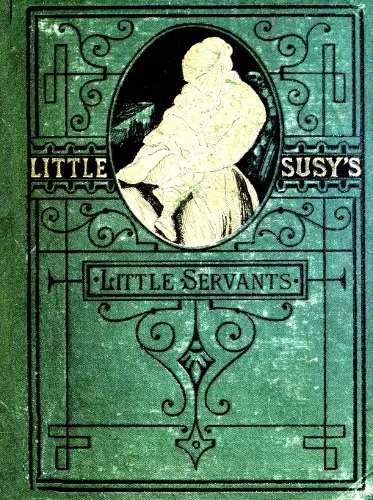
Little Susy’s Little Servants
E. (Elizabeth) Prentiss
THE CLASSIC COLLECTION · 1876
"The Home at Greylock" by E. Prentiss is a novel written in the late 19th century. The story revolves around Mrs. Grey and her daughter Maud, exploring themes of love, loss, and the complexities of familial relationships. The narrative delves into Mrs. Grey's deep bond with Maud, the challenges they face, and the implications of Maud's untimely death on their lives and the lives of their family members. At the start of the novel, we are introduced to Mrs. Grey, a devoted mother to seven children, all of whom have grown and married, except for her youngest daughter, Maud. The opening chapters vividly depict the loving relationship between Mrs. Grey and Maud, highlighting their shared joys and responsibilities. The story takes a poignant turn with Maud's tragic fate, presenting Mrs. Grey's struggle with grief while also showcasing her resilience and unwavering faith as she copes with the loss. As family members gather to support her in this time of sorrow, the narrative hints at Mrs. Grey's desire to open her home to a new life, reflective of her unyielding spirit and capacity for love amidst heartache.
Introduction adapted from the source catalogue; source summaries may be automatically generated.
Free to read · English · 77,004 words · No account needed
MAKE TIME FOR A GOOD BOOK
On by default. Untick to stop anonymous reading totals. Each page counts after 10 seconds in view. How this works.
Anonymous counting is on unless you have switched it off.
"And now about Julia," cried Mrs. Thayer. "She is naturally a nice child; but she is copying all Esther's ways. And before I forget it, I want to consult you about an incident that occurred just before you came. Julia is very energetic, and one day, when I was out, undertook to put my bureau in order. When I came in and found my room in an uproar--the bed, the floors, the sofa covered with heterogeneous masses of clothing--I was extremely displeased, and seized the child by the arm and marched her angrily out of the room. Whereupon she dropped a courtesy and said, 'Thank you, ma'am. You must have had a nice prayer-meeting!' I afterwards found that she had been preparing a pleasant surprise for me by putting my drawers in order. Ought I to say anything to her about it?"
"Yes, you ought to ask her pardon."
"Ask her pardon! Ask a child's pardon!"
"Why not? She has her individual rights as you have yours."
"But to degrade myself to a child of ten years!"
"To ennoble yourself in her eyes. The degradation was in losing your
temper."
"Well--well--well! This home has got to be pulled all to pieces and built up again, if we are to follow your suggestions."
"Pull away," said Mrs. Grey, smiling; "the sooner the better. And now won't you let me see the little nursery people?"
Mrs. Thayer's face cleared as she led the way to baby and his brother,
both large for their age.
"What splendid boys!" exclaimed Mrs. Grey.
"Are they not? And the others were just as fine, apparently."
Mrs. Grey took the baby from his nurse's arms and kissed it.
"I should think this room would be a city of refuge, with these innocent creatures in it," she said.
"Yes; doesn't it rest one to see little children before they are
spoiled?"
"You speak as if spoiling was inseparable from development; as if life were intended to be all retrograde."
"Oh, I thought I should find you ladies here," said Mr. Thayer, entering the room. "Suppose we adjourn to the library."
"Let me take Mrs. Grey to my room first, to see the children's
portraits."
Mr. Thayer assented, and they all proceeded thither.
Bob, Esther, and Julia had been grouped together and beautifully
painted by an artistic hand.
"I never saw a finer face than Bob's," said Mrs. Grey, "nor sweeter ones than those of the girls; it is hard indeed to think such children can turn out ill."
"Yes," said Mrs. Thayer, "I little thought when these portraits were
painted, how Bob was going to break my heart, and Esther refuse to
obey."
Your reading position is saved on this browser. Take it to another device with a library code. Reading pages adapt to text, rather than matching a printed edition.
E. (Elizabeth) Prentiss
BEHIND THE BOOK
This eBook is for the use of anyone anywhere in the United States and most other parts of the world at no cost and with almost no restrictions whatsoever. You may copy it, give it away or re-use it under the terms of the Project Gutenberg License included with this eBook or online at www.gutenberg.org. If you are not located in the United States, you will have to check the laws of the country where you are located before using this eBook. Read the source licence.
The original source file, including credits and licence, is retained by this library. Request an original-format copy at no charge. Please include the book title and Project Gutenberg identifier #47850.
KEEP YOUR CURIOSITY GOING
Coulson Kernahan

Maurice Baring
Frances Wright
Cécile Tormay

Frederic Jesup Stimson

W. H. P. (William Henry Pope) Jarvis