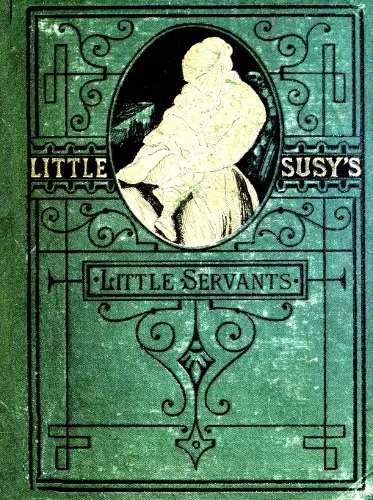
Little Susy’s Little Servants
E. (Elizabeth) Prentiss
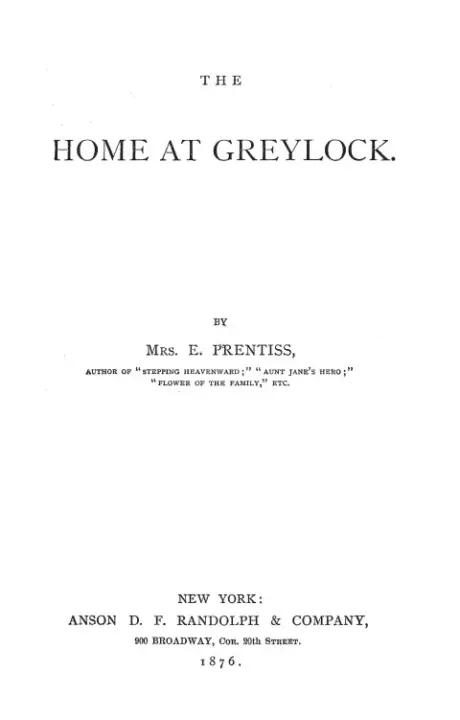
THE CLASSIC COLLECTION · 1876
"The Home at Greylock" by E. Prentiss is a novel written in the late 19th century. The story revolves around Mrs. Grey and her daughter Maud, exploring themes of love, loss, and the complexities of familial relationships. The narrative delves into Mrs. Grey's deep bond with Maud, the challenges they face, and the implications of Maud's untimely death on their lives and the lives of their family members. At the start of the novel, we are introduced to Mrs. Grey, a devoted mother to seven children, all of whom have grown and married, except for her youngest daughter, Maud. The opening chapters vividly depict the loving relationship between Mrs. Grey and Maud, highlighting their shared joys and responsibilities. The story takes a poignant turn with Maud's tragic fate, presenting Mrs. Grey's struggle with grief while also showcasing her resilience and unwavering faith as she copes with the loss. As family members gather to support her in this time of sorrow, the narrative hints at Mrs. Grey's desire to open her home to a new life, reflective of her unyielding spirit and capacity for love amidst heartache.
Introduction adapted from the source catalogue; source summaries may be automatically generated.
Free to read · English · 77,004 words · No account needed
MAKE TIME FOR A GOOD BOOK
On by default. Untick to stop anonymous reading totals. Each page counts after 10 seconds in view. How this works.
Anonymous counting is on unless you have switched it off.
Olaf knew little about art, but had some general idea that even this small study was beyond his means. But the musical tongue ran merrily on; he should have it for her country-woman for a mere song, and it would warm her heart to see a bit of her own sky.
"Yours," she said, "is bleak and cold. I would not live there; it would
kill my heart!"
At the same time she would have tried the experiment under the guidance of such a genial-looking man as Olaf, provided he had no wife.
"And now," she said, "something for the boy, with his blue eyes and
rosy cheeks."
"Black eyes and olive cheeks, like thine!" cried Olaf.
The girl blushed and smiled.
"Would this please him, think you?" she asked, producing a miniature palette, on which were fastened cakes, in water colors--a cheap affair, such as, however, has gladdened many a child's heart.
"And, stay, here are brushes, likewise--a gift to the Swedish boy with
my eyes and hair."
Olaf received the little gracefully-offered gift, and took leave, the young girl following his sturdy figure with her eyes as long as it was in sight.
"The saints grant that the father does not miss the picture, and beat me for as good as giving it away," she cried; "and if he does, Antonio shall paint him another. Ah, Antonio, if your eyes were but blue, and your cheeks ruddy! If you were tall, and straight, and strong, and not as black as a raven, and round-shouldered, and bow-legged! And still painted divinely!"
Olaf proceeded rapidly home, and greeted his wife in a way that procured for Carina, on the part of Eric, embraces, kisses, and asseverations not a few. But when the picture was produced, and Viola saw this bit of her native land, a strange complication of emotions she could not understand made her burst into tears. A sense of the beautiful had long lain dormant in her soul amid the stern scenes about her. Now came reminiscences of sunshine, birds and flowers, and delicious fruit; of works of art seen in the house of her master at Rome, and dimly appreciated.
"Thou wicked picture, to make the dear mother cry!" said Eric, rushing at it with a stick of wood. "I'll kill thee!"
But as his eye fell upon it, his hand dropped at his side, and a new soul illumined his face. They laughed at him, they shook him, they tried in every way to divert his rapt attention, but all in vain; he stood like a devotee before a shrine, and lost to all beside.
Your reading position is saved on this browser. Take it to another device with a library code. Reading pages adapt to text, rather than matching a printed edition.
E. (Elizabeth) Prentiss
BEHIND THE BOOK
This eBook is for the use of anyone anywhere in the United States and most other parts of the world at no cost and with almost no restrictions whatsoever. You may copy it, give it away or re-use it under the terms of the Project Gutenberg License included with this eBook or online at www.gutenberg.org. If you are not located in the United States, you will have to check the laws of the country where you are located before using this eBook. Read the source licence.
The original source file, including credits and licence, is retained by this library. Request an original-format copy at no charge. Please include the book title and Project Gutenberg identifier #47850.
KEEP YOUR CURIOSITY GOING
Coulson Kernahan

Maurice Baring
Frances Wright
Cécile Tormay

Frederic Jesup Stimson

W. H. P. (William Henry Pope) Jarvis