THE CLASSIC COLLECTION✦Among Famous BooksCLASSIC FREE BOOKS
Among Famous Books
John Kelman
THE CLASSIC COLLECTION · 1902
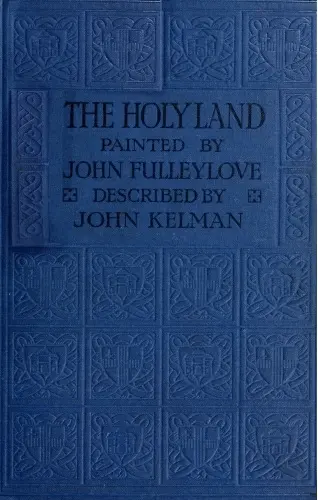
"The Holy Land" by John Kelman is a descriptive travelogue written in the early 20th century. The book explores the rich tapestry of history, spirituality, and the geographic beauty of the Holy Land, with a focus on both its ancient significance and the impressions it leaves on contemporary travelers. Kelman contemplates the cultural and religious ramifications of the land, providing readers with a thoughtful and engaging narrative that bridges past and present. The opening of the book sets a reflective tone, as the author introduces his intention to describe the Holy Land through personal impressions rather than scientific discourse. He emphasizes the sacramental nature of travel in these sacred spaces, urging readers to engage with the land as it exists now, beyond their expectations or preconceptions. Kelman elaborates on the distinct color palette of the region's landscapes, describing how the unique tones embody the essence of Syria and invite a deeper understanding of its past. By interweaving personal anecdotes with historical context, he invites readers to experience the Holy Land not merely as a geographical location but as a living testament to millennia of faith and human experience.
Introduction adapted from the source catalogue; source summaries may be automatically generated.
Free to read · English · 66,689 words · No account needed
MAKE TIME FOR A GOOD BOOK
On by default. Untick to stop anonymous reading totals. Each page counts after 10 seconds in view. How this works.
Anonymous counting is on unless you have switched it off.
Within, the white towns shew a strange mixture of splendour and of sordidness. The streets are aggressively irregular, and the whole impresses one as at once ancient and unfinished. The wider spaces are full of colour and of noise, and the houses which surround them are a patchwork of all manner of buildings, with smaller structures leaning against their sides, and gaudy awnings of ragged edge protecting doorways from the sun. Where the street narrows, it is filled with crowds of men, women, and children, and laden donkeys pushing them aside as they pass along. There are lanes, also, in deep shadow, with buttresses and long archways converting them into high and narrow tunnels. The shopkeepers in these lanes sit behind their piles of merchandise and converse in shrill voices with neighbours on the other side, not six feet away. The whole appearance of the town is that of close-huddled dwellings, which have squeezed themselves into as little space as possible, and have been forced to expand upwards for want of lateral room.
These towns are the mingling-places of Syria--crucibles of its national life, in which new and composite races are being molten. One or two of them, like Nablus and Hebron, are inhabited chiefly by a fanatical Moslem population, and in these life stagnates. But the others are open to the world. In the past, long before the modern stream of travellers came, this process was going on. In very early times the towns were recruited by the neighbouring Canaanites and Arabs. They were, as they still are, so insanitary that if it were not for such additions their population would soon die out. In Christ’s time the Greek and Roman world poured itself into them; then came the long train of Christian pilgrims; after that the Crusader hosts. Each of these, and many other incursions, have helped to mix the race of townsfolk. In Bethlehem and elsewhere there are many descendants of the Crusaders, whose fair hair and complexion tells its own tale. But the mingling of races has gone on with quite a new rapidity during the last few decades. Trade and travel have combined to force the West upon the East. Circassians, Kurds, Turks, Jews, Africans, Cypriotes have settled there. Travellers who have twice visited the land, with an interval of some years between their visits, are struck by the sudden and sweeping change. Even the passing visitor cannot fail to perceive it. The villagers remain apart, intermarrying within the village or with neighbouring Fellahin. The townspeople bring their brides from other towns, and sometimes from other nations. Many kinds of imported goods are exposed for sale in the bazaars. There are parts of Damascus where nothing is sold that was not made in Europe. The habits of the West are also invading towns. Intoxicating liquors are freely sold, and in Nazareth there are now no fewer than seventeen public-houses. “Paris fashions”--probably belated--are ousting the ancient customs. Tattooing is quite out of fashion among the women of the towns, and knives and forks have penetrated native houses even in Hebron. The traveller comes into contact with the townspeople far less fully than with the villagers. In the towns everybody is minding some business or other of his own, and the stranger meets with the residenter merely as buyer with seller. Once only did we see the interior of a town house, and that visit confirmed the impression of a new and composite life very remarkably. It was in Tyre. An agreeable native, who had brought some curiosities for sale, invited us to go home with him and inspect his stock. The house was in a narrow street, but the rooms were large. His wife sat near the window smoking a nargileh, her eyebrows painted black, and her face heavily powdered and rouged. The room was crowded with furniture. There were a sofa and two European beds with mosquito curtains; a new English wardrobe of carved walnut, with a large mirror; a kitchen dresser covered with dinner dishes of the customary European kind. Dry-goods boxes were drawn forth from under the beds and the sofa, and pasteboard boxes from drawers and shelves, all filled with the most indescribable medley of curiosities from rifled tombs. Bracelets, tear-bottles, ear-rings came to light in rapid succession. Finally, a square foot of lead-work appeared--part of a leaden winding-sheet which had recently been torn off an ancient corpse in a sarcophagus--a heavy shroud, finely ornamented with deep-moulded garlands and figures. Our hosts were good-humoured and pleasant people, who conducted the conversation in some five different languages, and appeared to combine in themselves and their properties several centuries of human life.
Your reading position is saved on this browser. Take it to another device with a library code. Reading pages adapt to text, rather than matching a printed edition.
BEHIND THE BOOK
This eBook is for the use of anyone anywhere in the United States and most other parts of the world at no cost and with almost no restrictions whatsoever. You may copy it, give it away or re-use it under the terms of the Project Gutenberg License included with this eBook or online at www.gutenberg.org. If you are not located in the United States, you will have to check the laws of the country where you are located before using this eBook. Read the source licence.
The original source file, including credits and licence, is retained by this library. Request an original-format copy at no charge. Please include the book title and Project Gutenberg identifier #55958.
KEEP YOUR CURIOSITY GOING
Wilfrid Scawen Blunt
Wilfrid Scawen Blunt

E. W. (Edgar Watson) Howe

David Patterson (Spirit) Hatch

David Patterson (Spirit) Hatch

David Patterson (Spirit) Hatch