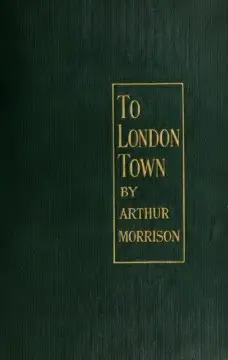
To London Town
Arthur Morrison
THE CLASSIC COLLECTION · 1902
"The Hole in the Wall" by Arthur Morrison is a novel written in the early 20th century. The story revolves around young Stephen, who recounts his experiences growing up with his grandfather, Nathaniel Kemp, the owner of a public house on the river's edge in Wapping, called the Hole in the Wall. Through Stephen's innocent eyes, readers are introduced to a world filled with sailors, dock life, and the darker underbelly of London society, juxtaposed with moments of nostalgia and childhood whimsy. At the start of the novel, Stephen shares memories of his grandfather, highlighting both fondness and the complexities of his family life, marked by loss and the absent presence of his father at sea. The narrative transitions into a vivid depiction of Stephen's new life at the Hole in the Wall, alongside his grandfather—a man of considerable physical presence and a distinct reputation. The opening chapters establish the setting filled with colorful characters, including dubious sailors and intricate relationships, and hint at the darker themes of crime, mortality, and survival that weave through Stephen's childhood as he navigates the bustling environment around him.
Introduction adapted from the source catalogue; source summaries may be automatically generated.
Free to read · English · 63,871 words · No account needed
MAKE TIME FOR A GOOD BOOK
On by default. Untick to stop anonymous reading totals. Each page counts after 10 seconds in view. How this works.
Anonymous counting is on unless you have switched it off.
A little farther along, and we came upon Ratcliff Highway. I saw the street then for the first time, and in truth it was very wonderful. I think there could never have been another street in this country at once so foul and so picturesque as Ratcliff Highway at the time I speak of. Much that I saw I could not understand, child as I was; and by so much the more was I pleased with it all, when perhaps I should have been shocked. From end to end of the Highway and beyond, and through all its tributaries and purlieus everything and everybody was for, by, and of, the sailor ashore; every house and shop was devoted to his convenience and inconvenience; in the Highway it seemed to me that every other house was a tavern, and in several places two stood together. There were shops full of slops, sou'westers, pilot-coats, sea-boots, tin pannikins, and canvas kit-bags like giants' bolsters; and rows of big knives and daggers, often engraved with suggestive maxims. A flash of memory recalls the favourite: "Never draw me without cause, never sheathe me without honour." I have since seen the words "cause" and "honour" put to uses less respectable.
The pawn-shops had nothing in them that had not come straight from a ship--sextants and boatswain's pipes being the choice of the stock. And pawn-shops, slop-shops, tobacco-shops--every shop almost--had somewhere in its window a selection of those curiosities that sailors make abroad and bring home: little ship-models mysteriously erected inside bottles, shells, albatross heads, saw-fish snouts, and bottles full of sand of different colours, ingeniously packed so as to present a figure or a picture when viewed from without.
Men of a dozen nations were coming or going in every score of yards. The best dressed, and the worst, were the negroes; for the black cook who was flush went in for adornments that no other sailor-man would have dreamed of: a white shirt, a flaming tie, a black coat with satin facings--even a white waistcoat and a top hat. While the cleaned-out and shipless nigger was a sad spectacle indeed. Then there were Spaniards, swart, long-haired, bloodshot-looking fellows, whose entire shore outfit consisted commonly of a red shirt, blue trousers, anklejacks with the brown feet visible over them, a belt, a big knife, and a pair of large gold ear-rings. Big, yellow-haired, blue-eyed Swedes, who were full pink with sea and sun, and not brown or mahogany-coloured, like the rest; slight, wicked-looking Malays; lean, spitting Yankees, with stripes, and felt hats, and sing-song oaths; sometimes a Chinaman, petticoated, dignified, jeered at; a Lascar, a Greek, a Russian; and everywhere the English Jack, rolling of gait--sometimes from habit alone, sometimes for mixed reasons--hard, red-necked, waistcoatless, with his knife at his belt, like the rest: but more commonly a clasp-knife than one in a sheath. To me all these strangely bedight men were matter of delight and wonder; and I guessed my hardest whence each had come last, what he had brought in his ship, and what strange and desperate adventures he had encountered on the way. And wherever I saw bare, hairy skin, whether an arm, or the chest under an open shirt, there were blue devices of ships, of flags, of women, of letters and names. Grandfather Nat was tattooed like that, as I had discovered in the morning, when he washed. He had been a fool to have it done, he said, as he flung the soapy water out of window into the river, and he warned me that I must be careful never to make such a mistake myself; which made me sorry, because it seemed so gallant an embellishment. But my grandfather explained that you could be identified by tattoo-marks, at any length of time, which might cause trouble. I remembered that my own father was tattooed with an anchor and my mother's name; and I hoped he would never be identified, if it were as bad as that.
Your reading position is saved on this browser. Take it to another device with a library code. Reading pages adapt to text, rather than matching a printed edition.
Arthur Morrison
Arthur Morrison
Arthur Morrison
Arthur Morrison
BEHIND THE BOOK
This eBook is for the use of anyone anywhere in the United States and most other parts of the world at no cost and with almost no restrictions whatsoever. You may copy it, give it away or re-use it under the terms of the Project Gutenberg License included with this eBook or online at www.gutenberg.org. If you are not located in the United States, you will have to check the laws of the country where you are located before using this eBook. Read the source licence.
The original source file, including credits and licence, is retained by this library. Request an original-format copy at no charge. Please include the book title and Project Gutenberg identifier #34538.
KEEP YOUR CURIOSITY GOING
Coulson Kernahan

Maurice Baring
Frances Wright
Cécile Tormay

Frederic Jesup Stimson

W. H. P. (William Henry Pope) Jarvis