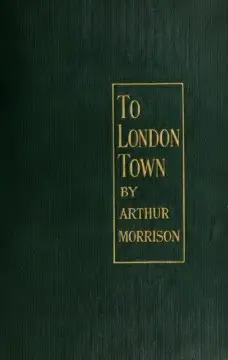
To London Town
Arthur Morrison
THE CLASSIC COLLECTION · 1902
"The Hole in the Wall" by Arthur Morrison is a novel written in the early 20th century. The story revolves around young Stephen, who recounts his experiences growing up with his grandfather, Nathaniel Kemp, the owner of a public house on the river's edge in Wapping, called the Hole in the Wall. Through Stephen's innocent eyes, readers are introduced to a world filled with sailors, dock life, and the darker underbelly of London society, juxtaposed with moments of nostalgia and childhood whimsy. At the start of the novel, Stephen shares memories of his grandfather, highlighting both fondness and the complexities of his family life, marked by loss and the absent presence of his father at sea. The narrative transitions into a vivid depiction of Stephen's new life at the Hole in the Wall, alongside his grandfather—a man of considerable physical presence and a distinct reputation. The opening chapters establish the setting filled with colorful characters, including dubious sailors and intricate relationships, and hint at the darker themes of crime, mortality, and survival that weave through Stephen's childhood as he navigates the bustling environment around him.
Introduction adapted from the source catalogue; source summaries may be automatically generated.
Free to read · English · 63,871 words · No account needed
MAKE TIME FOR A GOOD BOOK
On by default. Untick to stop anonymous reading totals. Each page counts after 10 seconds in view. How this works.
Anonymous counting is on unless you have switched it off.
"Why, yes, grandfather." Truly that was an easy enough thing to say; and in fact I was in some way pleased to know that my mother had been right, after all.
"Right, Stevy; be an honest boy always, and an honest man--better than me. Since I was a boy like you, I've gone a long way wrong, an' I've been a bad man, Stevy, a bad man some ways, at least. An' now, Stevy, I'm goin' away--for a bit. Presently, when I'm gone, you can go to the stairs an' call Bill Stagg--he'll come at once. Call Bill Stagg--he'll stay with you to-night. You don't mind Bill Stagg, do you?"
Bill Stagg was an excellent friend of mine, and I liked his company; but I could not understand Grandfather Nat's going away. Where was he going, and why, so late at night?
"Never mind that just now, Stevy. I'm going away--for a bit; an' whatever happens you'll always say prayers night an' mornin' for Gran'father Nat, won't you? An' be a good boy."
There was something piteous now in my grandfather's hard, grave face. "Don't go, grandfather," I pleaded, with my arm at his neck, "don't go! Grandfather Nat! You're not--not going to die, are you?"
"That's as God wills, my boy. We must all die some day."
I think he was near breaking down here; but at the moment a voice called
up the stairs.
"Are you coming?" said the voice. "Time's nearly up!" And it frightened me more than I can say to know this second voice at last for Viney's.
But my grandfather was firm again at once. "Yes," he cried, "I'm coming!... No more to do, Stevy--snivelling's no good." And then Grandfather Nat put his hands clumsily together, and shut his eyes like a little child. "God bless an' save this boy, whatever happens. Amen," said Grandfather Nat.
Then he rose and took from the cash-box the watch that the broken-nosed man had sold. "There's that, too," he said musingly. "I dunno why I kep' it so long." And with that he shut the cash-box, and strode across to the landing. He looked back at me for a moment, but said nothing; and then descended the stairs.
Bewildered and miserably frightened, I followed him.
I could neither reason nor cry out, and I had an agonised hope that I was not really awake, and that this was just such a nightmare as had afflicted me on the night of the murder at our door. I crouched on the lower stairs, and listened....
"Yes, I've got it," said my grandfather, answering an eager question. "There it is. Look at that--count the notes."
Your reading position is saved on this browser. Take it to another device with a library code. Reading pages adapt to text, rather than matching a printed edition.
Arthur Morrison
Arthur Morrison
Arthur Morrison
Arthur Morrison
BEHIND THE BOOK
This eBook is for the use of anyone anywhere in the United States and most other parts of the world at no cost and with almost no restrictions whatsoever. You may copy it, give it away or re-use it under the terms of the Project Gutenberg License included with this eBook or online at www.gutenberg.org. If you are not located in the United States, you will have to check the laws of the country where you are located before using this eBook. Read the source licence.
The original source file, including credits and licence, is retained by this library. Request an original-format copy at no charge. Please include the book title and Project Gutenberg identifier #34538.
KEEP YOUR CURIOSITY GOING
Coulson Kernahan

Maurice Baring
Frances Wright
Cécile Tormay

Frederic Jesup Stimson

W. H. P. (William Henry Pope) Jarvis