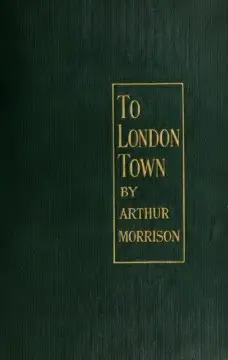
To London Town
Arthur Morrison
THE CLASSIC COLLECTION · 1902
"The Hole in the Wall" by Arthur Morrison is a novel written in the early 20th century. The story revolves around young Stephen, who recounts his experiences growing up with his grandfather, Nathaniel Kemp, the owner of a public house on the river's edge in Wapping, called the Hole in the Wall. Through Stephen's innocent eyes, readers are introduced to a world filled with sailors, dock life, and the darker underbelly of London society, juxtaposed with moments of nostalgia and childhood whimsy. At the start of the novel, Stephen shares memories of his grandfather, highlighting both fondness and the complexities of his family life, marked by loss and the absent presence of his father at sea. The narrative transitions into a vivid depiction of Stephen's new life at the Hole in the Wall, alongside his grandfather—a man of considerable physical presence and a distinct reputation. The opening chapters establish the setting filled with colorful characters, including dubious sailors and intricate relationships, and hint at the darker themes of crime, mortality, and survival that weave through Stephen's childhood as he navigates the bustling environment around him.
Introduction adapted from the source catalogue; source summaries may be automatically generated.
Free to read · English · 63,871 words · No account needed
MAKE TIME FOR A GOOD BOOK
On by default. Untick to stop anonymous reading totals. Each page counts after 10 seconds in view. How this works.
Anonymous counting is on unless you have switched it off.
Dan was surly; first because it was policy to say little, and to seem intractable, and again because, after the night's adventure, it came natural. "So you're Viney, are you?" he said. "Well, I ain't afraid o' you. I know about you. Blind George told me your game."
"Who said anything about afraid?" Viney protested, the eternal grin twitching nervously in his yellow cheeks. "We needn't talk about being afraid. It seems to me we can work together."
"O, does it? How?"
"Well, you know, you can't change 'em."
"What?"
"O, damn it, you know what I mean. The money--the notes."
"O, that's what you mean, is it? Well, s'pose I can't?"
"Well--of course--if you can't--eh? If you can't, they might be so much
rags, eh?"
"P'raps they might--if I can't."
"But you know you can't," retorted the other, with a spasm of apprehension. "Else you'd have done it and--and got farther off."
"Well, p'raps I might. But that ain't all you come to say. Go on."
Viney thoughtfully scratched his lank cheek, peering sharply into Dan's face. "Things bein' what they are," he said, reflectively, "they're no more good to you than rags; not so much."
"All right. S'pose they ain't; you don't think I'm a-goin' to make you a present of 'em, do you?"
"Why no, I didn't think that. I'll pay--reasonable. But you must remember that they're no good to you at all--not worth rag price; so whatever you got 'ud be clear profit."
"Then how much clear profit will you give me?"
Viney's forefinger paused on his cheek, and his gaze, which had sunk to Dan Ogle's waistcoat, shot sharply again at his eyes. "Ten pounds," said Viney.
Dan chuckled, partly at the absurdity of the offer, partly because this bargaining for the unproducible began to amuse him. "Ten pound clear profit for me," he said, "an' eight hundred pound clear profit for you. That's your idea of a fair bit o' trade!"
"But it was mine first, and--and it's no good to you--you say so
yourself!"
"No; nor no good to you neither--'cause why? You ain't got it!" Dan's chuckle became a grin. "If you'd ha' said a hundred, now----"
"What?"
"Why, then I'd ha' said four hundred. That's what I'd ha' said!"
"Four hundred? Why, you're mad! Besides I haven't got it--I've got nothing till I can change the notes; only the ten."
Dan saw the chance he had hoped for. "I'll make it dirt cheap," he said, "first an' last, no less an' no more. Will you give me fifty down for 'em when you've got 'em changed?"
"Yes, I will." Viney's voice was almost too eager.
"Straight? No tricks, eh?"
Your reading position is saved on this browser. Take it to another device with a library code. Reading pages adapt to text, rather than matching a printed edition.
Arthur Morrison
Arthur Morrison
Arthur Morrison
Arthur Morrison
BEHIND THE BOOK
This eBook is for the use of anyone anywhere in the United States and most other parts of the world at no cost and with almost no restrictions whatsoever. You may copy it, give it away or re-use it under the terms of the Project Gutenberg License included with this eBook or online at www.gutenberg.org. If you are not located in the United States, you will have to check the laws of the country where you are located before using this eBook. Read the source licence.
The original source file, including credits and licence, is retained by this library. Request an original-format copy at no charge. Please include the book title and Project Gutenberg identifier #34538.
KEEP YOUR CURIOSITY GOING
Coulson Kernahan

Maurice Baring
Frances Wright
Cécile Tormay

Frederic Jesup Stimson

W. H. P. (William Henry Pope) Jarvis