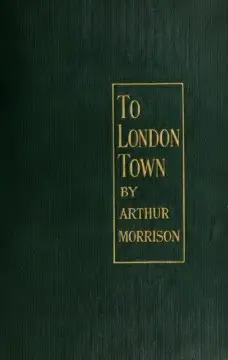
To London Town
Arthur Morrison
THE CLASSIC COLLECTION · 1902
"The Hole in the Wall" by Arthur Morrison is a novel written in the early 20th century. The story revolves around young Stephen, who recounts his experiences growing up with his grandfather, Nathaniel Kemp, the owner of a public house on the river's edge in Wapping, called the Hole in the Wall. Through Stephen's innocent eyes, readers are introduced to a world filled with sailors, dock life, and the darker underbelly of London society, juxtaposed with moments of nostalgia and childhood whimsy. At the start of the novel, Stephen shares memories of his grandfather, highlighting both fondness and the complexities of his family life, marked by loss and the absent presence of his father at sea. The narrative transitions into a vivid depiction of Stephen's new life at the Hole in the Wall, alongside his grandfather—a man of considerable physical presence and a distinct reputation. The opening chapters establish the setting filled with colorful characters, including dubious sailors and intricate relationships, and hint at the darker themes of crime, mortality, and survival that weave through Stephen's childhood as he navigates the bustling environment around him.
Introduction adapted from the source catalogue; source summaries may be automatically generated.
Free to read · English · 63,871 words · No account needed
MAKE TIME FOR A GOOD BOOK
On by default. Untick to stop anonymous reading totals. Each page counts after 10 seconds in view. How this works.
Anonymous counting is on unless you have switched it off.
Dan and the woman exchanged a quick look; plainly something had gone before that gave the words significance. "No," Marr went on, "mus'n' go 'ome. I'm sailor man jus' 'shore from brig Juno in from Barbadoes.... No, not Juno, course not. Dunno Juno. 'Tain' Juno. D'year? 'Tain' Juno, ye know, my ship. Never heard o' Juno. Mine's 'nother ship.... I say, wha'sh name my ship?"
"You're a rum sailor-man," said Dan, "not to know the name of your own ship ten minutes together. Why, you've told us about four different names a'ready."
The sham seaman chuckled feebly.
"Why, I don't believe you're a sailor at all, mate," the woman remarked, still playfully. "You've just bin a-kiddin' of us fine!"
The chuckle persisted, and turned to a stupid grin. "Ha, ha! Ha, ha! Have it y'r own way." This with a clumsily stealthy grope at the breast pocket--a movement that the others had seen before, and remembered. "Have it y'r own way. But I say; I say, y'know"--suddenly serious--"you're all right, ain't you? Eh? All right, you know, eh? I s-say--I hope you're--orright?"
"Awright, mate? Course we are!" And Dan clapped him cordially on the
shoulder.
"Awright, mate?" shouted the blind man, his white eye rolling and blinking horribly at the ceiling. "Right as ninepence! An' a 'a'penny over, damme!"
"We're awright," growled the broken-nosed man, thickly.
"We don't tell no secrets," said the woman.
"Thash all very well, but I was talkin' about the Juno, y'know. Was'n I talkin' about Juno?" A look of sleepy alarm was on the fair man's face as he turned his eyes from one to another.
"Ay, that's so," answered the fellow at his side. "Brig Juno in from
Barbadoes."
"Ah! Thash where you're wrong; she ain't in--see?" Marr wagged his head, and leered the profoundest sagacity. "She ain't in. What's more, 'ow d'you know she ever will come in, eh? 'Ow d'ye know that? Thash one for ye, ole f'ler! Whar'll ye bet me she ever gets as far as--but I say, I say; I say, y'know, you're all right, ain't you? Qui' sure you're orrigh'?"
There was a new and a longer chorus of reassurance, which Dan at last ended with: "Go on; the Juno ain't ever to come back; is that it?"
Marr turned and stared fishily at him for some seconds. "Wha'rr you mean?" he demanded, at length, with a drivelling assumption of dignity. "Wha'rr you mean? N-never come back? Nishe remark make 'spectable shipowner! Whassor' firm you take us for, eh?"
Your reading position is saved on this browser. Take it to another device with a library code. Reading pages adapt to text, rather than matching a printed edition.
Arthur Morrison
Arthur Morrison
Arthur Morrison
Arthur Morrison
BEHIND THE BOOK
This eBook is for the use of anyone anywhere in the United States and most other parts of the world at no cost and with almost no restrictions whatsoever. You may copy it, give it away or re-use it under the terms of the Project Gutenberg License included with this eBook or online at www.gutenberg.org. If you are not located in the United States, you will have to check the laws of the country where you are located before using this eBook. Read the source licence.
The original source file, including credits and licence, is retained by this library. Request an original-format copy at no charge. Please include the book title and Project Gutenberg identifier #34538.
KEEP YOUR CURIOSITY GOING
Coulson Kernahan

Maurice Baring
Frances Wright
Cécile Tormay

Frederic Jesup Stimson

W. H. P. (William Henry Pope) Jarvis