THE CLASSIC COLLECTION✦Anthology of Russian literature from the earliest period to the present time, volume 1 (of 2)CLASSIC FREE BOOKS
Anthology of Russian literature from the earliest period to the present time, volume 1 (of 2)
Leo Wiener
THE CLASSIC COLLECTION · 1899
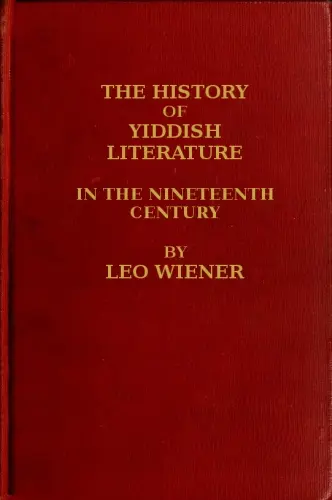
"The History of Yiddish Literature in the Nineteenth Century" by Leo Wiener is a historical account written in the late 19th century. The work delves into the development and characteristics of Yiddish literature during the 1800s, exploring the linguistic, cultural, and social influences that shaped it. The author aims to shed light on the often-overlooked literary contributions of the Jewish community and to acknowledge the significance of the Judeo-German works within the broader context of European literature. At the start of the work, Wiener sets the stage by discussing the background and circumstances that led to the emergence of a distinct Yiddish literature amid various cultural and historical influences. He recounts his journey to gather materials and data, highlighting the challenges he faced due to the fragmentation of Jewish literary works and the historical context surrounding them. The opening outlines the necessity for Jews in Eastern Europe to develop a unique vernacular literature, fueled by their isolation and desire for intellectual engagement in a changing cultural landscape. Wiener also notes the absence of systematic records and bibliographies of Yiddish literature, emphasizing the importance of his efforts to create a comprehensive history that reflects the literary richness and diversity of the Jewish experience during the 19th century.
Introduction adapted from the source catalogue; source summaries may be automatically generated.
Free to read · English · 118,675 words · No account needed
MAKE TIME FOR A GOOD BOOK
On by default. Untick to stop anonymous reading totals. Each page counts after 10 seconds in view. How this works.
Anonymous counting is on unless you have switched it off.
[40] The Urquell (see above) gives some children's songs. See also L. Wiener, Aus der russisch-jüdischen Kinderstube, in Mitteilungen der Gesellschaft für jüdische Volkskunde, herausgegeben von M. Grunwald, Hamburg, 1898, Heft II, pp. 40-49; R. F. Kaindl, Lieder, Neckreime, Abzählverse, Spiele, Geheimsprachen und allerlei Kunterbuntes aus der Kinderwelt, in der Bukowina und in Galizien gesammelt, in Z. d. V. f. V., Vol. VII. pp. 146, 147. In Linetzki's Dās chsidische Jüngel, p. 23, a number of children's songs are mentioned by title.
[41] See the prototype of this song in K. Francke, Social Forces in German Literature, p. 120.
[42] See p. 142 ff.; add to these A. M. Dick, Der soldatske Syn. Wilna, 1876, 16mo, 108 pp., which gives a graphic description of the career of a cantonist.
[43] Cf. Dr. Sokolowski, Die Gseere vun Gonto in Uman un' Ukraine, in Volksbibliothēk, Vol. II. pp. 53-60.
[44] Max Weissberg, Die neuhebräische Aufklärungs-literatur in Galizien. Eine literar-historische Charakteristik. Leipzig und Wien, 1898, 8vo, 88 pp.
[45] The first two weeklies of Galicia, the Zeitung and Die jüdische Post, published in 1848 and 1849 respectively, are not in the vernacular, but in a slightly corrupt German.
[46] The love for songs is very old with the German Jews. Steinschneider's catalogue in the Serapeum mentions a very large number of songs. See also L. Löwenstein, Jüdische und jüdisch-deutsche Lieder, in Jubelschrift zu Ehren des Dr. Hildesheimer, Berlin, 1890, pp. 126 ff., and under the same title, in Monatschrift für Geschichte und Wissenschaft des Judenthums, Vol. XXXVIII. pp. 78-89; A. Neubauer, Jüdisch-deutsches Weingedicht, in Israelit Letterbode, Vol. XII. 1. p. 13 ff. But the most thorough work is by F. Rosenberg, Ueber eine Sammlung deutscher Volks-und Gesellschafts-lieder in hebräischen Lettern, Berlin, 1888, 8vo, 84 pp. That the modern songs are set to music is generally indicated in the title-pages or the introductions to the printed collections, as, for example, Lieder zu singen mit sēhr schoene Melodien; Schoen zum Singen un' zum Lesen; Mit sēhr schoene Melodien. In one of his books Zunser (see pp. 90 ff.) informs us:
Ōb ihr lejent in Büchel meine Lieder,
Un' die Melodie hāt män euch nit übergegeben,
Is' dās wie a photographische Bild, liebe Brüder,--
Dacht sich, Alles richtig, nor es fehlt Leben.
INTRODUCTION TO HAMNAGEEN.
While another, B. Z. Rabinowitsch (in Disput vun a Schüler mit a Klausnik), thinks he must offer an apology for not having composed a tune for his poem:
Mit wās far a Melodie ihr wet spielen,
Wöllen die Wörter gewiss nāchtanzen!
Your reading position is saved on this browser. Take it to another device with a library code. Reading pages adapt to text, rather than matching a printed edition.
BEHIND THE BOOK
This eBook is for the use of anyone anywhere in the United States and most other parts of the world at no cost and with almost no restrictions whatsoever. You may copy it, give it away or re-use it under the terms of the Project Gutenberg License included with this eBook or online at www.gutenberg.org. If you are not located in the United States, you will have to check the laws of the country where you are located before using this eBook. Read the source licence.
The original source file, including credits and licence, is retained by this library. Request an original-format copy at no charge. Please include the book title and Project Gutenberg identifier #46729.
KEEP YOUR CURIOSITY GOING
Cécile Tormay

Moritz Busch
John L. Ransom
Frances Wright
Cécile Tormay

Mabel Potter Daggett