THE CLASSIC COLLECTION✦Anthology of Russian literature from the earliest period to the present time, volume 1 (of 2)CLASSIC FREE BOOKS
Anthology of Russian literature from the earliest period to the present time, volume 1 (of 2)
Leo Wiener
THE CLASSIC COLLECTION · 1899
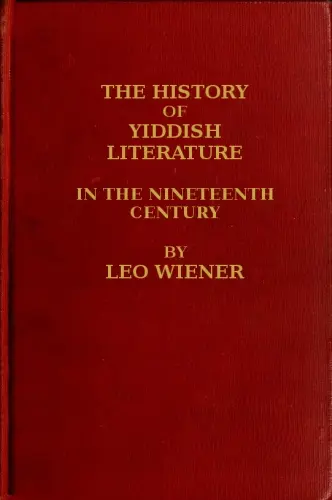
"The History of Yiddish Literature in the Nineteenth Century" by Leo Wiener is a historical account written in the late 19th century. The work delves into the development and characteristics of Yiddish literature during the 1800s, exploring the linguistic, cultural, and social influences that shaped it. The author aims to shed light on the often-overlooked literary contributions of the Jewish community and to acknowledge the significance of the Judeo-German works within the broader context of European literature. At the start of the work, Wiener sets the stage by discussing the background and circumstances that led to the emergence of a distinct Yiddish literature amid various cultural and historical influences. He recounts his journey to gather materials and data, highlighting the challenges he faced due to the fragmentation of Jewish literary works and the historical context surrounding them. The opening outlines the necessity for Jews in Eastern Europe to develop a unique vernacular literature, fueled by their isolation and desire for intellectual engagement in a changing cultural landscape. Wiener also notes the absence of systematic records and bibliographies of Yiddish literature, emphasizing the importance of his efforts to create a comprehensive history that reflects the literary richness and diversity of the Jewish experience during the 19th century.
Introduction adapted from the source catalogue; source summaries may be automatically generated.
Free to read · English · 118,675 words · No account needed
MAKE TIME FOR A GOOD BOOK
On by default. Untick to stop anonymous reading totals. Each page counts after 10 seconds in view. How this works.
Anonymous counting is on unless you have switched it off.
In 1894 Perez published a collective volume, 'Literature and Life,' which contains, like his periodical, mostly productions of his own. As they were composed at some later time than those spoken of above, and as they contain some matter in which he appears in a new rôle, we shall discuss the volume at some length. In the introduction are given his general aims, which are not different from those expressed in his former publication. The final words of it are: "We want the Jew to feel like a man, to take part in all that is human, to live and strive humanly, and if he is offended, to feel offended like a man!" The first sketch is entitled 'In the Basement.' It is the story of the incipient marital love of a young couple who are so poor that they live in a dark basement, in a room that serves as a dwelling for several families whose separate 'rooms' are divided off from each other only by thin, low partitions. The second is 'Bontsie Silent,' which is given in our Chrestomathy. It belongs to the same category of sketches as his 'The Messenger.' It presents, probably better than any other, the author's conception of the character of the virtues of the long-suffering masses. Who can read it without being moved to the depth of his heart? There is no exaggeration in it, no melodrama, nothing but the bitter reality. It expresses, in a more direct way than anything else he has written, his faith that the Kingdom of Heaven belongs to the lowly.
The sketch named 'The Fur-Cap' is one of the very few that he has written as an attack on the Khassidic Rabbi. There is here, however, a vast difference in the manner of Perez and of Linetzki. While the latter goes at it in a direct way, with club in hand, and bluntly lets it fall on the head of the fanatic, Perez has above all in mind the literary form in which he clothes his attack, and we get from him an artistic story which must please even if the thrusts be not relished. The Rabbi never appears in public without his enormous fur-cap, which is really the insignia of his office. In this story we find the furrier engaged in a monologue, in which he tells of his delight in making the Rabbi's cap. He feels that it is he who gives all importance to that dignitary, for it is the cap that makes the Rabbi. He relates of the transformation of a common mortal into an awe-inspiring interpreter of God's will on earth. No important occurrence in life, no birth, marriage, or death, can take place without the approval of him who wears that fur-cap. It is the cap, not the man, and his wisdom, that sanctions and legalizes his various acts. Were it not for the cap, it would not be possible to tell right from wrong. This fine bit of sarcasm is not a mere attack at the sect of the Khassidim; it is also meant as an accusation of our whole social system, with its conventional lies. Perez does not show by his writings to what particular party he belongs, but he is certainly not with the conservatives. He is with those who advocate progress in its most advanced form. He is opposed to everything that means the enslavement of any class of people. In Russia, where one may not express freely views which are not in accord with the sentiments of the governing class, authors have to resort frequently to the form of allegory, fable, or distant allusion, instead of the more direct way of writers in constitutional countries. For these reasons pure literature is generally something more to the Russians than mere artistic productions. The novel takes frequently the place of a political pamphlet, of an essay on social questions. The stories of the Judeo-German authors share naturally the same fate with those of the Russians, and, consequently, cannot be free of 'tendencies' whenever the writers have in mind the treatment of subjects which would be dealt with severely by the censor. Much of the alleged obscurity of Perez's writings is just due to the desire of avoiding the censor's blue pencil, and the more dangerous a more direct approach becomes, the more delicate must be the allegory. The best of that class of literature is contained in this volume in a series entitled 'Little Stories for Big Men.'
Your reading position is saved on this browser. Take it to another device with a library code. Reading pages adapt to text, rather than matching a printed edition.
BEHIND THE BOOK
This eBook is for the use of anyone anywhere in the United States and most other parts of the world at no cost and with almost no restrictions whatsoever. You may copy it, give it away or re-use it under the terms of the Project Gutenberg License included with this eBook or online at www.gutenberg.org. If you are not located in the United States, you will have to check the laws of the country where you are located before using this eBook. Read the source licence.
The original source file, including credits and licence, is retained by this library. Request an original-format copy at no charge. Please include the book title and Project Gutenberg identifier #46729.
KEEP YOUR CURIOSITY GOING
Cécile Tormay

Moritz Busch
John L. Ransom
Frances Wright
Cécile Tormay

Mabel Potter Daggett