Madame Roland: A Biographical Study
Ida M. (Ida Minerva) Tarbell
THE CLASSIC COLLECTION · 1904
"The History of the Standard Oil Company" by Ida M. Tarbell is an exposé published in 1904. Originally serialized in McClure's magazine, this groundbreaking work of investigative journalism reveals the monopolistic practices of John D. Rockefeller's Standard Oil empire. Through meticulous research and interviews with industry insiders, Tarbell uncovered evidence of price-rigging and predatory business tactics. Her revelations sparked public outrage and helped accelerate the company's eventual breakup in 1911, establishing a landmark example of muckraking journalism's power to challenge corporate abuse.
Introduction adapted from the source catalogue; source summaries may be automatically generated.
Free to read · English · 293,367 words · No account needed
MAKE TIME FOR A GOOD BOOK
On by default. Untick to stop anonymous reading totals. Each page counts after 10 seconds in view. How this works.
Anonymous counting is on unless you have switched it off.
Altogether the most important question concerning the Standard Oil Company to-day is how far it is sustaining its power by the employment of the peculiar methods of the South Improvement Company. It should never be forgotten that Mr. Rockefeller never depended on these methods alone for securing power in the oil trade. From the beginning the Standard Oil Company has studied thoroughly everything connected with the oil business. It has known, not guessed at conditions. It has had a keen authoritative sight. It has applied itself to its tasks with indefatigable zeal. It has been as courageous as it has been cautious. Nothing has been too big to undertake, as nothing has been too small to neglect. These facts have been repeatedly pointed out in this narrative. But these are the American industrial qualities. They are common enough in all sorts of business. They have made our railroads, built up our great department stores, opened our mines. The Standard Oil Company has no monopoly in business ability. It is the thing for which American men are distinguished to-day in the world.
These qualities alone would have made a great business, and unquestionably it would have been along the line of combination, for when Mr. Rockefeller undertook to work out the good of the oil business the tendency to combination was marked throughout the industry, but it would not have been the combination whose history we have traced. To the help of these qualities Mr. Rockefeller proposed to bring the peculiar aids of the South Improvement Company. He secured an alliance with the railroads to drive out rivals. For fifteen years he received rebates of varying amounts on at least the greater part of his shipments, and for at least a portion of that time he collected drawbacks of the oil other people shipped; at the same time he worked with the railroads to prevent other people getting oil to manufacture, or if they got it he worked with the railroads to prevent the shipment of the product. If it reached a dealer, he did his utmost to bully or wheedle him to countermand his order. If he failed in that, he undersold until the dealer, losing on his purchase, was glad enough to buy thereafter of Mr. Rockefeller. How much of this system remains in force to-day? The spying on independent shipments, the effort to have orders countermanded, the predatory competition prevailing, are well enough known. Contemporaneous documents, showing how these practices have been worked into a very perfect and practically universal system, have already been printed in this work.[174] As for the rebates and drawbacks, if they do not exist in the forms practised up to 1887, as the Standard officials have repeatedly declared, it is not saying that the Standard enjoys no special transportation privileges. As has been pointed out, it controls the great pipe-line handling all but perhaps ten per cent. of the oil produced in the Eastern fields. This system is fully 35,000 miles long. It goes to the wells of every producer, gathers his oil into its storage tanks, and from there transports it to Philadelphia, Baltimore, New York, Chicago, Buffalo, Cleveland, or any other refining point where it is needed. This pipe-line is a common carrier by virtue of its use of the right of eminent domain, and, as a common carrier, is theoretically obliged to carry and deliver the oil of all comers, but in practice this does not always work. It has happened more than once in the history of the Standard pipes that they have refused to gather or deliver oil. Pipes have been taken up from wells belonging to individuals running or working with independent refiners. Oil has been refused delivery at points practical for independent refiners. For many years the supply of oil has been so great that the Standard could not refuse oil to the independent refiner on the ground of scarcity. However, a shortage in Pennsylvania oil occurred in 1903. A very interesting situation arose as a result. There are in Ohio and Pennsylvania several independent refiners who, for a number of years, have depended on the Standard lines (the National Transit Company) for their supply of crude. In the fall of 1903 these refiners were informed that thereafter the Standard could furnish them with only fifty per cent. of their refining capacity. It was a serious matter to the independents, who had their own markets, and some of whom were increasing their plants. Supposing we buy oil directly from the producers, they asked one another, must not the Standard as a common carrier gather and deliver it? The experienced in the business said: “Yes. But what will happen? The producer rash enough to sell you oil may be cut off by the National Transit Company. Of course, if he wants to fight in the courts he may eventually force the Standard to reconnect, but they could delay the suit until he was ruined. Also, if you go over Mr. Seep’s head”—Mr. Seep is the Standard Oil buyer, and all oil going into the National Transit system goes through his hands—“you will antagonise him.” Now, “antagonize” in Standard circles may mean a variety of things. The independent refiners decided to compromise, and an agreement terminable by either party at short notice was made between them and the Standard, by which the members of the former were each to have eighty per cent. of their capacity of crude oil, and were to give to the Standard all of their export oil to market. As a matter of fact, the Standard’s ability to cut off crude supplies from the outside refiners is much greater than in the days before the Interstate Commerce Bill, when it depended on its alliance with the railroads to prevent its rival getting oil. It goes without saying that this is an absurd power to allow in the hands of any manufacturer of a great necessity of life. It is exactly as if one corporation aiming at manufacturing all the flour of the country owned all but ten per cent. of the entire railroad system collecting and transporting wheat. They could, of course, in time of shortage, prevent any would-be competitor from getting grain to grind, and they could and would make it difficult and expensive at all times for him to get it.
Your reading position is saved on this browser. Take it to another device with a library code. Reading pages adapt to text, rather than matching a printed edition.
Ida M. (Ida Minerva) Tarbell
Ida M. (Ida Minerva) Tarbell
Ida M. (Ida Minerva) Tarbell
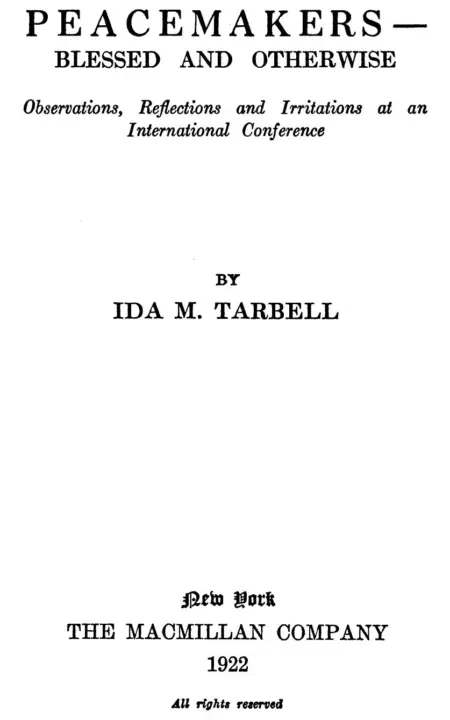
Ida M. (Ida Minerva) Tarbell
BEHIND THE BOOK
This eBook is for the use of anyone anywhere in the United States and most other parts of the world at no cost and with almost no restrictions whatsoever. You may copy it, give it away or re-use it under the terms of the Project Gutenberg License included with this eBook or online at www.gutenberg.org. If you are not located in the United States, you will have to check the laws of the country where you are located before using this eBook. Read the source licence.
The original source file, including credits and licence, is retained by this library. Request an original-format copy at no charge. Please include the book title and Project Gutenberg identifier #60692.
KEEP YOUR CURIOSITY GOING
Cécile Tormay

Moritz Busch
John L. Ransom
Frances Wright
Cécile Tormay

Mabel Potter Daggett