Madame Roland: A Biographical Study
Ida M. (Ida Minerva) Tarbell
THE CLASSIC COLLECTION · 1904
"The History of the Standard Oil Company" by Ida M. Tarbell is an exposé published in 1904. Originally serialized in McClure's magazine, this groundbreaking work of investigative journalism reveals the monopolistic practices of John D. Rockefeller's Standard Oil empire. Through meticulous research and interviews with industry insiders, Tarbell uncovered evidence of price-rigging and predatory business tactics. Her revelations sparked public outrage and helped accelerate the company's eventual breakup in 1911, establishing a landmark example of muckraking journalism's power to challenge corporate abuse.
Introduction adapted from the source catalogue; source summaries may be automatically generated.
Free to read · English · 293,367 words · No account needed
MAKE TIME FOR A GOOD BOOK
On by default. Untick to stop anonymous reading totals. Each page counts after 10 seconds in view. How this works.
Anonymous counting is on unless you have switched it off.
An indictment for conspiracy of three men of such prominence as Mr. Rogers, Mr. Archbold and Mr. McGregor riveted the attention of the whole country on the coming trial. It was apparent from the first that the Standard meant to put up a big fight to have the indictment quashed. They had, indeed, set a strong machinery at work immediately to get evidence on which to bring a counter charge of conspiracy; that is, that Matthews’s intention in starting the Buffalo Lubricating Works was never to do business, but to force the Standard to buy him out at a big price. They at once set a detective to work on the case, one item of his instructions reading: “We have reason to believe that the suit is brought for the purpose of forcing the Standard to purchase the works of the Buffalo Lubricating Company, and Matthews has made certain statements to that effect; would like reports of any statements or admissions by him in relation to his objects in these suits.” Under the direction of this detective, a man employed in Matthews’s works for some months made daily reports of what he saw and heard there, copies of which were forwarded to the Standard office in New York. A detective was also put on Miller’s track. Miller was now employed in a refinery in Corry, Pennsylvania, and here he was for a long time under espionage. The chief expression obtained from him was by luring him into a saloon one Sunday afternoon and getting him half drunk. While in this condition, the saloon-keeper testified, he said the Buffalo suit was a —— humbug, but there was money in it and that they (he and the persons who were drinking with him) might as well make it as anybody.
It was on May 2, 1886, that the trial began. The array of wealth and legal learning in the Buffalo court-room during the fourteen days’ case set not only the town, but the country agape. There were not only the Standard men indicted for conspiracy—H. H. Rogers, J. D. Archbold, Ambrose McGregor—but Mr. Rockefeller himself was there, quiet, steady, watchful. The hostile said the accused and their counsel were disdainful of the proceedings—nobody charged Mr. Rockefeller with disdain. With him were other strong men of the concern, William Rockefeller, Daniel O’Day, J. P. Dudley. There was a great array of legal learning—five eminent lawyers—Wilson S. Bissell, a former law partner of ex-President Cleveland; W. F. Cogswell, of Rochester, counted then one of the ablest lawyers of the state; Theodore Bacon and F. G. Outerbridge, both of Rochester; Daniel Lockwood, famous in politics as well as law; and, of course, S. C. T. Dodd. This for the accused. For the people was the district-attorney of Erie County, George T. Quinby, with one assistant. For fourteen days witnesses were examined, and the above story was dragged from them by dint of questioning and cross-questioning. On May 10 the testimony for the prosecution ended, and the “people rested.” The Standard lawyers immediately applied for the acquittal of Mr. Rogers, Mr. Archbold and Mr. McGregor, on the ground that no fact or circumstance had been proved that connected them in the slightest degree with the charge of conspiracy to lure Miller away or to destroy the Buffalo Works. The district-attorney combated the proposition vigorously. These gentlemen, he contended, owned three-fourths of the Vacuum Works; they were always present at directors’ meetings; it was a fair presumption that they knew what was done to persuade Miller to leave the Buffalo Works; they must have known the moneys paid him while he was doing little work. Mr. Rogers had certainly threatened Matthews that he would carry up the patent suits until the Buffalo Works got enough of it. Judge Haight, however, advised the jury to acquit Mr. Rogers, Mr. Archbold and Mr. McGregor. “The indictment charges a conspiracy,” the judge said. “It also charges certain overt acts. One of the acts charged in the indictment is the enticing away from the Buffalo company of a servant. Another of the acts alleged is an attempt to blow up or destroy the Buffalo Works, and another act that of bringing false suits against the corporation. So far as the agreement or combination to entice away a servant from the Buffalo company is concerned, I have not been able to recall any evidence which shows that either of these three defendants ever knew of it, ever heard of it, or ever took any part in it at all. So far as the charge of an attempt to blow up the Buffalo Works is concerned, I have been unable to recall any evidence that has been given in which either of these three defendants ever knew of it, ever heard of it, ever advised it, or ever took any part in it whatever. The only thing about which I have had any doubt was in reference to the maintaining of actions which have been brought upon patent rights which were formerly owned by the Everests, and by the Everests transferred to the Vacuum Oil Company, and it appears that two suits were brought upon patents, and that there was another suit, a third one, in reference to a trade-mark. It appears from the evidence that upon one occasion Mr. Matthews went to New York and had a talk with Mr. Rogers, and that his conversation has already been discussed and related in your hearing. The query in my mind was as to whether or not the inference could not be drawn, from this conversation, that Rogers did know of the bringing of these actions, acquiesced in their being brought, and in that way became a party to them; but, even conceding that the actions were brought with his knowledge and consent, I am inclined still to think that the evidence is hardly sufficient to warrant his conviction, for the reason that it does not appear that the actions were brought without probable cause; in other words, the bringing of an action and being defeated in the action is not of itself sufficient to authorise a jury to say that it was a false action. That standing alone is not sufficient to authorise a jury to say that it is a false action, but there must be shown in addition to that that there was a want of probable cause; in other words, that the party bringing the action knew and understood beforehand that he had no good cause of action.... I am inclined to the opinion that the evidence would not warrant his conviction upon that ground.”
Your reading position is saved on this browser. Take it to another device with a library code. Reading pages adapt to text, rather than matching a printed edition.
Ida M. (Ida Minerva) Tarbell
Ida M. (Ida Minerva) Tarbell
Ida M. (Ida Minerva) Tarbell
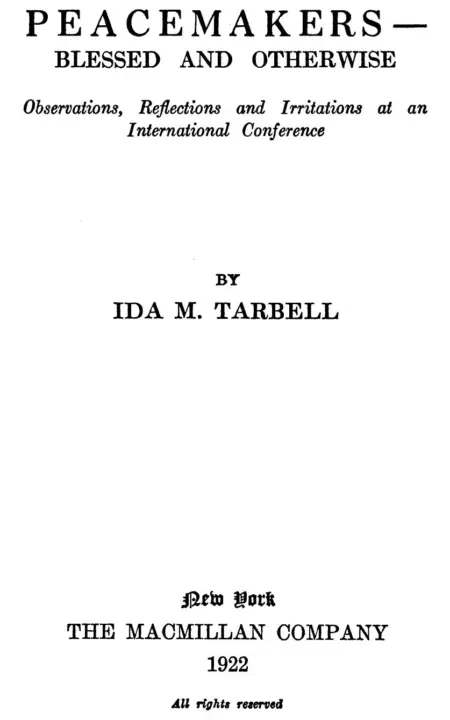
Ida M. (Ida Minerva) Tarbell
BEHIND THE BOOK
This eBook is for the use of anyone anywhere in the United States and most other parts of the world at no cost and with almost no restrictions whatsoever. You may copy it, give it away or re-use it under the terms of the Project Gutenberg License included with this eBook or online at www.gutenberg.org. If you are not located in the United States, you will have to check the laws of the country where you are located before using this eBook. Read the source licence.
The original source file, including credits and licence, is retained by this library. Request an original-format copy at no charge. Please include the book title and Project Gutenberg identifier #60692.
KEEP YOUR CURIOSITY GOING
Cécile Tormay

Moritz Busch
John L. Ransom
Frances Wright
Cécile Tormay

Mabel Potter Daggett