Madame Roland: A Biographical Study
Ida M. (Ida Minerva) Tarbell
THE CLASSIC COLLECTION · 1904
"The History of the Standard Oil Company" by Ida M. Tarbell is an exposé published in 1904. Originally serialized in McClure's magazine, this groundbreaking work of investigative journalism reveals the monopolistic practices of John D. Rockefeller's Standard Oil empire. Through meticulous research and interviews with industry insiders, Tarbell uncovered evidence of price-rigging and predatory business tactics. Her revelations sparked public outrage and helped accelerate the company's eventual breakup in 1911, establishing a landmark example of muckraking journalism's power to challenge corporate abuse.
Introduction adapted from the source catalogue; source summaries may be automatically generated.
Free to read · English · 293,367 words · No account needed
MAKE TIME FOR A GOOD BOOK
On by default. Untick to stop anonymous reading totals. Each page counts after 10 seconds in view. How this works.
Anonymous counting is on unless you have switched it off.
A. ... The original Standard Oil Company was organised in the early part of 1870. The increased capacity and the acquisition of the Cleveland refineries was, as I remember it, in 1872. It remained at that until 1875 or 1876,[85] according to the best of my recollection. Then was consummated a negotiation which had been pending for some two years, perhaps, with certain parties in Pittsburg, Philadelphia and New York, by which a value was agreed upon, and their refinery property was purchased and the capital of the company was increased a still further sum of a million, and they were paid for these properties, and money which they contributed, in the stock of the Standard Oil Company of Ohio.
By Mr. Gowen.
Q. When did the Standard Oil Company of Ohio first enter into an alliance with other refineries?
A. If you mean, (by) an alliance, Mr. Gowen, I should say never.
Q. I am only endeavouring to aid your friends in getting at what they want. Here, I notice, they propose to prove by you—I will give it in this way—that on account of the disastrous condition of the refining business, the Standard, on October 15, 1874, entered into an alliance with a number of Pittsburg refineries?
A. That is more correctly stated by saying that the Standard Oil
Company purchased the refineries owned by the parties in
Pittsburg.
Q. Who were they?
A. Lockhart, Frew and Company, I think was the company. Wait a moment. It was the Standard Oil Company of Pittsburg, it being a corporation, and Warden, Frew and Company, of Philadelphia, and, I should say, Charles Pratt and Company, of New York.
Q. Any others?
A. That is all.
Q. All those gentlemen, Warden, Frew and Company, and the Standard Oil Company of Pittsburg, Charles Pratt and Company of New York, are now associated with you as parties interested in the present Oil Trust?
A. They are stockholders. The property formerly owned by them was at that time purchased by the Standard Oil Company.
Q. When you speak of purchasing their interest, you do not exclude them from their interest? They united with you and remained as your associates in the business?
A. If it was not from the fact that ours was a corporation, we might call it a co-partnership.
Q. They becoming interested in yours, and you in theirs?
A. Yes, sir.
Q. And you simply used your name to represent the joint ownership,
as it was a corporation?
A. Yes, sir.
NUMBER 26 (See page 1153)
GEORGE H. BLANCHARD’S TESTIMONY ON THE BREAKING UP OF THE PIPE POOL OF
1874
[Report of the Special Committee on Railroads, New York Assembly, 1879. Volume III, pages 3445–3447 and 3449–3451.]
Your reading position is saved on this browser. Take it to another device with a library code. Reading pages adapt to text, rather than matching a printed edition.
Ida M. (Ida Minerva) Tarbell
Ida M. (Ida Minerva) Tarbell
Ida M. (Ida Minerva) Tarbell
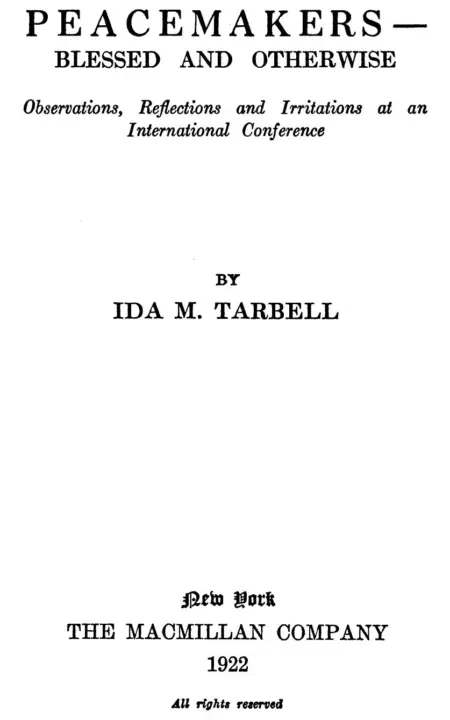
Ida M. (Ida Minerva) Tarbell
BEHIND THE BOOK
This eBook is for the use of anyone anywhere in the United States and most other parts of the world at no cost and with almost no restrictions whatsoever. You may copy it, give it away or re-use it under the terms of the Project Gutenberg License included with this eBook or online at www.gutenberg.org. If you are not located in the United States, you will have to check the laws of the country where you are located before using this eBook. Read the source licence.
The original source file, including credits and licence, is retained by this library. Request an original-format copy at no charge. Please include the book title and Project Gutenberg identifier #60692.
KEEP YOUR CURIOSITY GOING
Cécile Tormay

Moritz Busch
John L. Ransom
Frances Wright
Cécile Tormay

Mabel Potter Daggett