THE CLASSIC COLLECTION✦An outlaw’s diary: the CommuneCLASSIC FREE BOOKS
An outlaw’s diary: the Commune
Cécile Tormay
THE CLASSIC COLLECTION · 1883
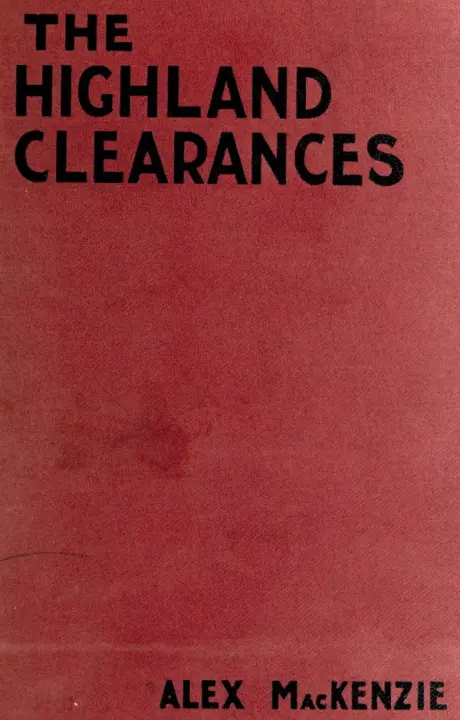
"The History of the Highland Clearances" by Alexander Mackenzie is a historical account written in the late 19th century. The book details the significant and often brutal evictions that characterized the so-called Highland Clearances in Scotland, particularly focusing on the Sutherland region. Through compelling narratives and testimonies, it explores the wrenching impact of these clearances on the Highland people, revealing themes of oppression, betrayal, and resistance. The opening of the book sets the stage for a deep examination of the Highland Clearances, establishing the crucial context of the socio-economic and political climate in which these events occurred. Mackenzie introduces the reader to the early phases of this tragic chapter, illustrating the systematic removal of Highland crofters from their ancestral lands, often without proper arrangements for relocation or support. Personal accounts and reflections from various witnesses—local clergy, community members, and landlords—are used to convey the heartbreak and devastation experienced by the Highland population, painting a vivid picture of a society caught between tradition and the relentless forces of modernization and capitalist exploitation. This introduction positions the reader to understand the broader implications of these clearances, not just as a local tragedy but as part of a larger narrative of human suffering and resilience.
Introduction adapted from the source catalogue; source summaries may be automatically generated.
Free to read · English · 98,865 words · No account needed
MAKE TIME FOR A GOOD BOOK
On by default. Untick to stop anonymous reading totals. Each page counts after 10 seconds in view. How this works.
Anonymous counting is on unless you have switched it off.
It was a very short time previous to my residence in Mr. MacKid’s family that the first “Sutherland Clearance” took place. This consisted in the ejection from their minutely-divided farms of several hundreds of the Sutherlandshire aborigines, who had from time immemorial been in possession of their mountain tenements. This sweeping desolation extended over many parishes, but it fell most heavily on the parish of Kildonan. It was the device of one William Young, a successful corn-dealer and land-improver. He rose from indigence, but was naturally a man of taste, of an ingenious turn of mind, and a shrewd calculator. After realising some hundreds of pounds by corn-dealing, he purchased from Sir Archibald Dunbar of Thundertown a small and valueless property in Morayshire called Inverugie. It lay upon the sea-shore, and, like many properties of more ancient date, it had been completely covered with sea-sand which had drifted upon its surface. For this small and worthless spot he paid a correspondingly small price--about £700--but, tasking his native and vigorous genius for improvement, he set himself at once to better his bargain. Making use of a plough of peculiar construction, he turned the sand down and the rich old soil up, and thus made it one of the most productive properties in the county. This, with other necessary improvements, however, involved him in debt; but, just as it became a question with him how to pay it, his praise in the north as a scientific improver of land reached the ears of the Stafford family, who, in connection with their immense wealth, were racked with the anxiety to improve their Highland estate. As William Young had been so successful on the estate of Inverugie they thought he could not but be equally so on the Sutherland estate. Young introduced the depopulating system into Sutherland.[3] This system, during his tenure of office as commissioner on the Sutherland property, was just at its commencement. It was first brought to bear on the parish of Kildonan. The whole north and south sides of the Strath, from Kildonan to Caen on the left bank of the river, and from Dalcharn to Marrel on the right bank, were, at one fell sweep, cleared of their inhabitants. The measures for their ejectment had been taken with such promptness, and were so suddenly and brutally carried out, as to excite a tumult among the people. Young had as his associate in the factorship a man of the name of Sellar, who acted in the subordinate capacity of legal agent and accountant on the estate, and who, by his unprincipled recklessness in conducting the process of ejectment, added fuel to the flame. It was said that the people rose almost en masse, that the constables and officials were resisted and their lives threatened, and the combination among the peasantry was represented as assuming at last so alarming an aspect that the Sheriff-Depute of the county was under the necessity of calling in the military to quell the riot. A detachment of soldiers was accordingly sent from Fort-George, a powder magazine was erected at Dornoch, and every preparation made as for the commencement of a civil war. But the chief magistrate of the county, shrewdly suspecting the origin of these reports, ordered back the military, came himself alone among the people, and instituted a cool and impartial enquiry into their proceedings. The result was that the formidable riot, which was reported to have for its objects the murder of Young and Sellar, the expulsion of the store-farmers, and the burning of Dunrobin Castle, amounted after all only to this, that a certain number of the people had congregated in different places and had given vent to their outraged feelings and sense of oppression in rash and unguarded terms. It could not be proved that a single act of violence was committed. Sellar laboured hard to involve my father and mother in the criminality of these proceedings, but he utterly failed. The peasantry, as fine as any in the world, were treated by the owners of the soil as “good for nothing but to be cast out and trodden under feet of men,” while the tract of country thus depopulated was divided into two large sheep farms, one of which was given in lease to William Cluness of Cracaig, and the other to a Mr. Reid from Northumberland.
Your reading position is saved on this browser. Take it to another device with a library code. Reading pages adapt to text, rather than matching a printed edition.
BEHIND THE BOOK
This eBook is for the use of anyone anywhere in the United States and most other parts of the world at no cost and with almost no restrictions whatsoever. You may copy it, give it away or re-use it under the terms of the Project Gutenberg License included with this eBook or online at www.gutenberg.org. If you are not located in the United States, you will have to check the laws of the country where you are located before using this eBook. Read the source licence.
The original source file, including credits and licence, is retained by this library. Request an original-format copy at no charge. Please include the book title and Project Gutenberg identifier #51271.
KEEP YOUR CURIOSITY GOING
Cécile Tormay

Moritz Busch
John L. Ransom
Frances Wright
Cécile Tormay

Mabel Potter Daggett