THE CLASSIC COLLECTION✦History of the Great American Fortunes, Vol. I Conditions in Settlement and Colonial TimesCLASSIC FREE BOOKS
History of the Great American Fortunes, Vol. I Conditions in Settlement and Colonial Times
Gustavus Myers
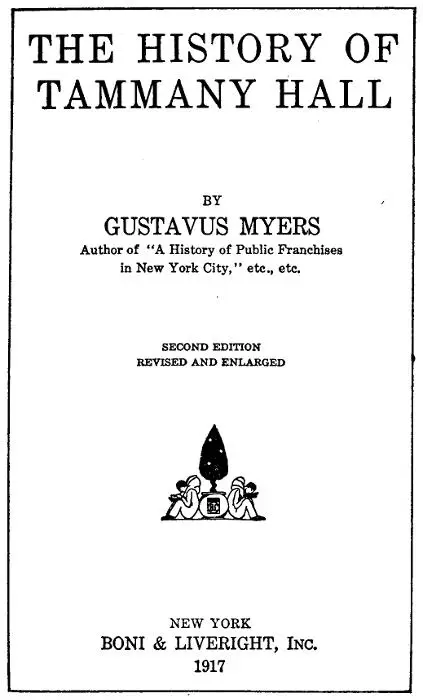
THE CLASSIC COLLECTION · 1917
"The History of Tammany Hall" by Gustavus Myers is a historical account written in the early 20th century. The book explores the intricate and often scandalous history of Tammany Hall, a powerful political organization in New York City, detailing its origins, key figures, and its impact on American politics. Myers aims to provide a comprehensive and impartial narrative of Tammany's practices and its long-standing influence on the city's governance. At the start of the narrative, the author sets the stage for the history of the Tammany Society, also known as the Columbian Order, which was founded in 1789 as a form of resistance against aristocracy and an advocate for political equality. In the opening portion, Myers discusses the society's roots in early American democracy and its evolution into a political organization. He highlights the conflicts between different political factions, particularly during the rise of the Federalists and their opposition to Tammany's principles. The chapter elaborates on the society's ceremonial practices and the role of influential leaders, including Aaron Burr, setting the groundwork for the significant events and characters that shaped Tammany Hall's notorious legacy.
Introduction adapted from the source catalogue; source summaries may be automatically generated.
Free to read · English · 126,721 words · No account needed
MAKE TIME FOR A GOOD BOOK
On by default. Untick to stop anonymous reading totals. Each page counts after 10 seconds in view. How this works.
Anonymous counting is on unless you have switched it off.
The Tammany men, regarding the Equal Rights men responsible for this loss of power, were now disposed to treat with them and willing enough to throw over the banker-corporation element.
[1] The minutes of the Common Council covering these years show continuous records of petitions from imprisoned debtors, praying for fuel and the patching up of windows in the dead of Winter. Charitable societies were in existence to supply the jailed debtors with food.
[2] This singular provision, by which non-residents were liable to imprisonment for debt, while the natives of the city were exempted, was erased in 1840.
[3] Journal of the Senate and Assembly, 1805, pp. 351 and 399.
[4] Ibid., 1812, p. 134.
[5] Journal of the Senate and Assembly, 1812, pp. 259-60.
[6] Stock given at par value meant an almost immediate rise in value to the legislator. Most stocks went upward from 10 to 15 per cent. on the passage of the charter, and in the case of the more profitable and exploitative corporations, far higher advances were scored in a short time.
[7] Journal of the Senate, 1824, pp. 498-532.
[8] Journal of the Senate, 1826, Vol. 6, Appendix B. A considerable part of the money and stock promised the members of the Legislature for their votes was withheld owing to the expected investigation.
[9] Ibid.
[10] Ibid.
[11] Senate Documents, 1834, No. 47, and Ibid., No. 94. Walter Bowne was the bank’s president.
[12] Ibid., No. 94.
[13] Ibid., No. 47.
[14] Journal of the Senate, 1833, p. 396.
[15] Documents of the Senate, 1834, No. 108.
[16] Lee was the last Mayor elected by the Common Council (1833-34).
[17] Lawrence had a curious habit of strolling the streets carrying his spectacles in his hand behind his back, and ogling all the pretty girls he met, a habit which was broken later when one winsome lass tangled him in a plot, much to his financial and mental distress.
[18] The next day the Equal Rights men were dubbed “Locofocos,” a name afterward applied by the Whigs to the entire Democratic party.
[19] Documents of the Board of Aldermen, 1836, Nos. 65 and 100.
[20] Ibid., 1837, No. 48.
[21] Ibid., 1837, No. 32.
[22] Documents of the Senate, 1836, Vol. II, No. 94.
[23] A short time before, at an Anti-Monopolist meeting, Chairman Job Haskell had represented that the Tammany Society--the secret body, responsible to no one and enforcing its demands through the Tammany Hall political organization--was to blame for the political corruption. Resolutions were then passed setting forth that whereas the self-constituted, self-perpetuating Tammany Society had assumed a dictatorial attitude and by usages made by itself endeavored to rule the people as with a rod of iron; and, as they (the Equal Rights men) believed the people were capable of managing their own affairs without the aid of said inquisitorial society, “that we deem the Tammany Society an excrescence upon the body politic and dangerous to its rights and liberties.”
Your reading position is saved on this browser. Take it to another device with a library code. Reading pages adapt to text, rather than matching a printed edition.
BEHIND THE BOOK
This eBook is for the use of anyone anywhere in the United States and most other parts of the world at no cost and with almost no restrictions whatsoever. You may copy it, give it away or re-use it under the terms of the Project Gutenberg License included with this eBook or online at www.gutenberg.org. If you are not located in the United States, you will have to check the laws of the country where you are located before using this eBook. Read the source licence.
The original source file, including credits and licence, is retained by this library. Request an original-format copy at no charge. Please include the book title and Project Gutenberg identifier #53115.
KEEP YOUR CURIOSITY GOING
Cécile Tormay

Moritz Busch
John L. Ransom
Frances Wright
Cécile Tormay

Mabel Potter Daggett