THE CLASSIC COLLECTION✦History of the Great American Fortunes, Vol. I Conditions in Settlement and Colonial TimesCLASSIC FREE BOOKS
History of the Great American Fortunes, Vol. I Conditions in Settlement and Colonial Times
Gustavus Myers
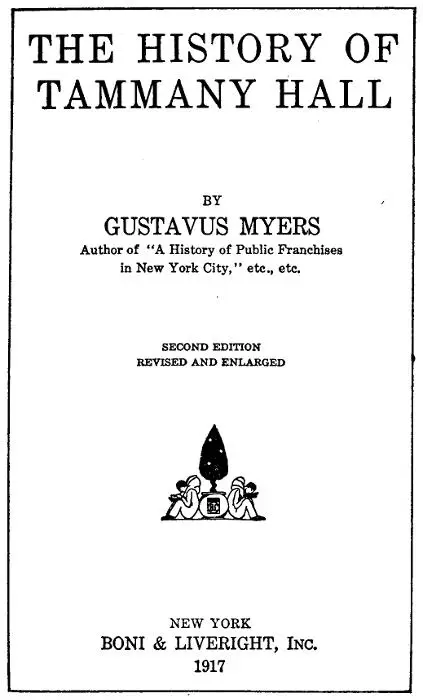
THE CLASSIC COLLECTION · 1917
"The History of Tammany Hall" by Gustavus Myers is a historical account written in the early 20th century. The book explores the intricate and often scandalous history of Tammany Hall, a powerful political organization in New York City, detailing its origins, key figures, and its impact on American politics. Myers aims to provide a comprehensive and impartial narrative of Tammany's practices and its long-standing influence on the city's governance. At the start of the narrative, the author sets the stage for the history of the Tammany Society, also known as the Columbian Order, which was founded in 1789 as a form of resistance against aristocracy and an advocate for political equality. In the opening portion, Myers discusses the society's roots in early American democracy and its evolution into a political organization. He highlights the conflicts between different political factions, particularly during the rise of the Federalists and their opposition to Tammany's principles. The chapter elaborates on the society's ceremonial practices and the role of influential leaders, including Aaron Burr, setting the groundwork for the significant events and characters that shaped Tammany Hall's notorious legacy.
Introduction adapted from the source catalogue; source summaries may be automatically generated.
Free to read · English · 126,721 words · No account needed
MAKE TIME FOR A GOOD BOOK
On by default. Untick to stop anonymous reading totals. Each page counts after 10 seconds in view. How this works.
Anonymous counting is on unless you have switched it off.
[2] Testimony Senate Committee on Cities, 1890, Vol. II, pp. 1711-12.
[3] The amendments to the charter of 1857 had abolished the Board of Councilmen and reinstituted the Board of Aldermen and the Board of Assistant Aldermen, the two constituting the Common Council. The “Tweed charter” continued these two boards, legislating the then incumbents out of office, and ordering a new election in May. The “ring,” of course, secured a large majority in this new Council.
[4] The Tweed Case, etc., Supreme Court, 1876, Vol. II, p. 1212.
[5] Document No. 8, p. 73.
[6] Ibid., pp. 84-92.
[7] Document No. 8, p. 212.
[8] Ibid., pp. 223-25.
[9] For the passage of this bill Tweed paid “in the neighborhood of $50,000 or $100,000.” Document No. 8, p. 154.
[10] While this was going on Tweed maintained the most benevolent attitude in public. At the Fourth of July celebration in the Wigwam he “called the vast assemblage to order, and with coolness, but delighting (sic) modesty, welcomed brothers and guests.” Celebration at Tammany Hall of the 94th Anniversary, etc., by the Tammany Society or Columbian Order. Published by order of the Tammany Society, 1870.
[11] Senate Journal, 1871, pp. 482-83.
[12] See A History of Public Franchises in New York City, by Gustavus
Myers.
[13] Winans was unfortunate in his bargain, for after rendering the service agreed upon, his employers failed to keep their promises. Tweed gave him only one-tenth of the sum promised, and the Erie Railroad Company gave him no office, nor, so far as can be learned, any compensation whatever.
[14] John Foley stated to the author that the six members of this committee were intimidated into making this report under the threat that the city officials would raise enormously the assessments on their very considerable holdings of real estate.
[15] Document No. 8, pp. 215-18.
[16] Ibid.
[17] It was city money which the reporters frequenting the City Hall and court buildings received. The Aldermen passed in 1869 a resolution giving them (sixteen in all) $200 apiece, for “services.” Mayor Opdyke vetoed the resolution, but it was passed over his veto. (Proceedings of the Board of Aldermen, 1862, Vol. LXXXVIII, p. 708.) The grant was made yearly thereafter.
[18] Statement of Mr. Foley.
[19] The tiger as the symbolic representation of Tammany Hall doubtless dates from this time. This animal was the emblem of the Americus Club, and in Mr. Nast’s cartoons it frequently appears, with the word AMERICUS on its collar. In all probability Mr. Nast was responsible for the transference of the symbol from the club to the organization. The author has been unable to find any earlier reference to the Tammany tiger.
Your reading position is saved on this browser. Take it to another device with a library code. Reading pages adapt to text, rather than matching a printed edition.
BEHIND THE BOOK
This eBook is for the use of anyone anywhere in the United States and most other parts of the world at no cost and with almost no restrictions whatsoever. You may copy it, give it away or re-use it under the terms of the Project Gutenberg License included with this eBook or online at www.gutenberg.org. If you are not located in the United States, you will have to check the laws of the country where you are located before using this eBook. Read the source licence.
The original source file, including credits and licence, is retained by this library. Request an original-format copy at no charge. Please include the book title and Project Gutenberg identifier #53115.
KEEP YOUR CURIOSITY GOING
Cécile Tormay

Moritz Busch
John L. Ransom
Frances Wright
Cécile Tormay

Mabel Potter Daggett